
Every year around October, the emails start. Countdown timers, red banners, "doors close at midnight," seventeen reminders in four days. By the Monday after Thanksgiving, everyone is exhausted and half the internet has unsubscribed from everything.
Black Friday marketing does not have to work like that. But you also do not have to sit the whole season out, because there genuinely is a stretch of the year when people are ready to invest in the thing they have been putting off.
Here is how to run a seasonal offer without turning into a person you would mute.
The dates you are working toward
It helps to see the actual calendar before you plan anything, so you are working with real deadlines instead of a vague sense that you are already behind.
- Black Friday: Friday, November 27, 2026.
- Cyber Monday: Monday, November 30, 2026.
Most coaches run one offer that opens on the Friday and closes on the Monday, which gives you a clean four-day window. You do not need more than that. If you want a little lead time, tell your list a week ahead that something is coming. That is the whole schedule. Working backward from those two dates, not forward from a countdown timer, keeps the season calm.
First: should you even do this?
Start here, because for a lot of coaches the honest answer is no.
Reasons it can be a good idea. You have people who have been circling your offer for months and just need a reason to decide. You have something genuinely valuable to give them. You would like to end the year with a bit of breathing room in the bank instead of white-knuckling January. A well-run seasonal offer can bring in new clients, wake up people who drifted, and thank the ones who have stuck with you.
Reasons to skip it. Discounting trains people to wait. If you run a sale every November, nobody buys in October ever again. It can quietly tell your existing clients, the ones who paid full price and trusted you, that they were the suckers. Every dollar you knock off is a dollar off your margin, so a discount that fills your calendar can still leave you working harder for less. And if your offer only sells when it is 40 percent off, the discount is not the fix. The offer is the problem.
None of that means discounts are bad. People do shop the deals: one U.S. study found 88 percent of shoppers had used a coupon in the past year, so the demand is real. The question is not whether discounts work. It is whether a discount is the right tool for your particular offer, or whether it will cost you more in the long run than it brings in.
I will tell you when it has worked for me. In 2022 I put a set of digital workshops on sale at 75 percent off for Black Friday, and it genuinely lifted my sales. It worked because those were digital products that cost me nothing extra to deliver, so a deep discount did not eat my time or dilute my one-to-one rates. That is the distinction that matters. A steep discount on something leveraged can be smart. The same discount on your coaching hours just teaches people your time is negotiable.
If you decide to skip it, skip it with a clear conscience. Nobody has ever gone out of business from declining to shout at their list in November.
What to offer instead of a discount
The interesting move is to add value rather than cut price. It protects your rates, it does not insult anyone who paid full freight in September, and it usually converts just as well.
- Add something. Same price, plus a bonus session, a template pack, a month of support. Now the offer is better without your work being worth less.
- Open something you rarely open. Scarcity that is real: a handful of one-to-one spots for the new year, a small cohort, a door that genuinely is not open the rest of the time.
- Bundle what belongs together. If people usually buy two things in sequence, offer them together at a fair price. That is a kindness, not a trick.
- If you do discount, keep it modest and keep it simple. One offer, one price, one deadline. Not a tiered maze that takes a spreadsheet to understand.
Whatever you pick, it should be something you would be glad to sell in March. If you would be embarrassed by it in March, do not sell it in November.
Building an offer worth buying
Once you know the shape, the actual work is making the thing genuinely good. The most reliable way is to pick one specific problem your bigger program solves and hand people a real head start on it. Not the whole transformation, just one clear win they can hold.
Say you are a health coach and your clients want to eat better but never have time to cook. A strong seasonal offer might be a small meal-prep package: a shopping checklist, a handful of recipes, and one live group session where you walk them through a week of prep and answer questions. It solves a real problem this week, and it gives people an honest taste of what working with you feels like, which makes your main program an easier yes later.
A couple of things make an offer like that land:
- Aim it at the outcome they actually want, and remove the obstacles they expect. If your clients believe they have no time, show them the shortcut, like ordering catering they can portion out for the week, rather than assuming they will find two hours to cook.
- Make it leveraged. The best seasonal offers are worth far more to the buyer than they cost you to deliver. A recorded workshop, a template, a group call: high value to them, low ongoing drain on you. That is what lets you be generous without burning out.
- Back it with a guarantee that removes the risk. The clearest one I know is the old Domino's line, "delivered in 30 minutes or it's free." You do not have to copy it, but that is the feeling you want: the buyer should not be the one taking the chance. When you carry the risk instead of them, the price stops being the sticking point.
Bundling can quietly do the same work. A few years back I offered my planners as a "buy the physical one, get the digital one free" deal, and it nudged my average order value up without my discounting anything. People got more, I sold more, and nothing on the price tag changed.
Honest urgency, and the fake kind
This is the whole thing, so I want to be precise about it.
Real: the price does go up on Monday. The cohort does start in January. There really are six spots, and when they are gone they are gone. You are telling people the truth about a boundary that exists.
Fake: a countdown timer that resets when you reload the page. "Only 3 left" of an infinite digital product. Language engineered to make someone feel stupid for not buying, or afraid of what happens if they do not.
The difference matters because your audience can feel it, even when they cannot name it. Fake urgency might get you the sale. It also gets you a client who feels vaguely tricked, a refund request in February, and a slightly worse reputation you will never be able to measure.
A real deadline is a service. It helps someone who has been stuck in maybe for six months finally decide. Just make sure it is real, and then honor it. If you say the cart closes Monday, close it Monday.
One caution about the bonuses you use to sweeten a real deadline: make sure they do not quietly cost you your December. In 2021 I ran an early-bird bonus that gave people a free coaching session, and I ended up with a calendar so crowded it wore me out. The offer worked. I just paid for it in hours I did not have. These days I lean toward digital or group bonuses that reward early buyers without eating my time. A bonus you dread delivering is not a bonus, it is a debt.
Promoting it without becoming unbearable
You need fewer emails than you have been told. Here is a whole campaign, mapped to the four-day window:
| When | What it does | |
|---|---|---|
| A week before | Heads-up | Tell them something is coming and what it is. No hype, just so nobody feels ambushed. Add a line saying they can opt out of the sale emails and stay on your list. |
| Friday (day it opens) | It's open | What it is, who it is for, what it costs, exactly how to buy. Clear and short. |
| Saturday or Sunday | One useful email | A story, a client result, or an answer to the question everyone keeps asking. Genuinely helpful on its own, with the offer mentioned at the end. |
| Monday (last day) | It closes tonight | Short, clear, no theatrics. Remind them what it is and when it ends, then let them decide. |
That is four emails. Add a couple of social posts if you like. When you promised at the top that people could opt out of the sale emails and stay on your list, actually honor it. You will lose a handful of sales and keep a lot of goodwill, and goodwill is the thing that is still there next year.
The page they land on needs to do four jobs: say what it is, say who it is for, say what it costs, and make it obvious how to buy. You do not need a long, high-pressure sales page for a seasonal offer, but a simple, mobile-friendly page with a clear button usually converts better than sending people straight to a checkout. Most sales pages fail on that last job, the obvious button, so start there.
A menu of offers, calm end first
If you are staring at a blank page, here are options to borrow from. They run from the add-value ideas that protect your rates down to the plain discounts, so start at the top and only reach for the bottom if it truly fits your offer.
Add value or open access:
- Include a free gift, a template pack, or a bonus session with every coaching package.
- Bundle a physical product with its digital companion (the move that lifted my order value).
- Open early access to your 2027 coaching programs.
- Open a small, real number of one-to-one spots for the new year.
- Sell a "Master Your New Year's Resolutions" bundle aimed squarely at January.
- Give a free seat at a clients-only networking event with a package purchase.
- Run a "bring a friend to coaching free" offer to grow through word of mouth.
- Double your referral bonus for the month.
- Start a "learn and earn" affiliate program so past students can share what helped them.
- Run a "coaching for a cause" event and donate a portion to something your audience cares about.
- Invite people to share their transformation story to win a spot, which also gathers testimonials you can use all year.
- Host a holiday-themed coaching challenge, which doubles as list-building.
- Pair a purchase with a gift card they can pass to a friend.
Discount, if it genuinely fits:
- Offer free shipping on physical products like planners and swag.
- Use "pay what you want" on a digital or group product, never on your time.
- Buy one, get a second at a set discount.
- Spend a threshold and get a percentage off a future purchase.
- Run a "course of the day" if you have a back catalog to feature one at a time.
- Put a simple whole-store coupon code out for the weekend.
Notice there is no artificial 24-hour flash clock on this list. You do not need a fake countdown when the calendar already gives you a real one.
Afterward, look at what happened
When it is over, resist the urge to just close the laptop and recover. A short review while it is fresh is what makes next year easier, and it does not take long.
Start with the numbers. Write down four: how many people saw it, how many clicked, how many bought, and how many unsubscribed. Then, if you sold more than one thing, look a little closer:
- How much did the whole promotion bring in?
- What was your best-selling offer?
- What was the average order value?
- How many new clients did you actually gain?
- Which offer or discount converted best?
Then look at how it converted, so you know what to repeat and what to drop:
- What was the conversion rate on the sales page, the emails, any ads?
- Which message or subject line got the most engagement?
- Which channel actually drove sales, versus which just felt busy?
- What is the one takeaway you want to remember for next year?
Then ask a few buyers. A short note to the people who bought, asking what almost stopped them and what tipped them over, will teach you more than any dashboard. You are not fishing for compliments. You are finding the sentence that made it click, so you can lead with it next time.
And add the number that nobody tracks and everybody feels, which is how you felt while you were running it. If the revenue was fine but you spent two weeks with your stomach in a knot, that is real information. A promotion that works but costs you your peace is not a promotion you can run every year, and a business you cannot run every year is not a business.
The calm version
Decide early whether you are in. If you are, make one good offer, give it a deadline that is actually true, tell people about it four times, and then stop. Take the weekend off. Let the people who want it come and get it.
That is Earn without the hangover, and it is the version you will still be willing to do in five years.
Not sure whether a seasonal offer is right for where you are? Book a clarity call and we will look at it honestly, including the option of not doing it at all. Or take the five-minute quiz to find out what your business actually needs before the year turns over.
Whenever you're ready, here's how I can help
Start free and go at your own pace. No pressure, ever.
- Free: Keep reading the blog and subscribe on YouTube. I share everything I know.
- DIY: Get the PeacefulBiz app to organize, plan, create, and simplify your marketing.
- Guided: Join the Peaceful Marketing Lab, and let's build together.
- Direct: Book a strategy call for 1:1 help, a custom website, or to decide which program is right for you.
Want the whole framework?
The PEACE Blueprint Guide walks you through all five pillars, with planner pages to build your own peaceful marketing system.
Get the free guide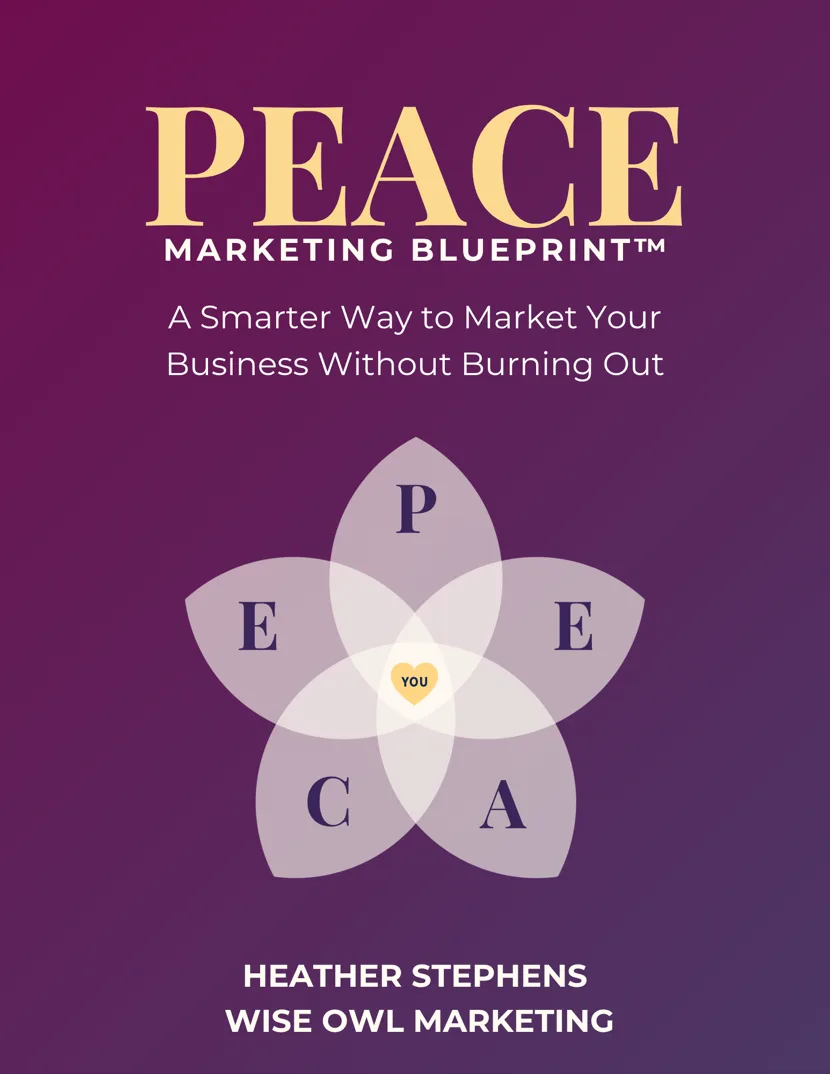

Heather C. Stephens
27+ years in marketing and 11 helping coaches and service providers get found online without burning out. Founder of Wise Owl Marketing and creator of PeacefulBiz and the PEACE Blueprint.
More about Heather →


Get peaceful marketing ideas delivered to your inbox each week.
One practical idea at a time, written like a note from a friend who happens to know marketing. Read it and try it that afternoon.