
A sustainable marketing strategy for coaches is the practice of creating valuable, evergreen content that attracts ideal clients through search engines and AI tools, without requiring constant social media activity. Unlike social media marketing, which demands daily posting and disappears within hours, content marketing creates permanent business assets that compound over time.
How to build a business that markets itself, even when you can't.
It's snowing again as I write this post. The deck sits naked, quietly waiting for the time to get dressed up again in patio furniture and flower pots.
Maybe it's the tulips my kids bought me for Valentine's Day, or the few warm-ish days we had this past week, but my heart is craving spring. I can't wait to be sitting on the deck again, in the warm morning sunshine, with my coffee and journal.
I know there's a season for everything, but still, I struggle with patience when I'm ready for the seasons to change.
There are seasons in our businesses, too.
Some seasons you'll have energy for big creative projects and ambitious launches. In others, you're doing great just to show up to your Zoom calls two minutes late with no make-up and your "I showered five minutes ago" wet hair up in a bun.
Both seasons are real.
Both are part of running a sustainable business over years and decades, not just months. It's totally normal for our capacity to fluctuate with the seasons, stress, health, and life.
I didn't see it like this for a long time. I thought my low capacity was a character flaw, or something I needed to overcome by planning better, getting focused, and trying to be more productive.
The problem comes when we expect ourselves to show up like it's summer when we're in a winter season of life. We can't perform at peak capacity all the time.
When we build marketing strategies that require us to be at our best just to function, they crumble the moment life gets hard.
Instead, we need to build sustainable marketing strategies that allow us to thrive during our weakest seasons. We need to plan for winter.
How?
By investing our energy instead of spending it.
The Half-Life of Your Marketing Efforts
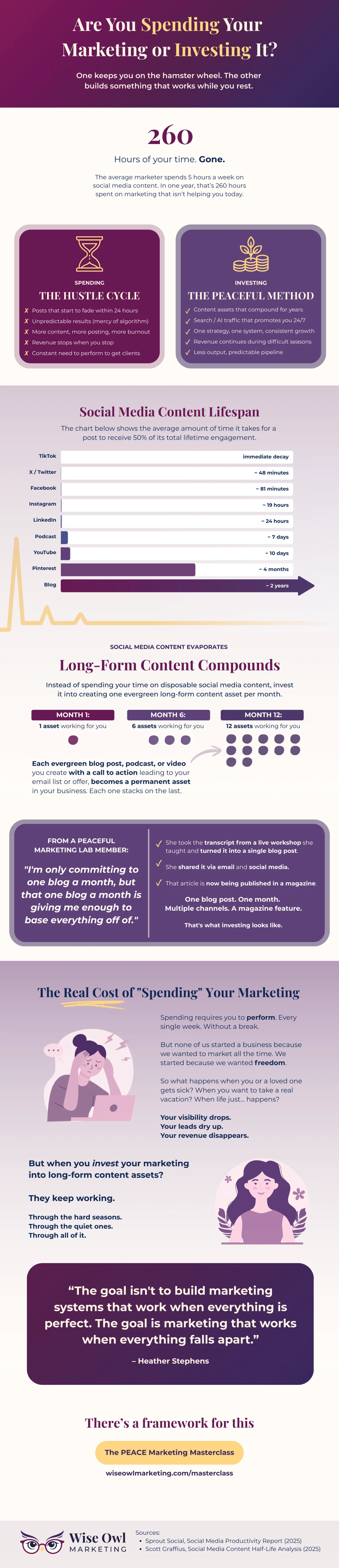
Take a look at this chart showing the half-life of content online:
Half-life measures the time it takes to reach 50% of a piece of content's total engagement. Source: Scott Graffius's 2025 research on 5 million social posts.
Spending is creating content for Instagram that has a 19-hour lifespan. Then it's gone, and you're back to zero.
The truth is, if you've been posting on social media 5 times a week for 3 years, that's 780 pieces of content that basically no longer exist.
What if you had invested that energy into building assets that continued to work during the good seasons and the bad?
A blog post has an average half-life of about 2 years.
If you'd spent your time each week writing one optimized blog post instead of 5 Instagram posts, you'd have an asset that could work quietly in the background, bringing people to you through search while you sleep. Or take a walk. Or deal with life… for years to come.
Why Content Marketing Works Better Than Social Media for Coaches
The compound effect
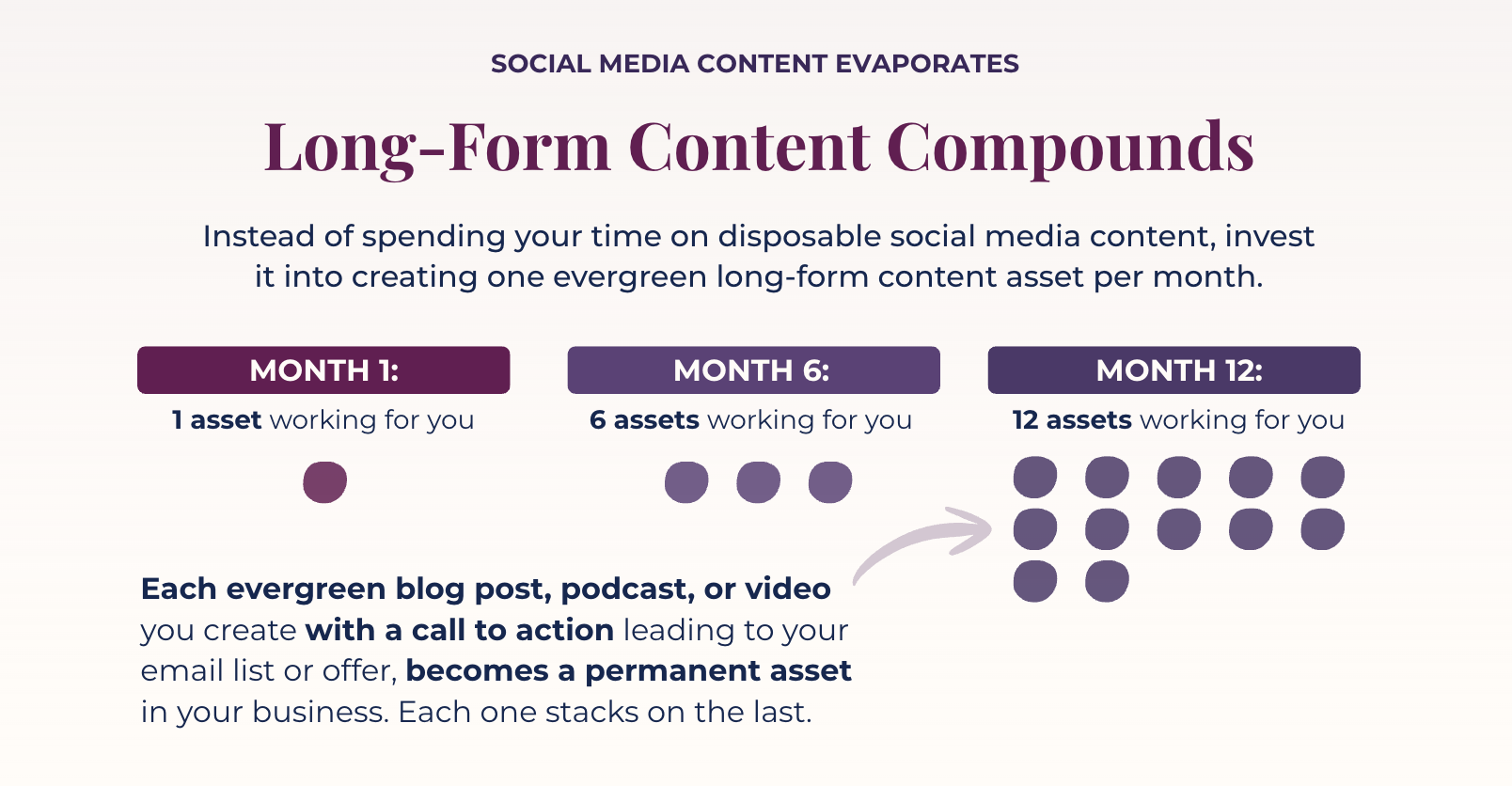
Here is what happens when you commit to creating one piece of long-form content per month.
In Month 1, you have one blog post working for you. One asset showing up in search results. One asset getting cited by AI. One piece of content you can share with your email list and reference in conversations.
By Month 6, you have six. Six pages indexed by Google. Six pieces of content that potential clients can find without you lifting a finger. Six assets that each strengthen the others, because search engines reward websites with depth on a topic.
By Month 12, you have twelve. A library. A body of work. A marketing engine that runs whether you post on Instagram this week or not.
Compare that to 260 social media posts created in the same year. Every one of those required your time, your energy, your creative capacity. And not one of them is generating a lead today.
When she joined the lab she mentioned that she had content from a workshop she provided to another company, bShe took the transcript from a live workshop she taught and turned it into a single blog post. She shared it with her email list and on social media. That article is now being published in an online magazine in her niche.
One blog post. One month. Multiple channels. A magazine feature. That is what investing looks like.
One piece of content fuels everything
The most common objection I hear from coaches is: "I don't have time to create content for every platform."
You don't have to. When you start with one long-form piece of content, everything else flows from it. That single blog post or podcast episode becomes the source material for your email newsletter, your social media posts, your carousel tips, your quote graphics, and your video scripts.
You're not creating more content. You're repurposing one strategic asset across every channel.
Another Lab member described the shift this way:
"I finally got it to do it. I had to kind of boss it a little bit... now that I've got it, I want to keep that win going month by month."
-- Peaceful Marketing Lab Member
That momentum is real. When you see one piece of content fueling your entire marketing calendar for a month, the hamster wheel feeling disappears.
My Accidental Sustainable Marketing Strategy & Marketing Emergency Fund
When I quit marketing last year, four things kept my business afloat:
1. Searchable content. Blog posts and resources I'd created over the years kept showing up in Google and ChatGPT, bringing new people to me without any additional effort on my part.
2. Nurture systems. Welcome emails, nurture sequences, and automations kept introducing me to new subscribers and guided them toward working with me. All running on autopilot.
3. Relationships. Real connections I'd built with clients and colleagues who referred people to me, even when I wasn't actively "networking."
4. Continuity programs. Recurring revenue from my website maintenance plans and the Peaceful Marketing Lab kept my cash flow positive even on months when I didn't sell anything new.
These four assets kept working when I couldn't. I call this my marketing emergency fund.
I promise you, I didn't intentionally build this into my business. I was fly-by-the-seat-of-my-pants for most of these last 10 years, trying to market the way everyone else did, and honestly, feeling like a failure because I couldn't.
Here's the thing though...the reasons I "couldn't" do traditional marketing were actually the reasons my emergency fund existed in the first place:
I'm an introvert. Blogging felt "safer" to me than putting myself out there on social media. (Honestly, I always felt like a failure for not being more active on social.) But those blog posts are what kept showing up in search results years later.
I have ADHD. Remembering to follow up is not my forte. (Thank goodness for automatic bill pay!) But email nurture sequences made it so I could follow up without having to remember to do it.
I go deep with my clients. Most of them stay with me for 5, 7, or more years. They are my friends. I care about them and their businesses. That depth of relationship is what made referrals happen naturally.
I really don't love "selling." Building recurring revenue made it so I could keep getting paid every month without constantly having to bring in new people.
The traits I thought were weaknesses became the foundation of a business that could sustain itself when I couldn't.
How to Build Your Sustainable Marketing Strategy for Your Business
Start with honoring where you are now...
If You're in a High-Capacity Season
Think about which of the four assets you need to strengthen in your business, and do one thing to make it stronger:
1. Searchable content: Create long-form blog posts, videos, or podcast episodes that share your expertise. Optimize them for the questions your ideal clients are actually asking. These are assets that compound over time.
2. Nurture systems: Set up a lead magnet with a welcome sequence and ongoing nurture emails that can run without constant upkeep. Even a simple 3-email welcome series is better than nothing.
3. Relationships: Reach out to past clients and colleagues; not to sell, but to genuinely connect. Send a referral to someone. Write a thoughtful LinkedIn recommendation. Deepen the relationships you already have so they're there when you need them.
4. Recurring revenue: Look at your offers. Is there something you could turn into a monthly or ongoing service? A membership, a maintenance plan, a retainer? Even one small recurring offer can be a lifeline during slow months.
If You're in a Low-Capacity Season
Follow my 4-step survival plan to help you weather the storm:
1. Protect your reserves. Cut any unnecessary spending and preserve your cash so you don't give your future self more stress and worries.
2. Protect your revenue. Prioritize your best clients, respond to warm leads, and keep your email list alive. (I learned this last one the hard way.)
3. Protect your relationships. Communicate with your clients. You don't have to share details, but a quick heads-up if your response time might be a bit longer goes a long way in maintaining trust.
4. Protect your peace. Take projects and future plans off your plate. Reduce the frequency of your posting, drop the perfectionism, and give yourself grace.
One More Thing
I've written a whole book about this approach. It's called Peaceful Marketing: For Business Owners Who Dread Marketing But Still Want Clients.
It covers all five principles of the PEACE Blueprint, the same system I use with my coaching clients.
It's not quite ready yet, but if you want to be the first to know when it launches, enter your name and email below.
Here's to honoring your capacity and marketing with love.
— Heather
Whenever you're ready, here's how I can help
Start free and go at your own pace. No pressure, ever.
- Free: Keep reading the blog and subscribe on YouTube. I share everything I know.
- DIY: Get the PeacefulBiz app to organize, plan, create, and simplify your marketing.
- Guided: Join the Peaceful Marketing Lab, and let's build together.
- Direct: Book a strategy call for 1:1 help, a custom website, or to decide which program is right for you.
Frequently asked questions
Want the whole framework?
The PEACE Blueprint Guide walks you through all five pillars, with planner pages to build your own peaceful marketing system.
Get the free guide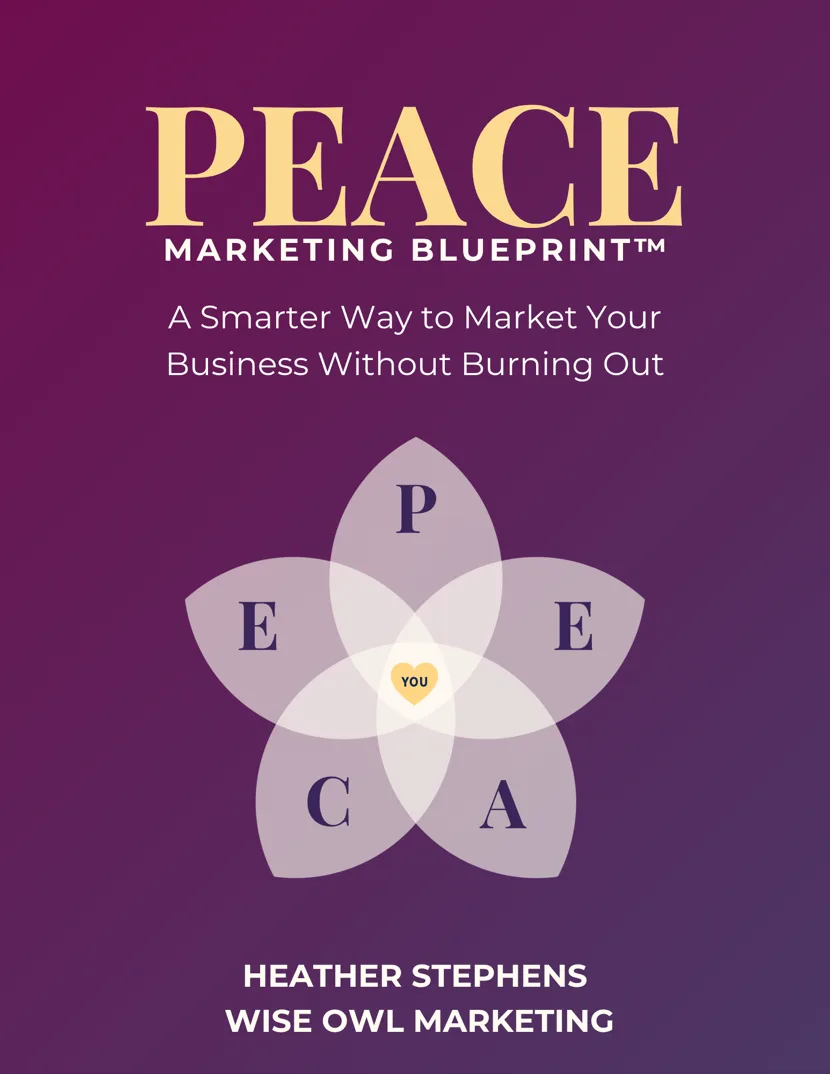

Heather C. Stephens
27+ years in marketing and 11 helping coaches and service providers get found online without burning out. Founder of Wise Owl Marketing and creator of PeacefulBiz and the PEACE Blueprint.
More about Heather →


Get peaceful marketing ideas delivered to your inbox each week.
One practical idea at a time, written like a note from a friend who happens to know marketing. Read it and try it that afternoon.