
A marketing bundle is a group promotion. A host gathers contributors, everyone gives away something free, everyone emails their list, and registrants claim whatever freebies they want. It's one of the few ways to reach an audience you didn't build. The cost isn't financial; it's that you spend your own list's attention, and your subscribers see fifty other offers alongside yours. Expect cold subscribers and higher unsubscribes. Before you say yes, spend twenty minutes on the organizer, and email two people who contributed last time. On the paid upgrade: hold the first time, because you won't have metrics to compare it against.
Subscribe to our YouTube Channel
Have you ever received an invitation from someone you kind of know? "Hey, I'm running one of those marketing bundles, and I'd love to have you! Here's the form to register if you're interested in contributing."
You think, "Free leads? Why not. Sounds like Peaceful Marketing to me!" So you submit your low-ticket offer as the freebie, write your email sequence, and submit your entry, without really considering if this is the right decision for you and your business.
Then the promo begins. You agreed to send one dedicated email to your list and at least one social media post. You queue up your content and watch your email list with bated breath, waiting to see all these new leads coming in. Then you end up with 378 new subscribers who don't seem to be opening your emails, and you're not sure whether it was a win or not.
In today's post, I'm going to introduce you to the world of marketing bundles and share what I've learned from participating in a few of them so you can decide if they're a Peaceful Marketing strategy you want to try.
Let's start by defining the roles:
Host: The business owner who is organizing the bundle.
Contributors: The business owners who agree to donate a gift and help promote the bundle to their audience.
Visitors: The audience members who register to gain access to the free offers in the bundle.
What is a marketing bundle?
A marketing bundle is a group promotion where a host recruits other business owners to join. Contributors agree to donate a gift, like a workshop, template, or mini-course that they normally charge for, and to promote the bundle to their own audience, expanding the reach to drive more visitors to the bundle. When a visitor registers for the bundle, their email is added to the host's email list in exchange for access to browse all the offers in the bundle and sign up for anything that interests them.
The real "product" of the bundle is that each contributor is introduced to new leads as the host and the other contributors promote the bundle to their audiences. That's why bundles sit alongside podcast guesting and newsletter swaps rather than anything resembling advertising.
Think of a marketing bundle like a farmer's market for businesses, where every vendor is giving away a free gift. Visitors opt in with their email address to get into the farmer's market, and when they find a free gift inside they want, they can opt in to the vendor's email list to get it.
Marketing bundles can be small, with a handful of contributors, or huge, with a hundred or more.
Where do the bundle opt-ins go? Who's actually winning here?
The Host:
The host is the biggest winner in a marketing bundle. Every single visitor who registers to browse the bundle is added to her email list. Remember, she may have fifty contributors helping to promote the bundle at once, so she's likely to see a big injection of new subscribers.
She may also bring in revenue by selling premium placement to a few bundle contributors, and an all-access pass, VIP tier, or an upgrade to visitors.
The investment is her time and labor. Imagine ...
Recruiting fifty business owners to participate
Gathering offers, copy, photos, and links from each of them
Testing each of the contributors' opt-ins to make sure they work
Building a landing page with fifty offers on it, and making all the edits contributors request
Providing copy swipe files and promotion resources to each contributor
Getting everyone to promote on time
Promoting the bundle to her own audience (emails, social posts, website placement, and possibly paid ads)
Fielding questions and providing support to the contributors and visitors, before, during, and after the bundle
It's a lot of work, to say the least.
The Contributors
The contributors get emails from the visitors who choose to claim their offer. The real benefit to contributors is access to people they had no other way of reaching.
Imagine someone with a list of 7,500 subscribers who have no idea you exist introduces you to all of them for free. Going from 200 subscribers to 500 might normally take you a season with content marketing. A bundle can do it in a week.
Another benefit is you also get to meet the other contributors, which could be worth more than the new subscribers. They are people running businesses like yours, serving the same audience, and are open to collaborations. Some of the best referral relationships I've seen started with two business owners commenting on each other's posts.
Their investment is:
The free offer they are donating
Labor building a landing page people will visit to opt in to download it
A welcome sequence to deliver your freebie and guide visitors to your paid offer
Time spent promoting the bundle to their audience.
Bottom line: If you choose to participate in a bundle, it's important to be aware that your host has more to gain than you do. If you choose to host a bundle, know what you're getting yourself into.
What's the cost of participating in a bundle?
Most bundles are free to join, but the real cost is not financial.
You have to help promote the bundle during the dates it is live. Requirements usually include a couple of emails to your list, one of them a solo email where you're only promoting the bundle, and social media posts.
You are sending your audience's attention to a promo where you are one of fifty offers. Your subscribers will end up on someone else's list if they register for the bundle or any offers within the bundle. You risk losing engagement on your own list as their inboxes are flooded with welcome sequences from every offer they claim. That's a hefty cost. If you wouldn't be willing to email your own list about it, don't join.
Your freebie also has to be really good. You're "competing" for opt-ins with all the other contributors. A thin resource can damage your reputation.
You also need to budget for time setting up your landing page, opt-in form, thank you/delivery page, welcome sequence, upsell page, etc. Add more time if you need to build your free offer from scratch.
What results can you expect when participating in a bundle?
Have you ever opted into a bundle as a visitor and downloaded the freebies? If not, I suggest you try it so you can relate to the person on the other side.
She registers, sits down with a coffee to browse the bundle, and claims about 12 offers in 5 minutes. Yours is one of them. Her inbox is flooded with 12 welcome email sequences all promising to make life better in the area of focus around the bundle's theme. A few days later, she forgot she downloaded your offer, and your email feels like one more promo cluttering her inbox.
The people who register for bundles are not leads; they are strangers.
It's normal to expect your unsubscribe rate runs higher than usual for a while. A lot of freebie seekers register to hoover up the goods, and bail afterward. They never would have been buyers anyway.
Your open rates will dip too. A batch of subscribers who never open anything drags your averages down. Eventually this can hurt your deliverability if you don't scrub your list.
Your results can also swing wildly depending on where your offer is placed on the page, how many contributors there are, and how well the theme of the bundle matches your audience's interest. You also have to factor in your image, title, and copy as to how your offer will stand out on the page.
You may see more opt-ins at the beginning and end of the bundle, with the biggest spike on the final day. Most bundles remain accessible to the visitors who opted in for a period of time after the bundle promotion ends, so leads could keep trickling in for a while.
How to judge the success of a bundle you participated in
I'm a big one for trusting your intuition unless we're talking about the results of a marketing campaign. At that point, metrics are the only thing I can truly trust. You might "feel" like the promotion was a success if the number of subscribers on your list went up, but there is more to it than that. Here is a list of data and metrics I suggest tracking.
Data to Track:
New subscribers: How many new subscribers did you gain from the bundle?
Unsubscribes/Bounces: How many unsubscribes and bounced emails did you get?
# Opens: How many of your new subscribers opened the emails in your welcome sequence?
# Click-throughs: How many of your new subscribers clicked through to your paid offer page from your welcome email sequence?
Landing page visits: How many visitors did you get to your landing page?
Thank you page visits: How many people visited your thank you page?
# Sales: How many sales did you make?
$ Revenue: What was your total revenue?
Metrics to track:
Opt-in conversion rate: What percentage of landing page visitors opted in?
(subscribers ÷ visits) x 100 = conversion rateEmail open rate: What percentage of your new subscribers opened the emails?
(number of opens ÷ number of new subscribers) x 100 = open rate
Email CTR - Click-through rate: What percentage of your new subscribers clicked links to the offer?
(link clicks ÷ new subscribers) x 100 = click-through rate
AOV - Average Order Value: How much did each person spend on average?
total revenue ÷ number of sales = average order valueEPL: What were your earnings per lead?
revenue ÷ # new subscribers = earnings per lead
Calculate your numbers when the promotion ends, at 30 days, at 60 days, and at 90 days (depending on how long it typically takes a new subscriber to buy your offer - every business is different).
Your EPL - Earnings Per Lead is the holy grail of metrics. After all, the goal of participating in a bundle is ultimately not to just grow a big list; it's to make money. Right? Calculating your earnings per lead will tell you if the new subscribers you gained are buyers or freebie seekers.
Tracking your metrics also helps you decide which bundles are the best fit for your audience and your offer. That matters most if you plan to use bundles as a regular part of your list-building strategy, because the second and third invitation are much easier to judge once you know how the first one performed.
Keep them side by side. Same rows, one column per bundle, filled in ninety days after each one closes.
Metric | Bundle 1 | Bundle 2 | Bundle 3 |
|---|---|---|---|
New subscribers | |||
Unsubscribes and bounces | |||
Opt-in conversion rate | |||
Open rate | |||
Click-through rate | |||
Sales | |||
Revenue | |||
Earnings per lead |
Which bundles should you participate in?
People judge you by the friends you keep. So be picky about who you associate yourself and your business with.
Most bundle hosts are exactly who they appear to be. Some run what feels like a lead generation scheme, and others are genuinely trying to raise the tide for everyone. It's pretty easy to tell them apart.
Here's how to do your due diligence before signing up.
Does the theme of the bundle align with your business? If you're a health coach participating in a bundle that promotes AI Marketing for business owners, the majority of visitors who register are not going to be interested in your offer.
Check out the host's business, not just the bundle page. Do they have real clients, a real body of work, something they're passionate about and known for? Someone whose entire public presence is running bundles is a different scenario than an established business owner who hosts one a year.
Ask to see last year's bundle. You can judge the listings and the company you'd be keeping. Look at the gifts. Are they mostly discount codes, free discovery calls, or thin offers, or are they real resources? How is the layout of the page? Does the page feel polished or junky? Are the images the same size and high quality? Have the descriptions been edited? Consistency means the host cares about the details.
Ask what the numbers from last year were, too. How many contributors registered, how many visitors signed up? What can you expect as a contributor (approximately)? A good host will track their numbers. If their answers are vague, pass.
Email two to three people who contributed last time. They're listed publicly, right there on the old page. "Hi, I've been invited to this year's bundle and saw you were in the last one. Would you do it again?" People answer that honestly, often at length, and often with things they'd never post publicly. It will tell you more than anything on the sales page.
Review the application, too. A few other things I'd want to see before committing:
Does it ask real questions about your audience and your offer, or is it a name and a link?
Dates and promotion requirements in writing, before you say yes rather than after
Swipe copy and correctly sized graphics. (A host who makes promoting easy has done this before.)
A testing window, so you can check your own link works before the doors open
A contributor group where the host actually shows up during the week, which is precisely when you'll need them
Red flags that would make me say no:
Requirements that grow after you've committed. You agreed to one email and one social post. Three weeks later it's two emails and a social post, and then there's a note in the group asking if everyone could go live on the opening day. A host who renegotiates after you've said yes will keep doing it.
Be careful about paid bundles, especially if you can't see the page, a contributor list, or any proof that the event is real.
A HARD NO: Anyone asking you to upload or hand over your list. Your subscribers didn't consent to that.
Should you pay for a better spot on the landing page?
Most bundles have a paid tier that gives you placement in a featured row at the top of the page. Should you upgrade or not? The answer is, it depends on your goals and finances.
If this is your first bundle, I'd hold. You don't have a baseline, so you won't know if the upgrade was worth it. Join the bundle at the free level, and then consider paying the next year when the host runs it again so you can compare.
What was the ROI for past contributors who upgraded? Ask the host. She should be able to give you an indication as to how the featured positions performed compared to the regular placements.
How big is the bundle? If it's small, skip the upgrade. If there are only twenty contributors, for example, visitors won't have to scroll the height of the Eiffel Tower before seeing your listing.
Are you contributing a new or unproven offer? If so, hold off until you know your copy and image convert well. Or run a simple paid ad test to dial in your image and copy before submitting it to the bundle.
Is the upgrade worth it financially? Here's how to calculate it:
To run the numbers, ask the host what a featured listing produced last time compared with a standard one. The gap between those two is what you're actually buying.
Formula 1:
# subs from upgraded listing - # subs from standard listing = # of subs you're paying for
Formula 2:
cost of the upgrade ÷ # subs your paying for = cost per additional subscriber
Formula 3:
If cost per additional subscriber < earnings per lead = consider the upgrade
If cost per additional subscriber > earnings per lead = pass on the upgrade
If you don't know what a subscriber is worth to you, skip the upgrade this time. Measure your results, and decide next time when you have real data.
How to make the marketing bundle work for you
If you've decided to participate in a bundle, here's a plan to make sure you're happy with your results.
Pick a resource that qualifies people rather than just attracting them. Broad appeal brings volume you'll never convert. Something specific to the problem you actually solve brings fewer subscribers but better leads.
Write the title as an outcome and the description for one person, remembering everyone will be skimming it in about a second next to dozens of other offers.
Send people to your own opt-in page rather than a direct download. That way you get the lead. You can also control the experience, introduce yourself properly, and you get to decide where they go after opting in.
Tag your bundle subscribers separately. If everyone is mixed into your general list, you won't be able to tell if the bundle was successful or not.
Have the welcome sequence written before the doors open, not during. And resist pitching in the first email. They've just collected a stack of resources from strangers, so let them use yours first.
Then promote it properly, on the dates you agreed. Hosts notice who showed up and who quietly didn't, and that's what decides who gets invited next year.
Talk to the other contributors. Reply in the group, comment on their listings, start actual conversations. The subscribers arrive and mostly drift. The relationships with other collaborators tend to stick around.
What should I do after the bundle ends?
Watch your engagement and unsubscribes for the next few sends. A dip is expected. A dip that doesn't recover is not.
Sixty to ninety days out, clean out the people who've never opened anything.
I know it feels counterproductive to delete subscribers you just worked to get, but they're costing you money and lowering your deliverability. I promise, a smaller list that opens is worth more than a big one that doesn't. Those unengaged subscribers were never going to buy anyway.
Then compare the bundle segment against your normal signups. Opens, clicks, sales, and earnings per lead. That comparison is your answer on whether to do another one.
Write down what you'd do differently next time, while it's still fresh in your mind. You won't remember the details if you decide to participate in another bundle 6 months from now.
Where to find bundles in your niche
You can't Google your way into these. Access runs through relationships.
Watch what your peers promote bundles in their feeds, in Facebook groups, newsletters, and in their private communities like Skool and Circle.
Anyone serving a similar audience will email their list about bundles they've joined, and those are the hosts worth knowing. Get on those hosts' lists directly, because they will announce contributor applications to their own subscribers first.
Join the groups where your peers gather, since that's where most invitations circulate.
Do one, and you'll get asked to more. Contributors talk, hosts recommend the people who actually promoted, and the second invitation is much easier to come by than the first.
When to say no to a bundle
Skip it if you don't have a welcome sequence and won't have one by the start date. You will be promoting the bundle to your subscribers while getting little to nothing in return.
Skip it if you sell something high-ticket to a tiny niche. Three hundred loosely related subscribers won't bring you sales.
Skip it if your own list is small and highly engaged and the promotion requirement would spend trust you've spent months or years building.
Skip it if you won't have the capacity to look after new people for the next few months.
Skip it if it conflicts with your own promotion schedule. If you'll be just coming off of a launch or gearing up for one, protect your list.
Skip it if the bundle does not align with your niche, offer, values, or goals.
Skip it if the bundle feels unorganized or spammy.
If you're deciding right now
Spend twenty minutes on the organizer, and email two contributors from last year. Then look at your own setup honestly and ask whether someone landing on your list would get tremendous value and whether you're confident you'll be able to generate sales from those new leads.
If the answer's no, fix that first. The bundle will come round again.
Frequently asked questions about marketing bundles
What is a marketing bundle?
A marketing bundle is a group promotion. A host recruits business owners who each donate something they normally charge for, everyone promotes the event to their own audience, and visitors register once with their email to browse the collection and claim whatever interests them. Every gift a visitor claims adds them to that contributor's email list.
Are marketing bundles worth it for list building?
They can be, and it depends far more on your preparation than on the bundle. The contributors who do well have a freebie that qualifies people rather than just attracting them, an opt-in page they control, a welcome sequence written before the doors open, and a way to measure what happened. The ones who are disappointed usually said yes because they were asked, sent everyone to a bare download, and then wondered why several hundred strangers never opened anything.
If all the gifts are free, what does joining a bundle actually cost?
Your inbox peace, and your own list's attention. You have to promote the bundle during the dates it runs, usually a solo email and social posts, so you are spending your audience's attention on a promotion where you are one of fifty offers. Some of the people you send will end up on other contributors' lists. You also spend time building the freebie, the landing page, and the welcome sequence.
Do subscribers from a marketing bundle actually convert?
Some do, and far fewer than the raw subscriber count suggests. They registered for a collection, claimed a stack of offers in one sitting, and may not remember which one was yours. Earnings per lead is the number that answers this honestly: revenue divided by new subscribers, calculated at 30, 60 and 90 days.
Should I pay for a featured spot in a bundle?
Not the first time. You have no baseline, so whatever happens you will not know whether the upgrade caused it. Join at the free level, measure your results, and consider paying the next time the host runs it. When you do consider it, ask the host what a featured listing produced compared with a standard one, divide the upgrade cost by that difference, and compare it against your earnings per lead.
How do I know if a bundle host is trustworthy?
Look up their actual business rather than just the bundle page, ask to see last year's bundle, and ask what the numbers were. Then email two or three people who contributed last time. They are listed publicly and they will tell you things that never appear on a sales page. Two hard limits: never upload or hand over your list, and be careful paying for placement before you can see the page, the contributor list, or proof the event is real.
Can joining a bundle hurt my email deliverability?
It can, if you do nothing afterwards. A batch of cold subscribers who never open anything drags your averages down, and sustained low engagement affects whether your email reaches everyone else. Sixty to ninety days after the bundle closes, clean out the people who have never opened. A smaller list that opens is worth more than a big one that does not.
When should I say no to a bundle invitation?
Say no if you do not have a welcome sequence and will not have one by the start date, if you sell something high-ticket to a tiny niche where volume does not help, if your list is small and highly engaged and the promotion would spend trust you spent years building, if you will not have capacity to look after new people for the next few months, or if the bundle does not align with your niche, offer, values, or goals.
How do I know whether a bundle was worth it?
Compare the bundle segment against your normal signups on opens, clicks, sales, and earnings per lead. Do it when the promotion ends, then again at 30, 60 and 90 days, since every business has a different lag between someone joining and someone buying. Track each bundle separately so you can see which ones actually fit your audience.
Whenever you're ready, here's how I can help
Start free and go at your own pace. No pressure, ever.
- Free: Keep reading the blog and subscribe on YouTube. I share everything I know.
- DIY: Get the PeacefulBiz app to organize, plan, create, and simplify your marketing.
- Guided: Join the Peaceful Marketing Lab, and let's build together.
- Direct: Book a strategy call for 1:1 help, a custom website, or to decide which program is right for you.
Want the whole framework?
The PEACE Blueprint Guide walks you through all five pillars, with planner pages to build your own peaceful marketing system.
Get the free guide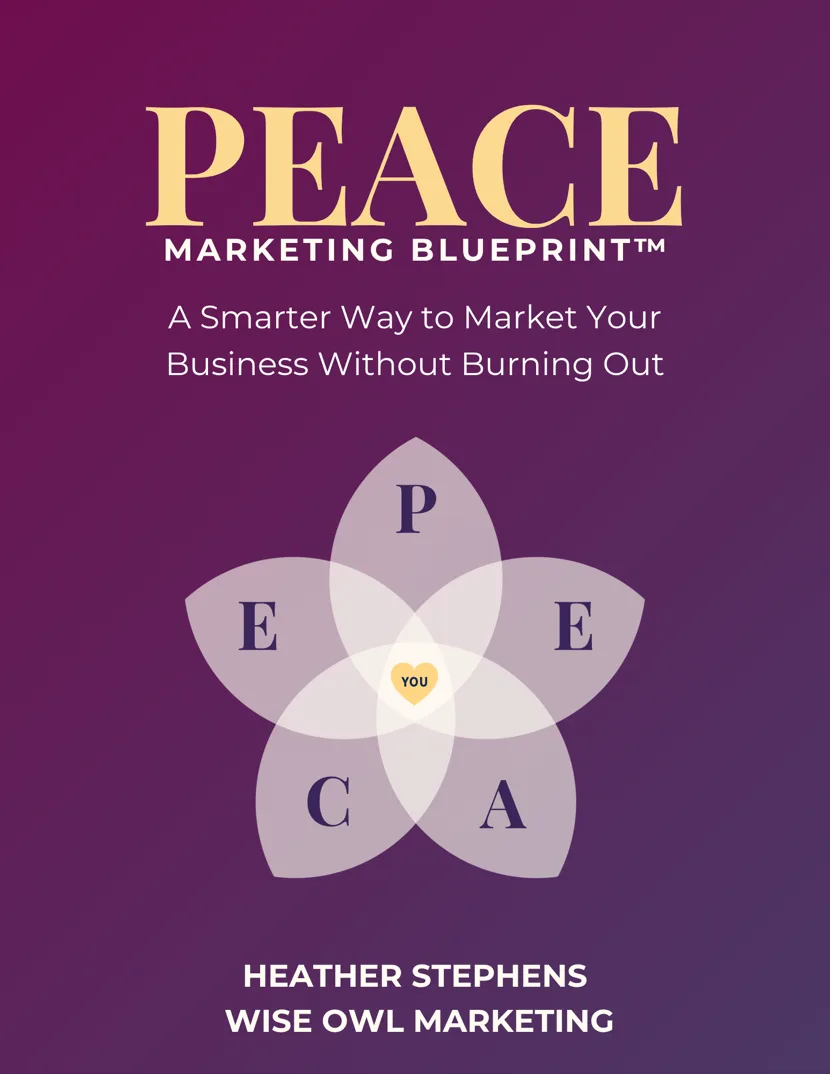

Heather C. Stephens
25+ years in marketing and 11 helping coaches and service providers get found online without burning out. Founder of Wise Owl Marketing and creator of PeacefulBiz and the PEACE Blueprint.
More about Heather →


Get peaceful marketing ideas delivered to your inbox each week.
One practical idea at a time, written like a note from a friend who happens to know marketing. Read it and try it that afternoon.