
A good sales funnel is a lot like a family canoe trip. My family canoes down the Wisconsin River every summer, my dad steering one of his wooden Old Town canoes. One of the stories everyone still tells is about floating past the clothing-optional beach that used to sit along the bank before the DNR closed it in 2016. My dad would say "pull your hat down and paddle faster," or point out something fascinating on the opposite bank. It never worked. Everybody looked.
I am the same way about marketing. I go out into the actual world and I cannot help but watch how businesses sell things.
Which is how I ended up taking notes at a bridal shop while my oldest daughter shopped for her wedding dress.
Everything before the sale
We walked in and the whole place was already doing its job. Rooms of dresses on the right, each with a fancy cursive sign above it: Ballgown, Empire, A-line, Boho. A baby grand piano. Vanilla velvet benches, which my husband and son found within about four seconds. Signs propped against the front desk reading "I Said Yes to the Dress."
You could feel the brand in every square inch. Elegant, upscale, romantic. Nobody had to tell us what kind of place this was. Funnel anatomy: branding.
Tucked in the corner was a tuxedo shop, and behind it a rainbow wall of bridesmaid dresses, and past that a room of darker beaded gowns which I correctly assumed were for me. Without a word, they had told us: you can get all of it here. Funnel anatomy: the cross-sell.
Then our consultant, Audrey, walked us back to a room with a mirrored platform and a chandelier, sat down on the edge of it, and started asking my daughter questions. When is the wedding? Tell me about the groom. How did you meet? Do you have a venue? What styles do you like? What is your budget? How do you want to feel in your dress?
That last question is the one I want you to notice. She was not gathering data. She was finding out what my daughter was actually buying, which was never a dress. Funnel anatomy: discovery.
Then she disappeared to go pull dresses. My son asked how long these things take, sighed, and went back to his phone.
The never-ending funnel
My daughter is decisive. A handful of dresses in, she found the one. My husband stood up and started talking about lunch.
Reader, we did not go to lunch.
"If you buy your accessories today, you get ten percent off." In came the veils, the tiara, the jewelry, the detachable train. By the time Audrey was finished, the accessories cost about as much as the dress.
My husband stood up again. "Time for lunch?"
"Would you like to look at bridesmaid dresses while you are here? If you choose today, each bridesmaid gets twenty dollars off." We moved to another part of the store. My younger daughter started trying things on. My husband took my son down the street for a snack.
Then it was my turn. "Would you like to book your mother-of-the-bride style session? Twenty percent off if you schedule today." Then the groom's tux, free with four rentals. Then the dress cleaning and preservation package, discounted if we bought it before the wedding.
Several hours later we walked out with a bridesmaid dress from the sale rack, a bottle of pink champagne, a photo of my daughter holding the sign, and two extremely hungry men.
What this has to do with your business
They got about two hundred extra dollars out of us that afternoon. The bride checking out beside us, from the sound of it, spent a thousand or more: her veil, her jewelry, the preservation package, a mother-of-the-bride session.
Three quiet numbers grew for that shop, and not one of them came from pressure:
- Average order value. What one customer spends in a single visit. Ours went up because the veil and the cleaning were things we genuinely needed, not because anyone twisted an arm.
- Customer lifetime value. What a customer is worth across every visit, not just the first. A bride who felt looked after comes back for her sister's wedding, and sends her friends through the door.
- Revenue. The sum of all of it. It followed the service, not the squeeze.
Now, here is where most marketing people would tell you to go build a stack of upsells and start squeezing every client for more. That is not the lesson, and honestly, sitting in that chair for four hours, I could feel the difference between the moments that were generous and the moments that were just pressure.
The offers that felt good were the ones we would have needed anyway. We were always going to need a veil. The bridesmaids were always going to need dresses. That dress was always going to need cleaning after the wedding. Audrey was not inventing needs, she was removing errands. That is a service, and it is worth paying for.
The offers that felt like pressure were the ones with a clock attached for no reason. Twenty percent off, but only if you decide right now, in a room where your daughter is standing on a platform in a wedding dress and everyone is emotional. That part I did not love.
So take the useful half:
- Your first offer is a door, not the whole house. Most businesses stop the moment someone says yes, and then go right back out to hunt for another stranger. The person who just bought from you is the warmest audience you will ever have.
- Ask what they are really buying. Nobody wants a dress. They want to feel a certain way walking down an aisle. Nobody wants a website either. Find the real thing and build around it.
- Offer the next honest step. If you know what your client will need in three months, and you can provide it well, it is not pushy to say so. Staying quiet just means they will go buy it somewhere worse.
- Skip the fake deadline. A real reason to decide now is fine. A pretend one costs you the trust you just earned, and people remember how you made them feel in that room.
Done that way, serving people after the first yes is not a sales tactic. It is the Earn part of the PEACE Blueprint: you keep being useful, and the revenue follows the usefulness instead of the pressure. If you want the whole path mapped, from the first hello to the honest next step, that is what a good website and funnel quietly does for you.
Want help mapping out what comes after your first yes? Book a clarity call and we will sketch it together, or take the five-minute quiz to find the gap that is costing you the most right now.
Whenever you're ready, here's how I can help
Start free and go at your own pace. No pressure, ever.
- Free: Keep reading the blog and subscribe on YouTube. I share everything I know.
- DIY: Get the PeacefulBiz app to organize, plan, create, and simplify your marketing.
- Guided: Join the Peaceful Marketing Lab, and let's build together.
- Direct: Book a strategy call for 1:1 help, a custom website, or to decide which program is right for you.
Want the whole framework?
The PEACE Blueprint Guide walks you through all five pillars, with planner pages to build your own peaceful marketing system.
Get the free guide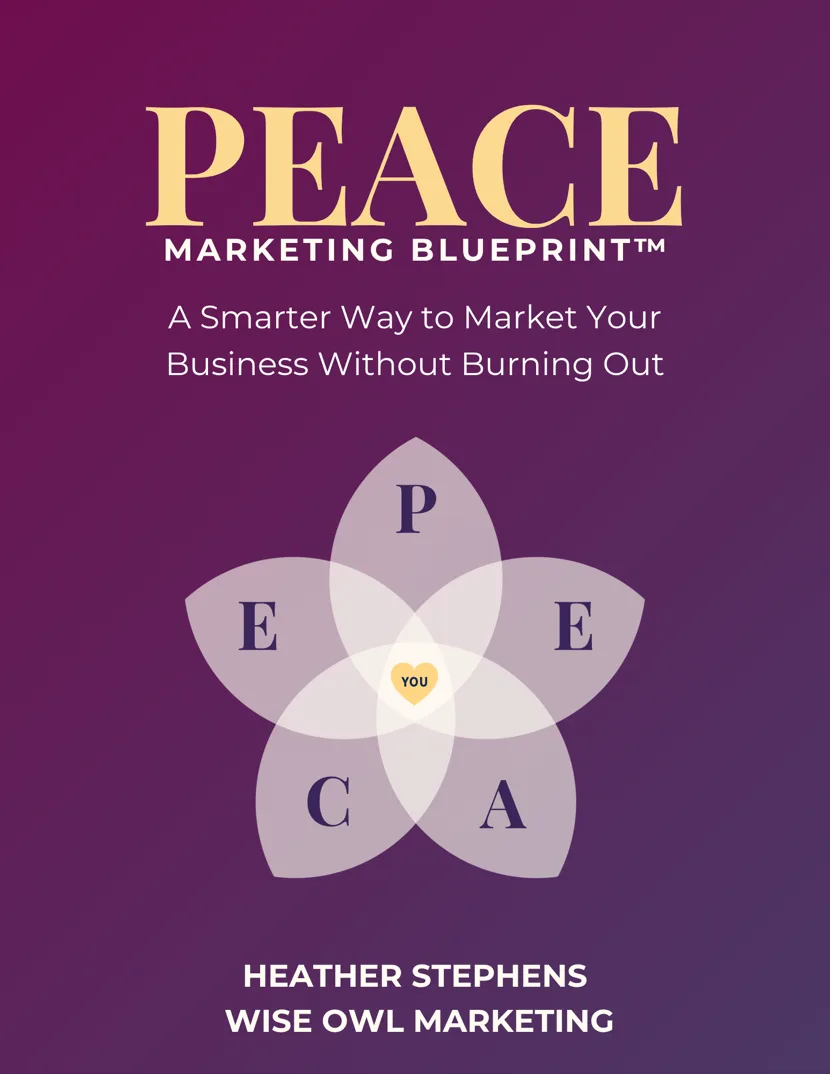
Heather C. Stephens
27+ years in marketing and 11 helping coaches and service providers get found online without burning out. Founder of Wise Owl Marketing and creator of PeacefulBiz and the PEACE Blueprint.
More about Heather →


Get peaceful marketing ideas delivered to your inbox each week.
One practical idea at a time, written like a note from a friend who happens to know marketing. Read it and try it that afternoon.