

Are you a DIY (Do it Yourself) dynamo? Do you fully embrace the “Everything is Fugureoutable!” philosophy that Marie Forleo talks about?
Is DIY a smart, money-saving move, or is it costing you more than you think? That’s what we’ll explore in today’s post…
The most successful coaches, marketers, and business owners in the coaching space have teams of talented experts to support them in their business. Most of the coaches and service providers I talk to on clarity calls are solopreneurs (aside from possibly an accountant they leverage at tax time). But overall, they’re flying solo and trying to grow their coaching business.
This week I was asked two questions that really got my wheels turning. “Do you work 14-hour days?” and “When should I hire someone?” My gut responses were, “No, not if I can help it,” and, “Yesterday.”
Our society idealizes the idea of the tireless worker. This “self-made” individual who conquers all through relentless hard work without relying on others. The reality is that no one achieves success in isolation; behind every so-called “self-made” man or woman there’s a support system, a network of mentors, friends, family, and hired professionals.
Valuing collaboration and asking for help doesn’t diminish success⏤it amplifies it! Teamwork and delegation are essential if you’re looking to scale your business to achieve more impact and better work-life balance.
Let’s dive in and explore why we love to DIY

DIY is part of an entrepreneur’s DNA
As a coach, my guess is that you’re a master of empowering others and guiding them toward success. I’d also bet money that most of you started your business because you:
- Wanted to do what you love while making a positive impact on the lives of others.
- You wanted a sense of autonomy and the power to control the direction of your work.
- And you wanted the freedom and flexibility being your own boss allows.
“Cox Business found that more than half of small business owners start their own businesses to be their own boss. They were also motivated by the idea of creating something from the ground up.” (Shayna Waltower, Business News Daily)
No wonder DIY is so appealing to entrepreneurs. It promises cost-savings and control. And it gives us the satisfaction and pride of building or creating something that helps others.
The Allure of DIY
In the early days, handling everything yourself makes sense. You probably had more time than money to invest in your growth.
Plus, the internet makes DIY easy. The “how to” content is abundant online. Thanks to a video I found on YouTube, I replaced the power window motor in my minivan in 2009, all by myself! Money was tight, and I was tired of not being able to open my window at the bank teller line or get my morning coffee at the drive-through. So in typical entrepreneurial fashion, I embodied the spirit of “where there’s a will, there’s a way!”
But as your business grows, the time and effort needed for DIY can become more of a barrier to growth than you realize. It’s sneaky, like those hidden money blocks abundance and mindset coaches frequently talk about⏤you don’t even know the limiting beliefs are there until you try to reach the next level of revenue. In the long run, DIY can end up costing you more money than you realize.
Let’s now take a look at the hidden cost of DIY.
3 ways DIY can hold us back from leveraging and scaling our businesses, costing us more in the long run
So if, as entrepreneurs, we’re wired to love DIY, and we tend to be really good at it, what’s the problem?
There are three, actually:
- DIY is often an excuse to stay in our comfort zones.
- DIY gets in the way of our ability to leverage and scale.
- DIY leads to overworking, exhaustion, and burnout.
Let’s explore each of those now…

1. DIY is often a way to avoid facing your fears or an excuse to stay in your comfort zone
Feeling like you need to handle everything yourself to get it just right? It’s a common struggle for many accomplished coaches, consultants, and service business owners.
Those feelings might be a clue to a limiting belief running in the background of your mindset, like those sneaky money blocks I mentioned earlier.
Here are some hidden mindset barriers that might be keeping you in the DIY loop, holding you back from playing full out in your business:
Fear of what others might think
This one is big for many of the coaches I work with (and me). When I started Wise Owl Marketing, I was instantly reminded of how much harder it is to promote myself than market someone else.
But fearing being judged, criticized, or “found out” is expected. We all feel this at times in our business. It’s the good old “impostor syndrome” people talk about.
Are you waiting for everything to be “perfect” before launching? Or distract yourself by working on small, non-critical tasks, avoiding the real work of connecting with others in your industry, following up with potential clients, or speaking at that next event.
This cycle of endless tweaking and refining and your failure to launch could be a mask for fear of rejection.
My client Amy described it beautifully when she said in her client spotlight interview, “The website was an excuse for me to not do the other things, like the networking or the outreach, that I needed to be doing to grow my business because I was spending all my time trying to fix my website…When it (the website) was all done, I was like, ‘crap, now I have no excuses. I have to start doing these things.'”
Fears of trusting others or losing control
Do you resist giving up control? This shows up as limiting thoughts like no one else can maintain your high standards. “Every part of my business is a reflection of me; I can’t let anyone else handle it.”
A fear of trusting others may be holding you back if you think no one else will be as reliable and competent as you are. “What if someone else’s mistake hurts my reputation or if someone steals my business secrets?”
Having a little bit of skepticism leads to healthy self-honoring boundaries. Too much mistrust becomes a barrier to success.
Fear of making a financial mistake or failing
“What if I invest in this, and it doesn’t work?”
Some business owners stay stuck in DIY mode because they are scared to invest in their business (and themselves). Many people fear that hiring someone is too expensive or that they may waste money on the wrong person. And then there’s the worry that hiring someone to help will eat into their profits.
Or, there’s an underlying fear that you won’t be able to bring in enough business to support another teammate. Or, they may hesitate to get help if they are not confident they can manage others effectively.
Ultimately these types of fears point to limiting beliefs around self-worth and self-confidence.
Fear of success
Finally, some business owners stay stuck in DIY mode because they fear success. They may worry that:
- The next level’s responsibilities will be overwhelming.
- They’ll have to work longer hours and have less time for family, hobbies, or self-care.
- Success will change who they are, and they might outgrow their relationships.
- Success isn’t safe. That one wrong move and they could lose it all, or being a huge success could put themselves or their family at risk.
What should you do if fear is trapping you in DIY mode?
Fear of judgment, mistrust, financial mistakes, and success are real fears. Don’t judge yourself if you suspect these fears are keeping you in DIY mode. Confront and work through your fears to transition into a more leveraged and scalable business model.
- Identify which fears are holding you back.
- Journal on them to see where they originated in your mindset.
- Seek professional guidance from a therapist or mindset coach if you need support to work through your fears.
- Dip your toes into delegating by handing over a few tasks to someone else. Start with the things you don’t enjoy doing in your business.
- Remember that delegating and accepting support from others gets easier with practice.
Now that we’ve explored the first way DIY keeps us from growing outside our comfort zones let’s talk about the impact DIY has on our ability to leverage and scale.

2. DIY gets in the way of being able to leverage and scale
We’ll break the hidden cost of DIY into 5 sections, Time, Quality, Money, Scaleability, and Mindset to see how DIY affects your ability to leverage and scale.
Time
- DIY keeps you from leveraging your time: You can work only so many hours each day. When you’re involved in every minor task, from website development to administrative work, it consumes time that could be better spent focusing on your core strengths and growing your business.
- DIY can slow your growth: Implementing new strategies, learning new platforms, or troubleshooting your tech takes time. When you’re the one doing it all, it stifles your ability to scale quickly.
Quality
- DIY Sometimes Looks⏤DIY: (Yes, I went there!) No one is an expert in all areas. DIY-ing tasks you haven’t done before or are not proficient at because you don’t do them frequently can give you subpar results and reflect poorly on your brand. Looking bad could be the least of your worries. DIY-ing legal and financial things could actually get you into big-time trouble.
- Being Spread Thin Can Impact Service Delivery: Something is bound to break if you spin too many plates simultaneously. A lead may fall through the cracks, or you might miss a deadline for a client. When your attention is divided between too many tasks, the quality of your primary service – coaching – will suffer, holding back your growth and client satisfaction.
Money
- Hidden Costs of Making Mistakes, Trial and Error, or Using the Wrong Tools: The apparent cost-saving of DIY can be misleading. I absolutely LOVE helping my clients save thousands of dollars a year by simplifying their tech stack. Most entrepreneurs struggle to avoid the “shiny object” syndrome. As a result, they end up paying for more tools than they need to run their business. In addition to saving money with the right tools, the time and energy they invest into tasks that could be outsourced often outweigh the financial savings.
- What Opportunity Costs Will You Have to Pay Because of DIY? DIY often takes longer than letting a pro do it. If you take three months to finish your funnel and a pro can get it live in one month, you would be missing out on two months of potential leads and clients. By focusing on tasks that could be delegated, you also take away opportunities to engage with potential clients, develop new products, or explore new markets.
Scalability:
- DIY Limits Flexibility: There’s a reason the big names in every niche have someone else handling their tech and customer service. DIY restricts your ability to respond quickly to client needs or pivot your business, impacting scalability.
- DIY Causes Bottleneck Barriers: When you rely solely on yourself, you become the bottleneck in your business. You only have so many hours in a day you can work. Outsourcing or hiring allows you to leverage the time of others. And as your business grows, your team can scale and grow with it.
Mindset:
- DIY Keeps You Playing Small: The desire to control every aspect of your business might keep you from putting yourself out there, taking risks, and limiting your ability to scale.
- A DIY Only Mindset Resists Change: A DIY mindset may resist adapting to changes or new methodologies that could leverage your business to a higher level.
3. DIY leads to overworking, exhaustion, and burnout
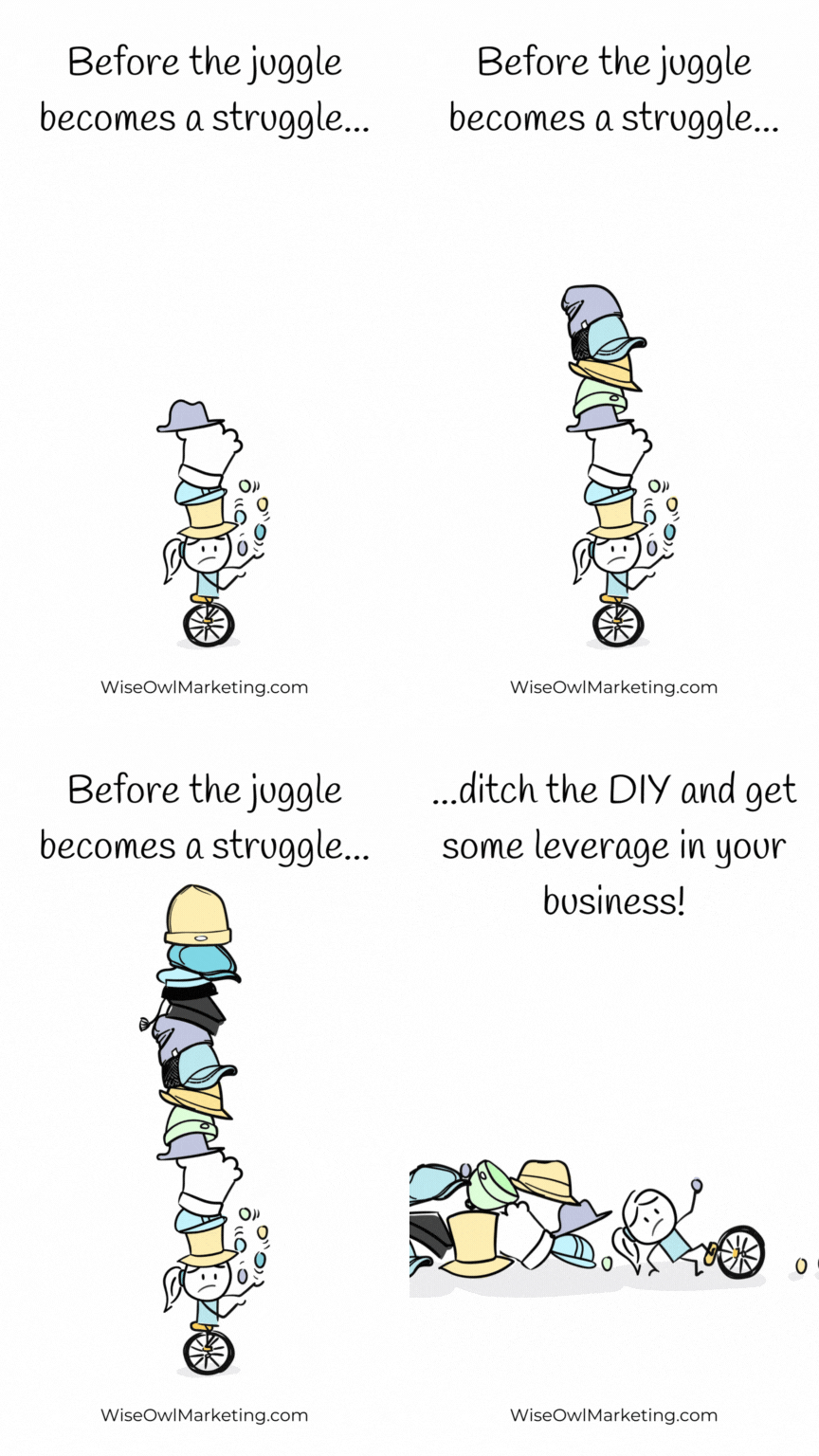
It’s a fact when you’re DIYing, you have more things on your plate, which eventually leads to working longer hours, stress, overwhelm, exhaustion, and burnout.
Here are some statistics I dug up on the number of hours self-employed small business owners work:
“Self-employed Americans stand out as those most likely to work atypically long hours, in many cases upwards of 60 hours per week.” (Source: Gallup)
“Thirty-three (33%) percent of small-business owners reported working more than 50 hours per week, while an additional 25% said they work more than 60 hours a week, according to a poll of readers of the New York Enterprise Report. The poll, conducted throughout January and February, found that 70% of respondents also worked at least one weekend on a regular basis.” (Source: Inc.com)
Working this many hours takes its toll on both health and relationships.
“People working 55 or more hours each week face an estimated 35% higher risk of a stroke and a 17% higher risk of dying from heart disease, compared to people following the widely accepted standard of working 35 to 40 hours in a week, the WHO says in a study that was published Monday in the journal Environment International.” Source: (NPR)
“The National Federation of Independent Business found that approximately 50% of small business owners experienced at least one divorce, compared to the average divorce rate in the United States of around 40-50%. Another study published in the Journal of Marriage and Family revealed that couples who operate family-owned businesses are more likely to divorce than couples who do not own businesses together.” (Source: BryanFagan)
Please don’t let the cost of DIY be your health and well-being.
Finally, overwhelm is likely to keep you from attracting clients!
Who would you prefer to work with?
- A relaxed coach, who is rested, and has self-honoring solid boundaries so she can show up as her best in every session?
- Or a coach who is tired, stressed, and overwhelmed because she has so much on her plate?
“Overworked” doesn’t look good on anyone, and it certainly isn’t going to help you attract clients.

How to Find the Right Balance Between DIY and Delegation
The appeal of DIY is clear, especially when starting your business. However, the DIY approach may become a barrier as your business grows, keeping you from leveraging opportunities and scaling your business.
So, you want to take advantage of the benefits of DIY while at the same time avoiding the hidden cost of DIY.
Which leads us to…
What should you DIY, and what should you delegate?
I’ve talked about the delegate vs. DIY dilemma before. I even created a printable to help you determine which things to DIY and which to outsource. You can grab that in our free printables library in the Wise Owl Marketing community.
Are you ready to dip your toes into the world of delegating? Start with an accountant, bookkeeper, and virtual assistant, and then move on to get the tech and customer service off your plate. If you only need to do something once in a great while, get someone who does it frequently to handle it instead of spending hours trying to figure it out yourself.
Who needs to troubleshoot website gremlins, design flashy graphics, or crunch numbers when you could be working with clients and helping them soar?
You free yourself up to focus on your core coaching activities and maximize productivity by delegating these tasks to professionals who are likely to do them better and faster than you can.

Here are some things business owners should not delegate
It’s essential to strike the right balance between what to DIY and what to delegate. Here’s a suggested breakdown to guide the decision-making process for coaches, consultants, and service providers:
Vision and Strategy Development
- Your vision and core strategy drive the business. If you wanted to follow someone else’s plan, you’d still be working in a 9–5 job building someone else’s dream. You knew you were meant for more! Your strategy needs to be as unique to you as your goals are. It must align with your gifts, skills, and interests and pull you toward your big beautiful vision for your business and life.
Building Key Relationships
- People do business with people they know, like, and trust. Personal connections with key clients, partners, and influencers are integral to your brand’s trust and credibility. It’s not what you know; it’s who you know and who knows you!
Personal Branding and Thought Leadership
- Your unique voice and perspective as a thought leader cannot be replicated by others. Engaging personally with your audience through training, content, speaking, and social media solidifies your status as an expert.
High-Level Decision Making
- Like your core values and long-term goals, business decisions related to finances, investments, partnerships, strategies, priorities, etc., are essential for you to do.
Quality Control and Customer Feedback
- Your brand is an extension of you. You can hire a team to help you with it, but everything they do reflects on you. It’s essential to personally monitor the quality of the content you’re sharing and the feedback you get from clients to ensure everything meets your standards and aligns with your customers’ needs.

How to start getting out of the DIY trap and shift into a more leveraged business model
Escaping the DIY trap and transitioning to a more leveraged business model takes time. It requires a strategy that aligns with your unique challenges and aspirations as a coach or service provider.
Here’s a step-by-step guide to help you grow a team to achieve your desire for growth, impact, and work-life balance:
Identify What You Can Automate and Delegate
- Audit Your Tasks: List your daily, weekly, and monthly tasks. (There’s a printable here to help you with that.)
- Decide Which Tasks to Automate: Identify which jobs don’t need the personal touch of a human that can be automated.
- Pinpoint Tasks to Delegate: Identify which jobs can be handled by someone else without losing your unique voice or quality.
Align Delegating with Your Vision and Goals
- Define Your Objectives: Identify what you are trying to achieve through delegation.
- Ensure Alignment: Make sure that delegation aligns with your business’s long-term vision and growth strategy.
Overcome Mindset Barriers
- Address Limiting Beliefs: Recognize and confront the fears and misconceptions that might be holding you back.
- Embrace a Growth Mindset: Understand that growth requires letting go of control in some areas. Start with baby steps.
Create Clear Systems and Processes to Support Your Team
- Develop Standard Operating Procedures (SOPs): Outline clear, repeatable processes for each delegated task.
- Implement Tools and Technology: Utilize software and tools that make collaboration and oversight easy. Tools like Loom and Tango make it easy to create SOPs. We catalog our SOPs as a Project in Asana for quick reference.
Find the Right Talent to Support Your Business Vision & Strategy
- Identify Skills Needed: Determine what qualifications and experience are required. Remember, it’s doubtful you’ll be able to “clone” yourself with one person. Instead, you’ll hire a few people with varying skill sets.
- Hire Carefully: Whether hiring a full-time team member or outsourcing, ensure they align with your brand values and quality standards. I like to give people a project to complete as part of the hiring process to see how they do.
Provide Training and Support
- Invest in Onboarding: Educate new team members about your brand, mission, and expectations. I like to give new teammates a maximum of three things to start with so they can get comfortable with how we work. Then I add to their plate when they consistently complete the first three tasks without my input.
- Offer Ongoing Support: Regular check-ins and feedback create a positive working relationship.
Monitor and Adjust
- Track Performance: Regularly assess how delegation is affecting your business. Is it creating a positive ROI on your time and/or revenue?
- Make Necessary Adjustments: Be willing to tweak roles, processes, or teammates as needed. This is not always easy but trust your gut. If you’re honest with yourself, you know if you have people in the correct positions.
Consult with a Trusted Advisor
- Seek Expert Guidance: Working with a coach or consultant who understands your unique challenges can streamline the transition.
- Join a Supportive Community: Networking with others who have successfully made this transition can provide invaluable insights and encouragement. They may also have referrals for you!
Conclusion: Ditch the DIY, Delegate What You Don’t Love to Do, Build a Leveraged Business
Shifting from a DIY to a leveraged business model isn’t about losing control; it’s about gaining the ability to make more money, help more people, and have more time to do what you love. If you find that the hidden costs of DIY in this post resonate with you, take some time to plan your strategic steps to leverage and scale so you can unlock a new level of growth, freedom, and impact.
You’ve got this!
Schedule a Free Clarity Call to Talk About Delegating Some of Your Website, Marketing, and Strategy to Us!
We’d love to help you leverage and scale your business! Book a call today if you’d like that too!





Looking for Something Specific?

Where Should I Send Your Free 2026 Marketing Planning Bundle?
*Your free planner will be delivered to your inbox. Check your spam folder if you don't see it within 15 minutes. Submit a support ticket if you need help. By entering your email address, you agree to receive emails, including marketing tips, offers, and announcements, in accordance with my privacy policy.
