
There's so much content out there that it can feel overwhelming. Everyone's already written about everything, right? AI can spit out a "Top 5 Tips" post faster and better than any of us ever could.
So here's the question: Is starting a blog in 2025 actually worth your time as a service business owner or coach?
The short answer? Yes. But not for the reasons you might think.
Who Am I to Talk About Business Blogging?
If we haven't met, Hi, I'm Heather Stephens, and I've been blogging almost weekly since 2009.
I started my first blog after seeing Julie & Julia, a movie about a woman who blogged her way through Julia Child's, The Art of French Cooking Cookbook. (Totally cliche, I know!)
Most blogs at that time, were a lot like personal journals, a place to share your thoughts and connect with a handful of readers who stumbled across your corner of the internet.
I started my blog with a different mission, to document my journey of building my business online.
My blog was my "test kitchen" to try out the various marketing strategies the internet marketing gurus were teaching, and reporting back on what worked, what didn't, and what I'd learned. The blog quickly turned into a full-fledged business, with a paid forum (old-school membership), blogging planners, coaching, accountability groups, co-working sessions, and more.
Since then, I've written thousands of articles for my own businesses, including 10 years of building Wise Owl Marketing. I've also written for clients across various niches, and spent half a decade as a content marketing manager for a well known cash back website.
When you're actively and consistently publishing content, it serves all areas of your business. Your blog can feed your socials, nurture your email list, help your clients find you in search as well as AI.
—Heather Stephens, Wise Owl Marketing
Why I'm Still Blogging to Get Clients (And Why You Should Too)
I haven't posted on social media in over a year. And my business? It's doing just fine.
Blog posts I wrote back in 2016, still bring me clients today. While your social media posts disappear into the algorithm void within hours, blog content keeps working for you, 24/7 for months and years to come.
Every week, I have potential clients who book discovery calls and check the box saying they found me on Google. Having that as a fallback has been wonderful. As social media algorithms change, as things shift in the online space, or when life gets busy and I don't have time to post, I have years of blog content that continues to bring me clients.
The real power of blogging in 2025 is not about churning out endless streams of content. It's about creating valuable marketing assets that thoughtfully serve your audience and compound over time.
—Heather Stephens, Wise Owl Marketing
The Shift: From SEO Content to Thought Leadership
The old way of blogging for SEO traffic, trying to stuffing keywords awkwardly into listicles and how-to posts, has now become commoditized. AI can spit out that kind of content better, faster, and cheaper than a whole team of writers ever could.
But here's what AI can't do: share your unique perspective, your hard-earned wisdom, and the specific way you think about solving your clients' problems. Sharing valuable insights on a blog serves your audience, the search engines, and AI platforms.
Thought leadership content builds trust.
It's the content AI tools love to cite.
It's the content that turns readers into leads and subscribers into clients.
The misconception here is that there's so much content out there that your content will never be found. The shift we need to make is focusing on content that helps us make a connection and nurture our relationship with our audience, not just cranking out AI-generated, keyword-stuffed content.
You've spent years deepening your knowledge, honing your craft, serving clients, solving problems, making mistakes, learning from them, and figuring out what works for your audience. That gives you insights AI can't replicate.
Mindset Reset: Blogging isn't just a marketing tactic. It's an awesome way to refine your thinking, clarify your message, and serve your audience, all while building long-term visibility for your business.
—Heather Stephens, Wise Owl Marketing
Why Having a Business Blog Still Matters in 2025 (Especially with AI)
Here's the truth most people aren't talking about: AI tools like ChatGPT, Claude, and Perplexity are actively scanning blog content right now. They're curating it, citing it, and recommending it to users who ask questions in your niche.
When someone asks an AI tool, "How do I find a business coach who can help with marketing strategy?" - if you've written thoughtful, insightful content about your approach, you could be the one AI recommends.
But only if that content exists.
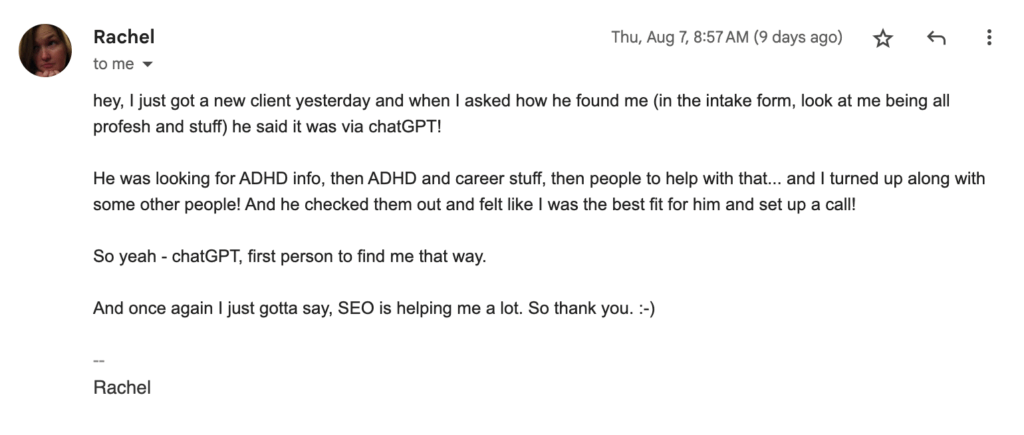
who received a client from ChatGPT thanks to her business blog!
Social media posts? AI doesn't cite them. And here's why that matters:
The lifespan of social media content is shockingly short, but your blog content can keep working for you, for years.
Here's another stat that'll change how you think about marketing:
When you send an email to your list sharing your blog post, you'll get a 20%+ open rate. Compare that to Facebook, where only 2-6.5% of your followers even SEE your post. And email converts 3x better than social media, with an average ROI of $38 for every $1 spent (according to the Direct Marketing Association).
Your blog isn't just content, it's a marketing asset that:
- Shows up in Google searches
- Gets cited by AI tools
- Can be shared via email (where people actually see it)
- Works as a foundation for all your other marketing
- Keeps generating traffic and leads for years
"But Heather, I Don't Have Time to Blog"
I hear you. And I'm not going to tell you that blogging takes no time, because it does take some time.
But here's what I want you to consider: what's the cost of NOT blogging?
When you don't have searchable content out there working for you, you're stuck on the social media hamster wheel. You have to show up every single day, post multiple times, engage with comments, ride the algorithm waves... and the second you stop? Your visibility drops to zero.
With blogging, you create it once and it works for you forever (or at least until you decide to take it down). That post you write today could bring you a client in 2027.
How to Make Blogging for Your Business Manageable
Step 1: Start with one post per week.
Step 2: Use AI as your assistant, not your ghostwriter.
Step 3: Repurpose everything.
- An email to your list
- 5-7 social media posts
- A resource you can share when someone asks a question
- Content for a lead magnet or guide down the road
So you're not creating content for blogging AND social AND email. You're creating one piece and using it everywhere.
TIP: Batch your writing.
The truth is, most coaches spend 5-10 hours a week on social media that disappears into the void. If you redirected even half that time to blogging, you'd have an asset library that keeps working for you long after you hit publish.
— Heather Stephens, Wise Owl Marketing
You don't need more time. You just need to use your time differently.
What Makes Blogging Work for Service Businesses and Coaches in 2025
Let me be real with you about what's changed and what hasn't when it comes to growing a business blog.
What hasn't changed: You still need to create valuable content that helps your audience solve problems.
What HAS changed: The type of content that works.
Generic "Top 5 Tips" posts? AI can create those in seconds. But what AI can't do is:
- Share YOUR specific coaching framework
- Tell stories from YOUR client experiences
- Explain WHY you do things differently
- Provide CONTEXT and INSIGHT that go beyond the facts
- Build trust through YOUR authentic voice
- Position YOU as the coach they want to work with
"The more you optimize for context and credibility (not just keywords), the more AI pulls your content into answers for 1 billion+ daily ChatGPT queries." - SEO Expert, Neil Patel
Business Blogs are a Long-Game Marketing Strategy
The mistake I see many (dare I say most) service business owners and coaches are making is that they don't focus on creating long-term searchable content assets. Instead, they pour most of their time into social media, creating content that ends up only being seen by a fraction of their audience before it quickly fades into the newsfeed, gone forever.
Having a business blog serves many areas of your business at once and perform so much better than social media alone.
When you're blogging and creating long-form content that has a long shelf life on the internet, people can find it in Google and AI tools.
It's also content you can repeatedly share to your email list and break apart into your social media.
Think of blogging like fishing. Every blog post you publish is like another line in the pond of potential clients looking to solve a problem. The more lines you have out there and the more chances you have to catch the right people. And the better you tailor your content to appeal to your audience the more potential leads and clients each post will bring in.
Unlike social media posts that quickly sink to the bottom of the feed, your blog post fishing lines stay active, working for you while you're sleeping, spending time with your family, or working with clients.
When Blogging ISN'T Right for You
Let's be honest about when blogging might not be your best strategy:
If you need clients this week: Blogging is a long-game strategy. It typically takes 3-6 months to see consistent traffic from search engines. If you need immediate results, focus on networking, referrals, or paid ads first, then start building your blog for long-term sustainability.
If you absolutely hate writing: Don't force it. But consider using AI to help you draft posts, then add your voice. Or record yourself talking and have it transcribed. There are ways to blog without "writing" in the traditional sense. (TIP: I used the voice recorder in Google Docs to ramble my thoughts for this post. Then I used Claude AI to help me organize it. Then I popped the draft into WordPress to re-write, revise, edit, fine-tune, and publish.)
If you're not willing to be consistent: Sporadic posting won't work. You need to commit to at least one post per month (ideally weekly) for blogging to build momentum.
If you want to stay invisible: Blogging means putting your ideas out there. If you're not ready to be visible and share your expertise publicly, work on your mindset first.
But if you're willing to invest 2-3 hours per week to create valuable content? Blogging will bring you more qualified leads than most other marketing channels without the social media burnout.
Side Note: The other two marketing channels that I see working for business owners right now are long-form Podcasts and YouTube videos. However, when you consider the tech challenges, video/audio editing, etc. blogging is hands-down the easiest for most business owners, plus AI loves citing written content!
Frequently Asked Questions About Blogging for Coaches
Is blogging dead in 2025?
How long before I see results from blogging?
Do I need to be a good writer to blog?
Can I use AI to write my blog posts?
How often should I blog?
What if my coaching niche feels oversaturated?
Should I blog if I'm already active on social media?
How long should my business blog posts be?
What's the best blog platform for coaches and service businesses?
What if I've already written about a topic?
Key Takeaways: Should You Blog in 2025?
Yes, if you want long-term, sustainable client attraction. Blogging in 2025 is more valuable than ever because AI tools actively cite and recommend blog content to users seeking coaching help.
Your blog works 24/7. While social posts disappear in hours, blog content from years ago still brings in qualified leads. 61-80% of website traffic comes from "old" blog posts.
You own your content. Unlike social media (where platforms control your reach), your blog is yours. Build an asset that can't be taken away by algorithm changes.
It's not about volume—it's about value. One thoughtful post per week that showcases your unique perspective is enough to build authority and attract clients.
The time investment pays off. Blog content you create once becomes email newsletters, social posts, lead magnets, and SEO that compounds over time—making it the most efficient marketing strategy for coaches.
Bottom line: If you're willing to invest 2-3 hours per week to create valuable content, blogging will bring you more qualified leads than any other marketing channel—without the social media burnout.
Your Next Step: Start Creating Blog Content That Actually Works
The biggest hurdle for most business owners isn't writing, it's knowing what to write about. That's exactly what I cover in this post: 12 Proven Methods to Generate Endless Blog Post Ideas for Coaches.
I'll show you simple systems for brainstorming a year's worth of business blog topics in under an hour. No more staring at blank screens. No more writer's block. Just practical methods you can use today to fill your content calendar.
Want Help Planning Your Business Blog Content Strategy?
Join our monthly planning sessions for just $10/month. They are live, interactive workshops where we plan your content together. Register for our next planning session here.
Happy marketing,
Heather
Whenever you're ready, here's how I can help
Start free and go at your own pace. No pressure, ever.
- Free: Keep reading the blog and subscribe on YouTube. I share everything I know.
- DIY: Get the PeacefulBiz app to organize, plan, create, and simplify your marketing.
- Guided: Join the Peaceful Marketing Lab, and let's build together.
- Direct: Book a strategy call for 1:1 help, a custom website, or to decide which program is right for you.
Want the whole framework?
The PEACE Blueprint Guide walks you through all five pillars, with planner pages to build your own peaceful marketing system.
Get the free guide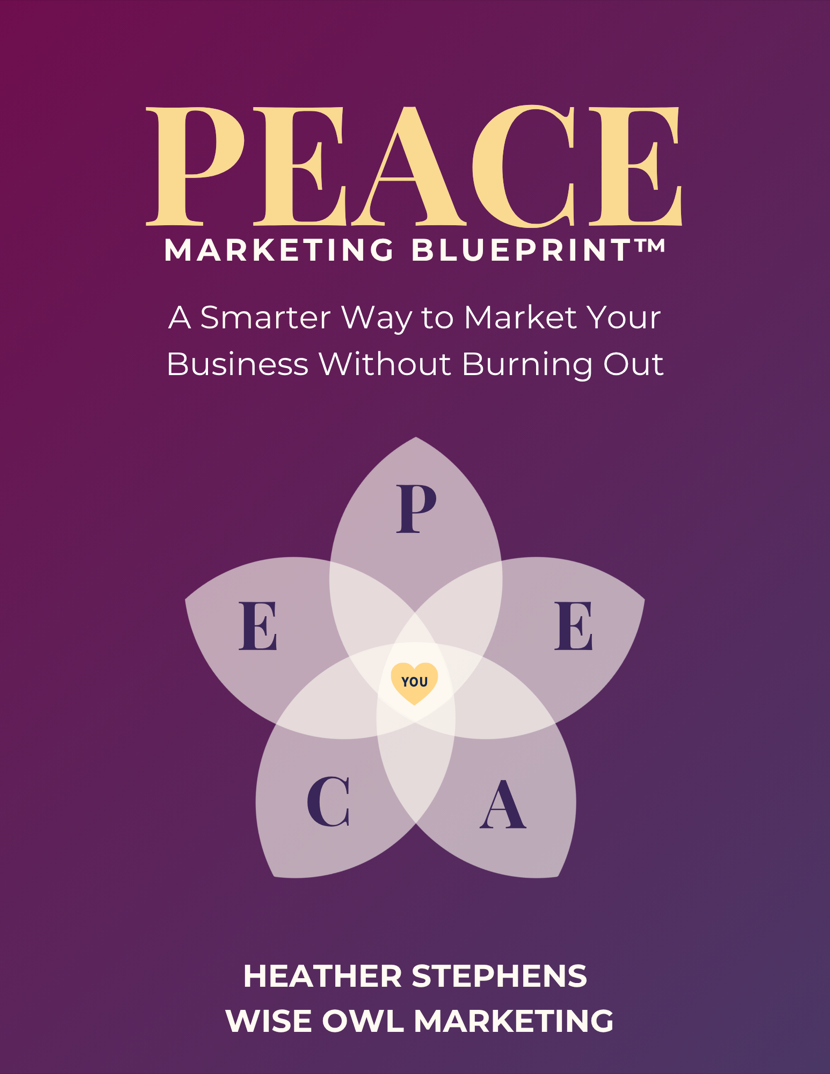

Heather C. Stephens
25+ years in marketing and 11 helping coaches and service providers get found online without burning out. Founder of Wise Owl Marketing and creator of PeacefulBiz and the PEACE Blueprint.
More about Heather →Keep reading
Get peaceful marketing ideas delivered to your inbox each week.
One practical idea at a time, written like a note from a friend who happens to know marketing. Read it and try it that afternoon.