
Quick Summary: Most coaches run out of content ideas not because they lack creativity, but because nobody showed them where to look. These five sources work every week without brainstorming or AI: your client questions (and the question behind the question), the overflow moments from your real life, your existing content approached from a new angle, the signals your audience is already sending you, and your own past notes and unfinished ideas. Pick one source, spend ten minutes with it, and you have your next piece of content.
Subscribe to our YouTube Channel
Some weeks, the cursor just blinks at you.
You love your work. You know your topic inside and out. But the pressure to say something new and brilliant every single week has quietly drained the well, and today your mind is blank. You need an engaging content idea, but right now, you've got nothing.
Here's what I want you to know: you're not out of ideas because you're not creative enough. You're out of ideas because nobody ever showed you where to look.
Everyone says the answer is to ask ChatGPT for 30 video ideas. But AI doesn't know your clients. It doesn't know your stories. Generic prompts only produce generic content, and generic content doesn't connect with anyone.
You don't need an algorithm to tell you what to say. You need a system for noticing what's already happening in your business.
That's exactly what this post is about. Five sources I go back to again and again, none of them requiring a brainstorm, an AI tool, or a single flash of inspiration. Once you know them, that blank screen stops being a brick wall and starts being an invitation.

I'm Heather Stephens. I've been doing online marketing for over 27 years, and for the last 11, I've worked specifically with coaches and service providers who are great at what they do but stuck on the marketing side. When I talk about content, I'm not talking theory. I'm talking about what actually works for people like you.
Let's get into the five sources.
Source 1: Mine Your Client Questions
The first place to look is the simplest one, and it's already sitting in your inbox, your DMs, your client calls.
Your clients are asking you questions every single day. And every single one of those questions is a content idea, already framed in the exact words your audience uses.
You may have heard this one before. Mine your client questions. Answer the ones you're tired of answering. Yes, do that. But here's where most people stop: they stay at the surface. They answer the question that was asked, and they completely overlook the question behind the question.
Let me show you what I mean. Say you're a weight loss coach. A client asks, "How do I lose weight?" That's the surface question. The real question underneath it might be, "How do I not undo everything I worked for all week when my weekend is kids' activities, a family gathering, dinner out, and no routine at all?" Or, "How do I stop sabotaging my progress every time life gets stressful?"
That's the question worth answering. And only you can hear it, because you've sat in enough sessions to know the surface question is almost never the real question.
Think about the last question a client asked you on a call. Maybe it was "How do I know if I'm ready to leave my marriage?" Or "Why do I keep self-sabotaging every time things start going well?" Or "How do I ask for a promotion without sounding desperate?" If one person is asking it, fifty more are Googling it. And underneath every one of them is a second question they didn't know how to ask.
So here's what I want you to do. Start keeping a list. A note on your phone, a sticky note on your desk, a running doc, whatever works for you. Every time a client asks you something, write it down in their words. Then right underneath it, write the question behind the question. Don't filter it. Don't decide if it's worthy. Just write it down.
That list is your content calendar. You don't need a strategy session or a brainstorm. You need to pay attention to the conversations you're already having, and listen one layer deeper.
Source 2: Teach From the Overflow
The second source is one most people overlook, even though it does a wonderful job of building connection with your audience.
It's the stuff happening in your life right now.
I went to a funeral this weekend. And before I even left the parking lot, that experience had become a potential piece of content. The pastor stood up and said that the greatest gift this man left behind was time. Time he gave to the people he loved, and a moment to reflect on the time we have left and decide how we want to spend it. Sitting there, I found myself asking: am I doing that? Am I giving my family my very best? Is my business built around the life I actually want, or am I just grinding through it?
That moment became a piece of content before I left the parking lot. Not because I was trying to turn it into something, but because it moved me, and I knew it would be meaningful for my clients too.
That's teaching from the overflow.
Here's another one. My husband decided to grow garlic in our garden. Eighty cloves. We were so excited to pull these big fat bulbs out of the ground at harvest time. Every single one was tiny. Turns out, garlic in our growing zone has to go in the ground the first week of October, scapes trimmed in June, and harvested the first week of July. No exceptions. Mother Nature does not negotiate.
And I thought: that's exactly what happens when a coach tries to launch before they've built trust, or when a client expects a breakthrough in week two. You can't shortcut the season.
That moment in the garden became a blog post.
A conversation with your kid. A book you couldn't put down. A walk where something finally clicked. These are not distractions from your content. They're the content, as long as you make the turn back to your audience.
Here's the practice. Keep a note on your phone called "overflow." Any time something strikes you, a quote, a moment, a question you can't stop thinking about, drop it in. Don't worry about whether it's a video yet. Just catch it. The connection almost always shows up later.
Source 3: Mine Your Existing Content
The third source is one most people walk right past, because they think content they've already made is content that's done.
It's not. It's a starting point.
A few years ago I wrote a blog post about sales funnels. Standard marketing topic. But then my daughter was shopping for her wedding dress, and I went with her, and what happened in that bridal shop was the most perfect funnel I had ever seen in my life.
You walk in, you try on dresses, you fall in love with one. Then they ask about the veil. Then the alterations. Then cleaning and preservation. Then whether you want to rush the order. Every single step was a yes or no offer, perfectly sequenced, completely natural. It was a funnel, just not a digital one.
So I wrote about it. Same topic, completely different angle. And that post connected with people who had glazed over my other funnel content, because this time they could see themselves in the story.
That's the opportunity sitting in your content library right now.
Go back and look at what you've already made. Not to recycle it lazily, but to ask: is there a fresher way in? A different angle that would reach someone my other version didn't?
Here are the lenses you can use to approach any topic you've already covered:
Story. The moment from your own work that taught you this.
Belief. What your client believes about themselves that keeps them stuck, "I'm just not consistent." You don't debunk it, you move the cause off the person.
Opinion. What most people in your field would push back on. Say it anyway.
Framework or System. Your repeatable way through the problem, walked step by step.
Insight. The thing you've noticed that your audience hasn't yet.
Problem or Obstacle. Name the frustration and leave it unresolved. Let the post be the resolution.
Myth. What your reader believes about the industry that isn't true.
Mistake. What you watch people do wrong, over and over.
Question or Objection. What clients actually ask on a call, or push back with.
Metaphor or Analogy. The comparison that makes it click. Sales funnels. Bridal shops. Same thing.
You don't need new ideas. You need new angles on the ideas you already own.
Source 4: Look for the Signals
The fourth source is about paying attention to what's already working. Because your audience is telling you what they want. You just have to look.
Start with your own numbers. Your insights and analytics show you which posts, videos, and emails people actually watched to the end, saved, shared, or replied to. That's not just data. That's your audience raising their hand and saying, "more of this, please." Take the topic that performed and go deeper on it, or come at it from a new angle using one of the lenses from source three.
But engagement only tells you part of the story. Here's my favorite way to find the signal that matters most. One coach I worked with added a single question to her intake form: "Which piece of content did you watch, read, or listen to right before you reached out to book this call?" That one question told her which content was actually bringing her clients, not just which content was getting likes. Your analytics show you engagement. That question shows you conversions. Add it to your intake form or ask it on your discovery calls, and you'll never have to guess again about which content to make more of.
And then look one step outside your own lane. Adjacent niches are full of ideas you haven't touched yet. If you're a career coach, look at what mindset coaches, habit coaches, and productivity coaches are teaching. Their audience overlaps with yours, and when you bring one of their ideas through your specific lens, it becomes yours.
Source 5: Steal From Your Past Self
The fifth source is you. Not you today. You from six months ago, two years ago, ten years ago.
Most coaches have a graveyard of half-formed ideas that are actually quite good. Journal entries. Old notes on your phone. The email you wrote to a client that turned into three paragraphs of advice they probably printed out. The video you outlined and never recorded. The course you built and stopped selling. The offer page you wrote and rewrote four times. The idea you jotted down at a red light and never opened again.
I keep a journal on my phone for exactly this reason. The funeral I told you about at the top of this post? That went in the journal first. So do the questions I can't stop thinking about, and the half-thoughts that don't make sense yet. When I go back through it, I almost always find something I'd forgotten I'd already figured out.
None of that was wasted. It was a first draft. So go dig. Open the old notes. Scroll back through the journal. Look in the folder you named "ideas" and haven't opened since. You are not starting from scratch. You are picking up where a past version of you left off, and they were smarter than you remember.
The One Habit That Ties It All Together
You don't need a content calendar. You need five lists.
One for client questions, with the question behind each one. One for overflow moments. One for content you've already made that you want to revisit with a fresh angle. One for signals: what performed, what brought a client in, what an adjacent niche is teaching. And one for your past self: the old notes and unfinished ideas worth going back to.
Keep them somewhere you'll actually use. A note on your phone. A running doc. A sticky note on your desk. Whatever works for you is the right answer.
Once a week, for about ten minutes, look at those five lists and pick one thing. Just one. That's your next piece of content.
You're not starting from scratch anymore. You're choosing from what's already there.
What to Do Next
If generating content consistently feels like the hardest part of your marketing, it's worth asking why. Because most of the time it's not a creativity problem. It's a system problem.
The [Peaceful Marketing Quiz](https://wiseowlmarketing.com/quiz) will help you see exactly where the friction is, and what to focus on first. It takes about three minutes, and you'll walk away with a clear next step.
Frequently Asked Questions
What do I do when I genuinely have no ideas and no client questions to pull from?
Start with source five. Go back through old notes, journals, past content, and unfinished ideas. You have more material than you think. Most coaches discover the ideas they thought were gone were just buried.
Do I need to use all five sources every week?
No. Pick one that fits where you are. On a good week, you might pull from two or three. On a hard week, one is plenty. The goal is to always have somewhere to look, not to work all five lists every time you sit down.
How do I know which content ideas are actually worth making?
The ones that came from a real client question or a real moment in your life almost always are. If you heard it in a session or lived it yourself, someone else needs it. The ideas that feel the most ordinary to you are usually the most valuable to your audience.
What if my existing content isn't performing well enough to mine for new angles?
Then use the lenses from source three to approach a topic you haven't written about yet. Story, opinion, myth, mistake, metaphor. Any topic you know well can be approached ten different ways. Start with the angle that feels most natural and go from there.
Is this approach only for coaches, or does it work for other service providers too?
It works for anyone who serves clients directly. Consultants, therapists, tutors, OBMs, designers. If you have client conversations, a life outside your business, and content you've already made, you have everything you need.
Whenever you're ready, here's how I can help
Start free and go at your own pace. No pressure, ever.
- Free: Keep reading the blog and subscribe on YouTube. I share everything I know.
- DIY: Get the PeacefulBiz app to organize, plan, create, and simplify your marketing.
- Guided: Join the Peaceful Marketing Lab, and let's build together.
- Direct: Book a strategy call for 1:1 help, a custom website, or to decide which program is right for you.
Want the whole framework?
The PEACE Blueprint Guide walks you through all five pillars, with planner pages to build your own peaceful marketing system.
Get the free guide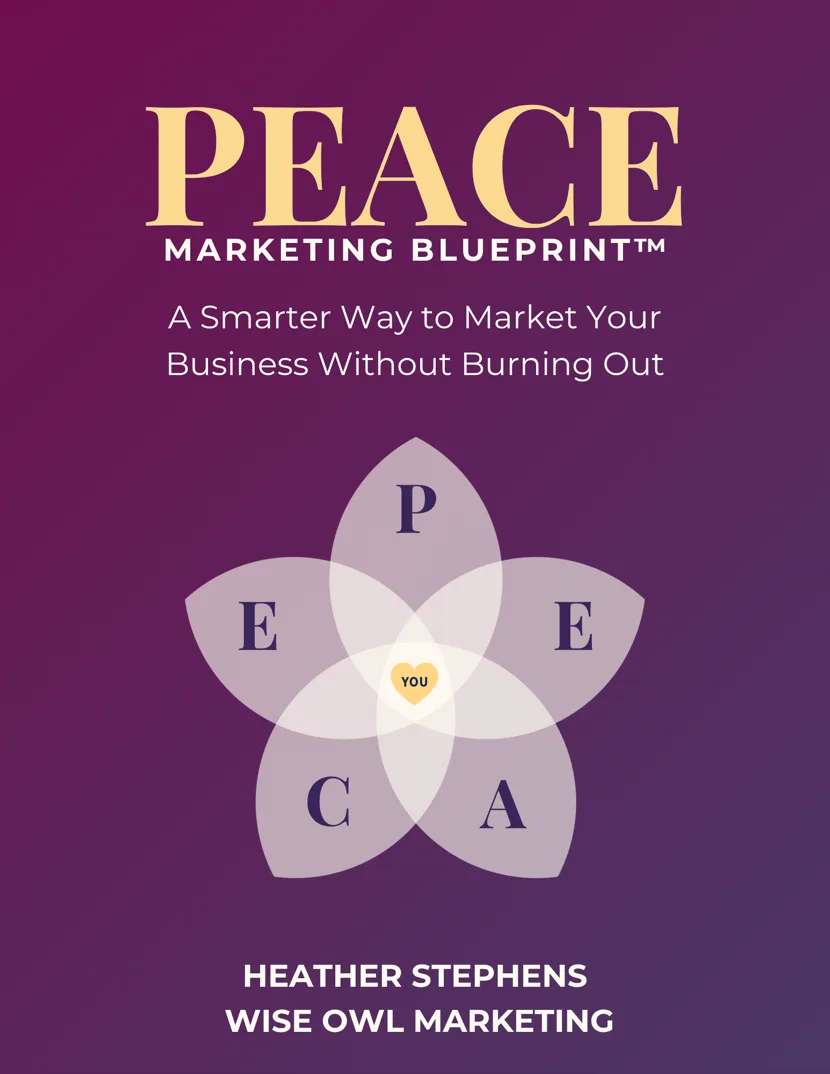

Heather C. Stephens
27+ years in marketing and 11 helping coaches and service providers get found online without burning out. Founder of Wise Owl Marketing and creator of PeacefulBiz and the PEACE Blueprint.
More about Heather →


Get peaceful marketing ideas delivered to your inbox each week.
One practical idea at a time, written like a note from a friend who happens to know marketing. Read it and try it that afternoon.