
Genius Content is long-form, searchable, evergreen content that shares your perspective, insights, opinions, and hard-won lessons, on the topics your ideal clients are already asking Google and AI about. In practice it means blog posts, videos, and podcast episodes published on a site you own, because those three have a far longer shelf life than social media and give you room to build a real relationship. Every genius piece answers a question, handles an objection, and ends with an invitation to join your email list, so the relationship keeps going after they close the tab.
The perspective is the part that matters. Anyone can now generate a competent, correct, forgettable article about your topic in seconds. Nobody else can write what you learned sitting across from a client in 2019, or why you changed your mind about something you used to teach.
I call it Genius Content because it comes out of your genius, which is the raw material you have been accumulating for a whole career. Client stories. The analogy you always reach for because it finally made something land. The framework you built because nothing on the market fit. The opinion you hold that most of your industry does not. Your genius is the raw material. Genius Content is what you publish from it.
What Counts as Genius Content
Blog posts, videos, and podcast episodes. I focus on those three for two reasons.
Shelf life. A social post has a working life measured in hours. A blog post you wrote three years ago can still be the reason somebody books a call with you this afternoon, and it can keep being that reason for years, in Google and in AI tools like Claude and ChatGPT.
Room. A real question from a real client usually takes more than a few words to answer properly. Long form gives you the space to answer it fully with context, and answering it fully is what earns trust. A caption cannot do that.
Video and podcast count fully, as long as the episode lives on your own site with text beside it: a summary, show notes, or a transcript. Search engines and AI tools read the text, not the video. This is also why I suggest you publish one thoughtful piece a week, bi-weekly, or monthly on your own site, rather than five short posts a week on somebody else’s platform. Pick a cadence you can maintain without burning out.
A social post | A genius piece | |
|---|---|---|
Where it lives | On a platform that can change the rules or close | On a site you own |
How long it works | Hours, sometimes a day | Years, and it gets easier to find over time |
How people find it | An algorithm decides whether to show it | Somebody types the question you answered |
What it can do | Remind people you exist | Answer the question, handle the objection, and ask for the opt-in |
A year later | Gone, and you owe the algorithm another one | Still bringing in people who have never heard of you |
Every Genius Piece Has a Call to Action
A call to action turns content into marketing.
A genius piece does a specific job, in order. It answers the question they came in with. It earns a bit of trust by being genuinely useful instead of a teaser for the useful version. It handles an objection they were quietly holding. And then it invites them to opt in to your email list, usually with a lead magnet that goes one step further than the piece itself.
That opt-in is the whole point of the exercise. Once they are on your list, you can keep nurturing that relationship so whenever they are ready to buy, you are the person they think of.
Content that informs somebody and then lets them wander off has done half of its job. Every genius piece gets a call to action.
Where the Topics Come From
Your framework decides your topics, rather than whatever you feel like writing about on a Tuesday.
Take the pillars of what you teach and list ten questions your clients frequently ask inside each one. Five pillars, ten questions each, and you have fifty pieces, which is about a year of publishing weekly. Every one of them is a question somebody is already typing into a search bar or their AI tool, and every one of them sits inside a topic you want to be known for.
Random content is busy work disguised as marketing.
If you want help picking which question to answer first, choosing the right keyword covers how to tell which phrasing people actually search, and the Content Constellation covers how one genius piece fans out into everything else you publish that month.
Where Genius Content Fits
Genius Content belongs to Express Magnetically, the first layer of the PEACE Blueprint. It is the part of the framework where you say the thing clearly and then say it somewhere it will last.
It is also the first of the four assets in a Marketing Emergency Fund, and the one most people build first, because it is the asset that keeps introducing you to strangers during the stretches when you cannot show up at all.
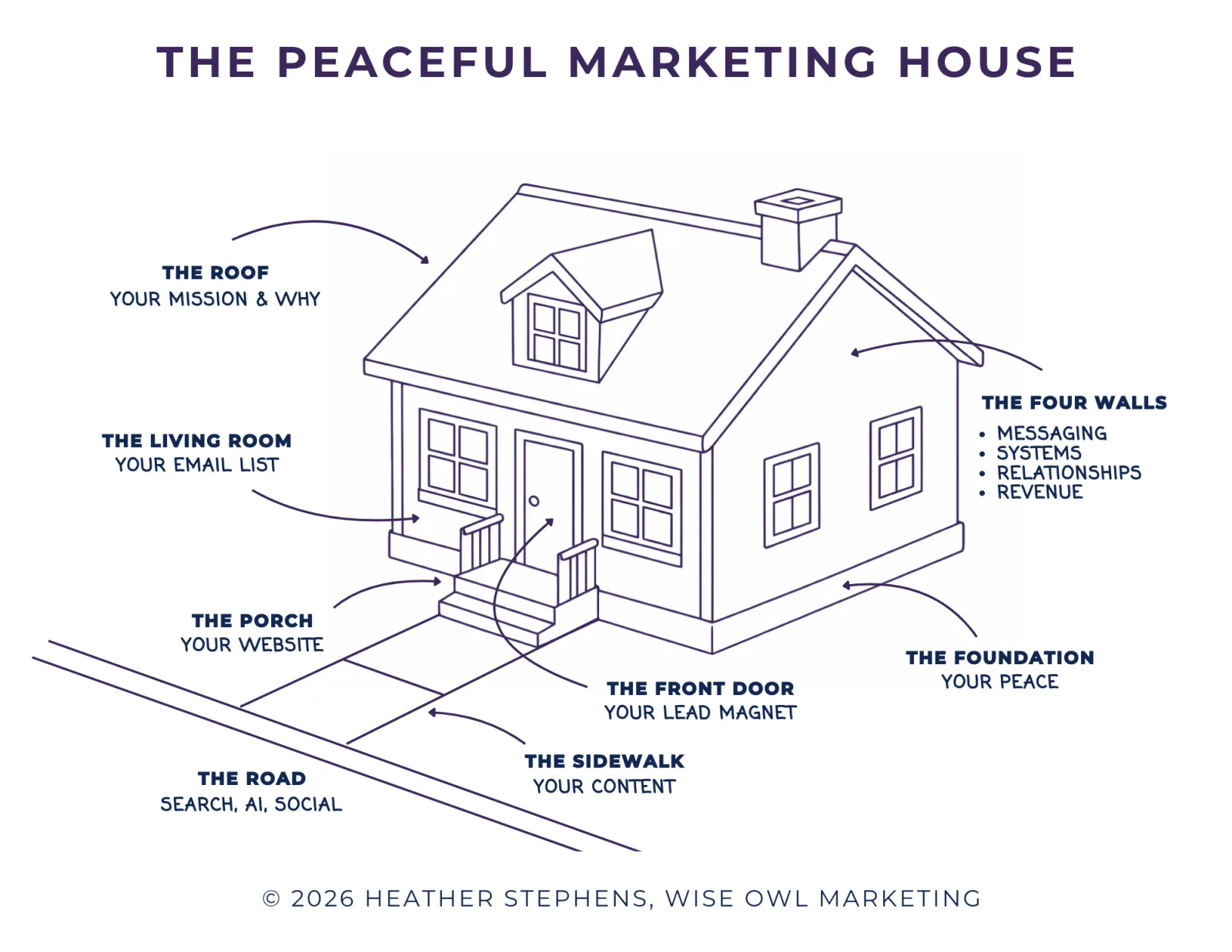
In the house I use to describe all of this, your Genius Content is the sidewalk. The road is search, AI, and social, and you do not own the road. The sidewalk is what brings somebody from the road to your front door.
Here is the part that convinced me. When I looked at traffic across my own coaching clients, the ones publishing blog content alongside their email and social were getting somewhere between 2,000 and 13,000 visitors a month. The ones with no blog were getting about 70.
This doesn't mean you have to be a writer. Remember, you can do a podcast or a video embedded into a blog with show notes, a summary, or a transcript turned into a blog.
Just focus on answering questions your clients ask and sharing your unique genius in a long-form content format that lasts.
Frequently Asked Questions About Genius Content
How is Genius Content different from just blogging?
Two things. It carries a point of view that could only have come from you, so it is not something a reader could get from any of the other twelve results. And it is chosen deliberately from the pillars of what you teach, rather than picked because it was interesting that week.
Does Genius Content have to be written?
No. Video and podcast count, and if talking is where you are strongest you will make better work that way. The requirement is that the piece lives on a site you own with text alongside it, because the text is what search engines and AI tools actually read.
What is the difference between my genius and my Genius Content?
Your genius is the raw material: your stories, analogies, frameworks, lessons, and opinions, most of which have never left your head. Genius Content is what you publish from it.
Does social media count as Genius Content?
Generally no, because it stops working almost immediately and it lives on property you do not control. Social is useful for pointing people toward your genius pieces. YouTube and Pinterest are the gray area, since both have a much longer shelf life than the rest, and both work best when the video or pin also lives on your own site.
Can I use AI to write Genius Content?
For the parts that are not the point, yes. Outlining, tightening, headlines, turning one piece into five. The perspective, the stories, and the opinions have to be yours, because those are the only part of the piece a reader cannot get anywhere else. Using AI without losing your voice goes through where the line sits.
How often do I have to publish?
Whatever cadence you can hold through a bad month. One piece a week is plenty, one every other week works, one a month works. Search-based content is slow to start and compounds later, so the honest measure is not this week’s traffic, it is whether you have more pieces out there working for you this quarter than last quarter.
How many pieces do I need before it starts working?
There is no threshold number, and any figure I gave you would be invented. What I can tell you is that it builds slowly and then holds. The pieces I wrote years ago are the ones still bringing people in now.
Whenever you're ready, here's how I can help
Start free and go at your own pace. No pressure, ever.
- Free: Keep reading the blog and subscribe on YouTube. I share everything I know.
- DIY: Get the PeacefulBiz app to organize, plan, create, and simplify your marketing.
- Guided: Join the Peaceful Marketing Lab, and let's build together.
- Direct: Book a strategy call for 1:1 help, a custom website, or to decide which program is right for you.
Want the whole framework?
The PEACE Blueprint Guide walks you through all five pillars, with planner pages to build your own peaceful marketing system.
Get the free guide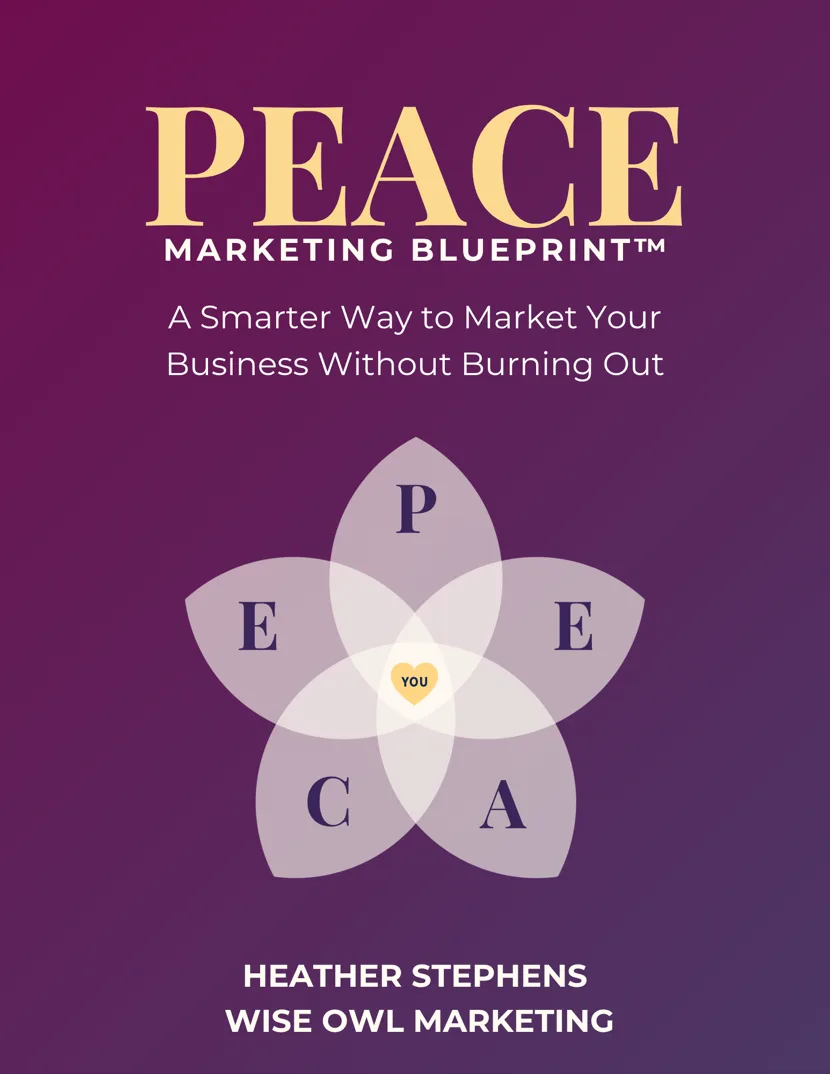

Heather C. Stephens
27+ years in marketing and 11 helping coaches and service providers get found online without burning out. Founder of Wise Owl Marketing and creator of PeacefulBiz and the PEACE Blueprint.
More about Heather →


Get peaceful marketing ideas delivered to your inbox each week.
One practical idea at a time, written like a note from a friend who happens to know marketing. Read it and try it that afternoon.