
Stop using AI as a vending machine that produces output, and start treating it as a thinking partner. Bring your own brain to it: your frameworks, your wisdom, your hard-won insights. Most of the work is upfront, giving it enough context and voice guidance that it supports your identity instead of replacing it. The rule of thumb is 70/30. Let AI do the heavy lifting, and keep the final thirty percent, the nuance, the soul and the editing, strictly human.
I think I've always used AI differently.
When most people talk about using AI for their business, they're talking about speed. Efficiency. Getting more done in less time. And I understand the appeal, who doesn't want that?
But here's the question I kept asking, and the one this post answers: how to use AI without losing your voice. How do you get the efficiency without sounding like everyone else? From the beginning, I approached AI as a partner, not a vending machine. Whether you're using ChatGPT, Claude, or another AI tool, the principles are the same—and they're different from what most "AI for business" content teaches.
What I've discovered over the past few years isn't how to produce more content. It's how to think more clearly, work more sustainably, and show up more authentically, even when life gets loud.
The AI Transaction Trap that Strips Your Authentic Voice
Here's how most coaches use AI:
They type "write me 5 social media posts about boundaries" and hit enter. They get five posts. They're... fine. Generic. They sound like everyone else's posts about boundaries.
Then they wonder why their audience isn't engaging.
I call this the vending machine approach. You insert a generic request, you get a generic result. The AI doesn't know your philosophy. It doesn't know your clients. It doesn't know that when you talk about boundaries, you're actually talking about sovereignty and self-trust, not just saying no to things.
The vending machine approach fails because AI without context produces content without soul. In fact, 76% of consumers report feeling frustrated when the interactions they have with a brand aren’t personalized. When we post generic AI content, we aren't just being efficient; we are actively creating friction with our audience.
One of my clients, Dr. Gwyn, a writing coach and therapist, described this perfectly when she first started working with AI: "It makes me feel fraudulent." She could feel the disconnect between what AI was producing and what she actually believed. The words were technically correct, but they weren't hers.
That feeling? It's information. It's telling you something important about how you're using the tool.
Here's the difference at a glance:
| Category | Using AI to Complete Tasks and Transactions | Using AI to Architect Transformation |
|---|---|---|
| Mindset | "Give me content" | "Help me think" |
| Input | Generic prompts | Your frameworks + context |
| Output | Sounds like everyone else | Sounds like you |
| Relationship | Transactional | Collaborative |
| Time | Quick but repetitive | Upfront setup, exponential returns |
| Result | More content | More clarity |
The Aligned AI Architect's Mindset: BYOB - Bring Your Own Brain
Provide structure that protects your voice.
The shift that changed everything for me was moving from execution to architecture.
Instead of asking AI to create something from nothing, I started bringing my own brain to the conversation, giving it my frameworks, my own philosophy, my own client language to every conversation. I became the architect, aligning AI to become my building partner.
When I approach AI this way, the output isn't generic. It's an extension of thinking I've already done. It's my ideas, organized. My frameworks, applied. My voice, amplified.
Another client, Maggie, described the shift this way: "It's an extension of my voice, not a replacement for it." That's the architect's mindset in action.
Here's what this looks like in practice:
Give AI Context to Understand Your Coaching Business
Try This: Before your next AI session, write a brief context paragraph:
"I'm a [type of coach] who helps [specific people] achieve [specific transformation] through [your unique approach]. My clients often struggle with [common challenge]. My philosophy is [core belief]."Feed that to AI first. Then ask your question. The difference in output will astound you.
While the Aligned AI Architect's mindset requires more upfront setup, the returns are exponential. Brands that use AI to scale while maintaining a distinct, human-aligned voice have seen click-through rates improve. It turns out that being 'unmistakably you' is actually a high-performance business strategy.

My #1 Tip for How to Use AI without Losing Your Voice:
Build a Relationship with AI, Instead of Just Running a Tool
This might sound strange, but I've developed a relationship with AI.
Not in a weird way. In the same way you might develop a relationship with a great editor, a thinking partner, or a colleague who challenges your ideas and helps you see what you're really trying to say.
Having a good relationship with Claude or ChatGPT is my secret behind how I use AI to create content that actually sounds like me.
My client Roseanne said something that made me laugh: she wanted to "go be friends and play on the swing set with Claude." What she meant was that working with AI felt playful, creative, collaborative, not transactional. Not extractive.
This relationship develops over time. The more context you share, the more useful AI becomes. The more you treat it as a thinking partner, the better your thinking gets.
I have Claude Projects set up for different areas of my business. Each one has context about that specific domain, my philosophy, my frameworks, examples of my voice, and information about my ideal clients. When I work within those projects, AI already knows the landscape. We can dive into real strategic thinking instead of starting from scratch.
Training AI to Sound Like You
Try This: Create a "voice document" that captures how you communicate. Include phrases you use often, words you never use, and the tone you aim for. Share this with AI and ask it to review something you've written for voice consistency. You'll be amazed at what it catches.
Sharing your voice document helps the AI get closer to your style, but remember the '70/30' rule. AI is brilliant at getting a draft to 70% completion, but that final 30%, the nuance, the shared history with your clients, and the soul, is a human-only advantage that builds real trust.

If you want the mechanics rather than the mindset, the four-part prompt structure covers how to write a prompt that returns something worth editing.
The Questions That Unlock the Real Power of AI
Shift from task completer to thinking partner.
The most powerful shift in my AI use came when I stopped asking AI to write and started asking it to think.
Instead of "Write me a blog post about client attraction," I ask:
- "Help me understand why my ideal clients resist marketing themselves."
- "What's the tension between wanting to grow and wanting to keep things simple?"
- "Challenge my assumption that coaches don't want to hear about systems."
These questions lead to insights I wouldn't have reached alone. Not because AI is smarter than me, but because the act of articulating the question clarifies my own thinking, and AI can hold space for exploration in a way that feels non-judgmental.
This is where the real magic happens. Not in content production. In content conception.
This is How to Use AI Without Losing Your Voice: My Step-by-Step Process
- Bring your unique frameworks, stories, concepts, and ideas to AI.
- Ask AI thinking questions to help you go deeper, find different angles, and discover the nuances.
- Uncover key topics you want to include in your content and keywords you want to target.
- Work with AI to draft the outline based on your conversation. Dance with it until you get it right.
- Then let AI write your first draft.
- Take the draft and make it yours, add your stories, refine anything that doesn't sound like you, and publish.
Want to learn more about this: Read How to Use AI for Content Creation
Try It for Yourself: Thinking Questions to Ask AI
Instead of asking AI to write, try asking it to think:
- "Help me understand why my ideal clients resist ."
- "What are the unspoken fears someone might have about ?"
- "Challenge my assumption that ."
- "What patterns do you notice in what I've shared about my work?"
- "Where might my messaging be creating unintended pressure?"
- "What's the tension between what my clients say they want and what they actually need?"
Presence Over Permanence
In 2024 and 2025, the stress levels I experienced in my life spiked.
My father-in-law's health declined rapidly. My daughter, who lived three hours away, was wrestling with a high-risk pregnancy. Driving back and forth to help her cut deeply into my available work time. I got an ADHD diagnosis that explained decades of my life. Two key team members moved on. My beloved dog died. And my husband had a cancer scare that, thankfully, turned out to be nothing, but those weeks of waiting were some of the hardest of my life.
During all of this, I made a self-honoring decision: I stopped posting on social media. Completely. For over a year now, I've posted almost nothing.
And here's what happened: my business kept running.
Not because I had magically built something that worked without me. But because I had spent years building systems, email sequences, lead magnets, blog posts, referral relationships, that continued to work while I focused on what mattered most.
This is the content part of my marketing emergency fund. It's different than a social media savings bank of extra posts that you can dip into when you're short on time. Instead, it's a bank of searchable, long-lasting content assets that keep driving traffic, leads, and sales for years to come.
AI didn't help me post more. It helped me need to post less.
My goal has shifted. I am not on a mission to help my clients build marketing systems that work. My goal is to help them simplify the content creation process so they can build marketing that keeps working, even when everything falls apart.
This has all come from the difficult season I'd been through. It's not about hustle. It's about clarity. About knowing what matters and building systems that support it.
For example, last month, I helped my Peaceful Marketing Lab members create their own AI Visionary Coach in Claude to help them reflect on their quarter or year, analyze what's actually working, and build an aligned plan for the year ahead. This month, we're building custom AI content creation systems so they can use AI for content creation without burning out or sounding like everyone else. Content that deeply serves their audience while allowing them to grow thriving businesses and live happy, balanced lives.
This is what peaceful marketing has always been about. Not leaving the biggest footprint. Not building monuments to prove we existed. But creating work that's an expression of who we are, and trusting that's enough. AI, used well, doesn't make you more productive. It makes you more present.
Frequently Asked Questions About AI for Coaches
Can coaches really use AI without it sounding robotic?
What's the best AI tool for coaches?
Will my coaching clients know I'm using AI?
How much time does it take to set AI up as a thinking partner?
Is using AI for my coaching business cheating?
What if AI gives me bad advice for my coaching business?
Can AI help me figure out what makes my coaching unique?
As she said, "There was nothing in there that I didn't know... But it put it together in this really affirmative, respectful package." AI can be the mirror that helps you see what you already know.
Your Voice is the Soul of Your Coaching
At the end of the day, how to use AI without losing your voice isn't about finding the perfect prompt; it’s about maintaining the architect’s mindset. When you stop asking AI to be you and start asking it to think with you, the technology stops feeling like a threat and starts feeling like a supportive partner.
You don't have to choose between modern efficiency and authentic presence. By leading with your values and using AI to amplify your natural insights, you can create a business that feels as spacious and honest as the coaching sessions you lead.
Want Help Learning How to Align AI Without Losing Your Voice?
It starts with knowing where you stand. Take the free Peaceful Marketing Assessment to discover your marketing strengths, what's draining your energy, and your personalized next step toward a business that works even when you're not online.
Already know you want support? Explore the Peaceful Marketing Lab.
Whenever you're ready, here's how I can help
Start free and go at your own pace. No pressure, ever.
- Free: Keep reading the blog and subscribe on YouTube. I share everything I know.
- DIY: Get the PeacefulBiz app to organize, plan, create, and simplify your marketing.
- Guided: Join the Peaceful Marketing Lab, and let's build together.
- Direct: Book a strategy call for 1:1 help, a custom website, or to decide which program is right for you.
Want the whole framework?
The PEACE Blueprint Guide walks you through all five pillars, with planner pages to build your own peaceful marketing system.
Get the free guide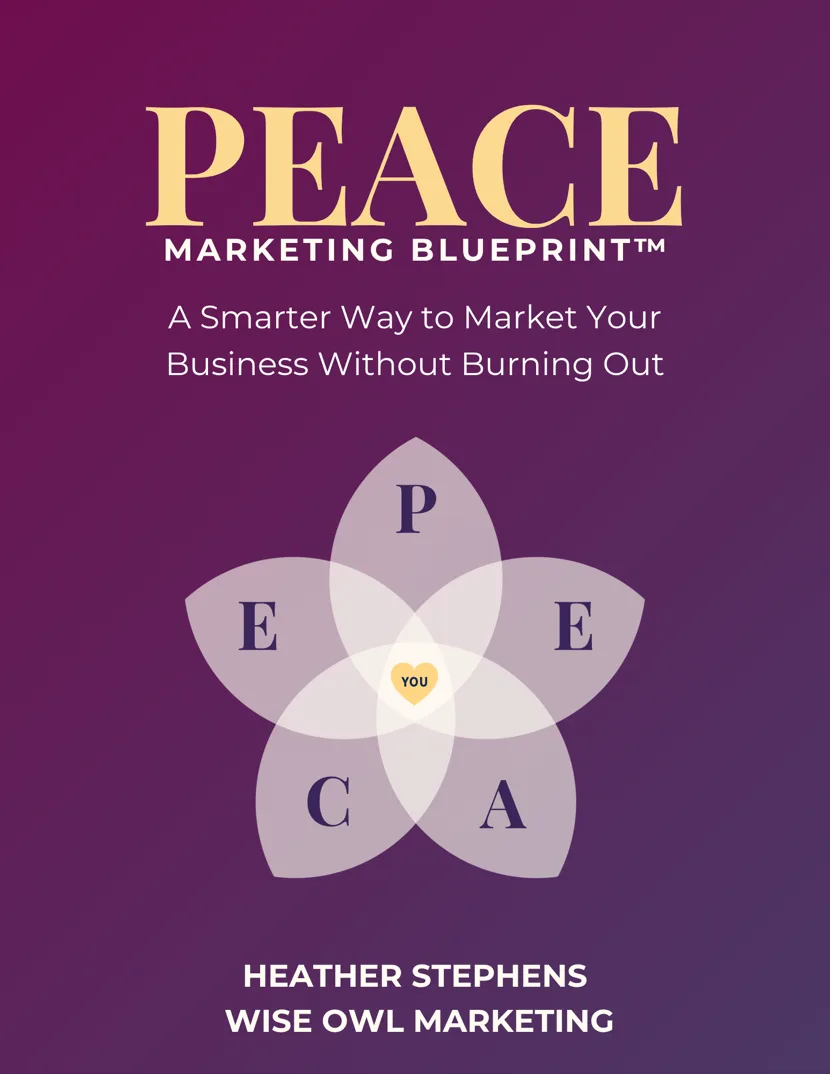

Heather C. Stephens
27+ years in marketing and 11 helping coaches and service providers get found online without burning out. Founder of Wise Owl Marketing and creator of PeacefulBiz and the PEACE Blueprint.
More about Heather →


Get peaceful marketing ideas delivered to your inbox each week.
One practical idea at a time, written like a note from a friend who happens to know marketing. Read it and try it that afternoon.