
Twelve ways to find blog post ideas, so you can pick the one that fits how you think rather than working through all of them. Some start from your own expertise, some from what your audience is already asking you, and some from search data. Pick one, work it properly, and you will come out with more topics than you can write.
Originally published January 2017. Updated by Heather Stephens, November 2025.
In my recent post, Should You Start a Business Blog in 2026 to Get Clients, I explained why blogging is still one of the most effective ways to get coaching clients in 2026. Now let's tackle the biggest hurdle: figuring out what to write about.
If you're staring at a blank screen wondering what to write about this week, I totally get it. Coming up with fresh blog post ideas can feel like one more thing on your never-ending to-do list.
Here's the thing: you don't need to reinvent the wheel every time you sit down to write. You just need a system that makes brainstorming blog topics as easy as opening your cookbook or checking your calendar.
In today's post, I'm going to show you 12 methods that'll give you more blog post ideas than you'll ever need, without the overwhelm.
These aren't random tips or theory. These are the exact strategies I have been using for myself since 2009 and with clients to create content calendars that actually get filled out and followed. (The exception is AI, which only came onto the scene a few years ago.) Bottom line - they work, and I know, without a doubt, there's a method that will work for you!
Pick one method, block 30-60 minutes on your calendar, and brainstorm your next month of topics. Once you've got your content plan in place, blogging stops feeling like a chore and starts feeling like a system that works for you instead of running your life.
Not sure which one to start with?
⚡ Need ideas FAST? → Start with Method #7 (ASK Method) or #9 (Social Butterfly)
📚 Love structure? → Use Method #1 (Cookbook) or #2 (Signature System)
🔍 Data-driven? → Try Method #8 (Researcher) or #3 (Buying Stage)
💡 Creative thinker? → Go with Method #5 (Myth Buster) or #6 (Thought Leader)
🎯 Want specific audiences? → Use Method #11 (Niche-Specific) or #12 (Demographics)
Before We Get to the Methods: A Few Essentials That'll Make Your Blogging Actually Work
If you're going to invest time in blogging, let's make sure it's time well spent. Here are the practices that separate content that converts from content that just sits there:
Know who you're writing for. Your blog isn't for everyone, it's for your ideal client. Write like you're having a conversation with them specifically.
Use a content calendar. Plan your topics ahead of time so you're not scrambling every week. Future You will be so grateful. (Need help? Download Your Free Marketing Planner!)
Block time to actually write. If it's not on your calendar, it won't happen. Schedule time each week to write, optimize for SEO, and share your post.
Start with a compelling headline. Your title should promise a solution or outcome. Make it clear what they'll get by reading.
Make it easy to read. Use subheadings, bullet points, and white space. People skim first, hook them, then they'll read deeper.
Always include a call to action. Every post should invite readers to take the next step, book a call, grab a resource, join your email list. Don't leave them hanging.
Promote your posts. Publishing isn't enough. Share on social, send to your email list, and repurpose the content. One blog post should give you a week's worth of marketing material.
Now, let's get into the 12 methods that'll keep your content calendar full all year long.
12 Proven Ways to Generate Blog Post Ideas to Grow Your Coaching or Service Business

1. The Cookbook Method: Organize Your Expertise Like Recipes
Go grab a cookbook from your kitchen. See how it's organized into chapters: Appetizers, Main Dishes, Desserts, Side Dishes?
Your expertise works the same way.
Here's how to use it:
Start by identifying 5-10 main categories in your niche. These are your "content pillars." For example, if you're a health coach, your pillars might be Nutrition, Exercise, Mindfulness, Stress Management, and Healthy Recipes.
Now, under each pillar, brainstorm 10 article ideas. That's 50 blog posts right there, one for every week of the year.
Your pillars keep you focused on what you want to be known for, and the subtopics give you endless angles to explore.
Example content pillars for different coaching niches:
- Business Coach: Marketing, Sales, Operations, Mindset, Team Building
- Life Coach: Goal Setting, Relationships, Career Transitions, Self-Care, Personal Growth
- Career Coach: Resume Writing, Interview Skills, Networking, Salary Negotiation, Career Pivots
- Relationship Coach: Communication, Conflict Resolution, Intimacy, Boundaries, Dating
2. The Signature System Method: Turn Your Process Into Content
Your coaching process is a content goldmine. Every step you take clients through can become multiple blog posts.
Here's how to map it out:
- Write down everything you do with clients (one task per sticky note)
- Group similar tasks into piles. These become your main steps
- Arrange the piles in order (aim for 3-12 steps total)
- List 5-10 blog post ideas for each step
The magic happens when you link these posts together. When someone reads about Step 3, you can say, "Check out this post on Step 4" or "Ready to work through all these steps together? Book a call."
You're not just creating content, you're widening the gap and giving them context as to where they are in the process and showing them you have a path to help them achieve their goals.
Example from my business:
My signature system has three phases: Empathetic Messaging, Efficient Mechanics, and Engaging Marketing. Under "Empathetic Messaging," I can write about:
- Why You Need to Choose an Ideal Client
- Why You Need a Powerful Brand Promise
- Lead Magnets – What You Need to Know
- The Best Lead Magnet Ideas for Coaches
- Avoid This Huge Website Mistake Many Businesses Make
That's five blog posts from just ONE phase of my system. When you multiply this across all your phases, you have dozens of blog post ideas that naturally connect to your services.
3. The Buying Stage Method: Meet Your Audience Where They Are
Not everyone who lands on your blog is ready to hire you. They're at different stages:
- Awareness: "I think I have a problem"
- Consideration: "I'm exploring solutions"
- Decision: "I'm ready to hire someone"
- Engagement: "I'm already a client or past client"
Create content for each stage. Educational posts for people in awareness. Comparison posts for those in consideration. Case studies and testimonials for decision-makers. Advanced tips and client spotlights for engagement.
When you match your content to where people are in their journey, you send more qualified traffic to your site and increase conversions.
"The more you optimize for context and credibility (not just keywords), the more AI pulls your content into answers for 1 billion+ daily ChatGPT queries."
Sample blog post ideas by stage:
Awareness Stage:
- "Understanding Your [Topic] Needs: How to Identify Areas for Improvement"
- "Common Challenges in [Your Niche]: Recognizing Obstacles You May Face"
- "The Benefits of [Your Service]: How [Your Offering] Can Make a Difference"
Consideration Stage:
- "Comparing Solutions: vs. Other Methods"
- "How [Your Service] Works: A Detailed Look at the Process"
- "Cost and Value Analysis: Understanding the Investment in "
Decision Stage:
- "Why Choose [Your Approach]: What Sets You Apart"
- "Client Success Stories: How Others Like You Thrived with "
- "What to Expect: Your First 90 Days Working Together"
Engagement Stage:
- "Advanced Strategies for "
- "Client Spotlight: Celebrating Your Success"
- "Taking Your Results to the Next Level"
4. The "They Ask You Answer" Method: Build Trust by Being Honest
Marcus Sheridan's book They Ask You Answer (Thanks for using my Amazon affiliate link!) changed how I think about content. The premise is simple: answer the questions your potential clients are actually asking, even the tough ones.
The Big 5 topics buyers care about:
- Cost: What does it cost? Is it worth it?
- Problems: What challenges will I face?
- Comparisons: How does this compare to alternatives?
- Reviews: What do others say about this?
- Best in class: Who's the best at this?
Most coaches avoid talking about pricing or potential problems. But when you address these topics openly, you build trust faster than any sales pitch ever could.
Sample blog post titles:
Cost Topics:
- "How Much Does [Your Type of Coaching] Really Cost?"
- "Is [Your Service] Worth the Investment? A Transparent Look at ROI"
- "How to Save Money When Hiring a [Your Type] Coach"
Problems Topics:
- "Common Challenges When Working with a [Your Type] Coach (And How to Overcome Them)"
- "What to Expect in Your First Month of Coaching"
- "Why Some Clients Don't Get Results (And How to Make Sure You Do)"
Comparisons:
- " vs. : Which Is Right for You?"
- "DIY vs. Hiring a Coach: What You Need to Know"
- "Group Coaching vs. 1-on-1: Pros and Cons"
Reviews Topics:
- "Case Study: How [Client Name] Achieved [Result] in [Timeframe]"
- "Client Success Stories: Transformations from "
- "What to Look for in [Your Type of Coach] Reviews and Testimonials"
Best in Class Topics:
- "The Gold Standard: What Top [Your Niche] Coaches Do Differently"
- "How to Find the Best [Your Type] Coach for Your Specific Needs"
- "Industry Leaders: Who's Setting the Bar in "

5. The Myth Buster Method: Challenge What Everyone "Knows"
Every industry has misconceptions and limiting beliefs. Your job? Call them out.
Write posts like:
- "The Truth About "
- "Common Misconceptions in [Your Niche] Debunked"
- "Why [Popular Advice] Doesn't Actually Work"
When you debunk myths with solid evidence and real examples, you position yourself as a thought leader who tells it like it is, the good, the bad, and the ugly, not just what people want to hear.
Examples of myth-busting posts:
- "Why 'Hustle Harder' Is Bad Advice for Entrepreneurs"
- "The Truth About Overnight Success (It Doesn't Exist)"
- "Common Misconceptions About Life Coaching Debunked"
- "Why You DON'T Need to Post on Social Media Every Day"
- "The Hidden Costs of "
6. The Thought Leader Method: Share Your Unique Insights
You've got experience and perspective that nobody else has. Use it.
Here's how to generate thought leadership content:
- Stay current with industry trends and news
- Identify knowledge gaps your audience has
- Share case studies and personal experiences
- Predict trends based on what you're seeing
- Simplify complex concepts into digestible advice
Try these fill-in-the-blank headlines:
- "The Secret to [Specific Goal]: How [Your Expertise] Can Transform [Ideal Client's] Success"
- "Navigating [Industry Challenge]: [Your Expertise] Strategies for [Ideal Clients]"
- "Discovering the Untapped Potential of [Your Expertise] for [Ideal Clients]"
- "The Roadmap to [Desired Outcome]: [Your Expertise] Insights for [Ideal Clients]"
- "Unlocking the Power of [Your Expertise] to Help [Ideal Clients] Achieve [Desired Outcome]"
Leverage your expertise and insights to provide unique guidance. Simplify complex concepts for your audience and offer a fresh perspective. When you become a source of enlightenment, your readers will keep returning for more.
7. The ASK Method: Let Your Audience Tell You What They Want
Another book, I highly recommend is, Ask: The Counterintuitive Online Formula to Discover Exactly What Your Customers Want to Buy...Create a Mass of Raving Fans by Ryan Levesque. (Thanks for using my Amazon affiliate link.)
This one's simple but powerful: ask your audience what they want to learn about.
Send surveys, run polls on social media, or just pay attention to the questions people ask you in DMs, on discovery calls, or in your Facebook group.
Then create content that directly answers those questions. You're not guessing what they need, you're giving them exactly what they're asking for.
How to implement the ASK method:
- Identify your audience's burning questions. Ask open-ended questions through surveys, polls, or direct interactions. Encourage them to share their challenges and uncertainties related to your industry.
- Segment your audience. Different people are at different stages. A beginner's questions will differ from an advanced practitioner's questions.
- Craft blog post topics as answers. For each segment, create topics that directly answer their questions or address their concerns. These should serve as informative, actionable solutions.
- Prioritize based on demand. Analyze responses to identify which questions are most frequently asked. Prioritize these topics, as they'll likely attract more readers.
- Explore different angles. Don't limit yourself to straightforward answers. Consider how-to guides, case studies, expert interviews, and in-depth analyzes.
By embracing the ASK method, you transform your blog into a valuable resource that directly addresses your audience's needs. This fosters a deeper connection and positions you as a trusted authority.
8. The Researcher Method: Use Data to Guide Your Topics
Let the data tell you what to write about:
- Google Trends: See what topics are trending up in your niche
- Keyword research tools: Find high-demand, low-competition keywords (Ubersuggest is my go-to tool for this!)
- Your own analytics: Look at which posts already perform well on your site
When you write about topics people are actively searching for, you increase your chances of showing up in search results and attracting organic traffic.
How to use the Researcher Method:
- Start with Google Trends and enter relevant keywords related to your industry. Focus on topics with upward trends to capture growing audience interest.
- Use keyword research tools to identify high-demand keywords and phrases. Look for search volume, competition, and related keywords.
- If you already have a website, analyze your traffic data. Identify your most popular blog posts and topics. Use tools like Google Analytics to uncover which keywords drive organic traffic to your site.
By employing the Researcher's Method, you ensure your blog posts align with your audience's current interests and inquiries, increasing the likelihood of attracting organic traffic and engagement.
9. The Social Butterfly Method: Listen to Industry Conversations
Social media is full of questions, discussions, and trending topics in your niche. Tap into it.
Follow relevant hashtags, join industry groups, and pay attention to what people are talking about. When you see the same question pop up repeatedly, that's your cue to write a blog post about it.
Don't just lurk, engage in conversations. Your interactions can spark ideas and help you understand what your audience really needs.
How to implement this method:
- Listen and observe. Start by actively listening to what's happening on social media. Follow industry-specific hashtags, join relevant groups, and focus on discussions within your niche.
- Engage and interact. Respond to questions, offer insights, and share valuable content when appropriate. Your participation can spark blog post ideas based on the questions and challenges people face.
- Ask for input. Don't hesitate to ask your social media followers what topics they'd like to see covered in your blog. Conduct polls or surveys to gauge their interests.
- Stay current. Follow emerging topics and discussions to keep your content relevant. Regularly check trending hashtags and popular conversations.
10. The Skill Level Method: Write for Beginners, Intermediate, and Advanced Audiences
Your audience isn't all at the same level. Some are just starting out. Others are experienced and looking for advanced strategies.
Create content for each level:
- Beginner: "Getting Started with "
- Intermediate: " to Level Up Your "
- Experienced: "Next-Level Techniques for "
This approach lets you cover the same topic multiple times from different angles without repeating yourself.
What to consider for each level:
- What do people at this level in your niche need to know?
- What common questions, concerns, or challenges do they face?
- What do you wish you knew when you were at their level?
- What are the current trends and new developments in your niche?
By tailoring your content to your reader's skill level, you challenge them without overwhelming them. You become a trusted resource and gain a loyal following.
11. The Niche-Specific Method: Speak Directly to Your Specialty
Whether you're a health coach, business coach, relationship coach, or something else entirely, create content that speaks directly to the unique challenges your niche faces.
Get specific. Instead of "How to Set Goals," write "How Health Coaches Can Help Clients Set Sustainable Wellness Goals."
The more specific you are, the more your ideal clients will feel like you're talking directly to them.
Examples of niche-specific angles:
Generic: "How to Manage Stress"
Niche-Specific: "Stress Management Techniques for Executive Leaders"
Generic: "Building Confidence"
Niche-Specific: "How Career Coaches Help Introverts Build Interview Confidence"
Generic: "Setting Boundaries"
Niche-Specific: "Boundary-Setting Scripts for Empathic Relationship Coaches"
12. The Demographics Method: Write for Specific Audiences
Sometimes the best way to connect is to write for a specific demographic: millennials, Gen Z, parents, entrepreneurs, women, men, new parents, empty nesters.
When you tailor content to a specific group's challenges and experiences, it resonates deeper than generic advice ever could.
Sample demographic-focused topics:
For Millennial Coaches:
- "Career Coaching for Millennials: Navigating Job Changes in Your 30s"
- "Financial Coaching for Millennials: From Student Debt to Wealth Building"
For Parent Coaches:
- "Time Management Strategies for Working Moms"
- "Parenting Through Transitions: Supporting Your Teen Through College Applications"
For Entrepreneur Coaches:
- "Business Coaching for First-Time Founders"
- "Scaling Strategies for 6-Figure Service Providers"
For Women:
- "Empowering Women: Navigating Career Challenges and Advancement"
- "Self-Care for Women: Prioritizing Wellbeing in a Busy World"
For Men:
- "Men's Mental Health: Overcoming Stigmas and Seeking Support"
- "Leadership Skills for Men: Thriving in Personal and Professional Life"
One More Bonus Tip: Use AI to Brainstorm
AI tools like ChatGPT and Claude can be your brainstorming buddy. Give it a prompt like:
"Generate blog post ideas for [your ideal client] in [your niche] around [topic]."
Then refine the suggestions to fit your audience and style. AI won't write your posts for you (at least not in your voice), but it's great for getting unstuck when you hit a creative wall.
How to use AI effectively:
- Define your niche and ideal client
- Use specific prompts with context about your audience
- Generate a list of 20-30 ideas
- Select the best ones that align with your expertise
- Add your unique angle and perspective
Caution: Using AI to write your content 100% might bite you in the butt. Here's a study (again by Neil Patel - he's my go-to for SEO stuff) showing that content written by humans performs 5x better than content written by AI.
AI is brilliant at creating generic content, but it can't replicate your wisdom, your specific client experiences, or your unique approach. Use it to generate ideas, then make them your own.
— Heather Stephens, Wise Owl Marketing
Frequently Asked Questions About Generating Blog Post Ideas
How do I know which blog post ideas to prioritize?
Start with the ASK method, create content around the questions your audience is actually asking. Then use the Researcher method to identify which topics have search volume. Prioritize ideas that intersect: high audience interest + decent search volume + aligned with your services.
What if I run out of things to say about my topic?
You won't. Use the Skill Level method to write the same topic for beginners, intermediate, and advanced audiences. Use the Demographics method to tailor content for different groups. Update and refresh old posts with new insights. Your perspective evolves, so your content should too.
How many blog post ideas should I brainstorm at once?
I like to aim for at 1-3 months of weekly content. This gives you enough runway to stay consistent without feeling overwhelmed. Plus it gives you flexibility to pivot throughout the year. Join our monthly planning sessions if you want help planning your content!
Should I write about trending topics or evergreen content?
Both. Evergreen content (timeless topics) brings consistent traffic over time. Trending topics can give you short-term traffic spikes and show you're current. Aim for 80% evergreen, 20% timely content.
What if my idea has already been covered by other blogs?
Perfect! That means there's demand for it. Your job isn't to find untouched topics, it's to add YOUR unique perspective, YOUR process, YOUR stories. That's what makes your content valuable and citable by AI tools.
How specific should my blog post topics be?
Specific enough to attract your ideal client, broad enough to have search volume. "Goal Setting" is too broad. "Goal Setting for Health Coaches Who Hate Structure" might be too narrow. "How to Help Clients Set Sustainable Wellness Goals" hits the sweet spot.
Can I reuse blog post ideas from my competitors?
Yes, but don't copy them. See what's ranking well in your niche, then create something better, more comprehensive, more actionable, more aligned with your unique approach. Do not steal, improve on what's already out there with your unique twist!
How do I turn blog post ideas into actual outlines?
Use AI to help! Give it your topic and ask for an outline. Then customize it with your stories, frameworks, and CTAs. Or use the "question method" to turn your topic into 5-7 questions your post will answer, then write a section for each question.
What if I have too many blog post ideas?
Great problem to have! Organize them in a spreadsheet by category, priority, and season. Some ideas will be better for January (goal-setting), others for September (back-to-school energy). Build a content calendar that distributes topics strategically.
Should I create a content calendar before writing?
Yes. A content calendar prevents last-minute scrambling and helps you see themes, avoid repetition, and plan strategic content around launches or seasons. Start simple: a spreadsheet with publish dates, topics, and keywords.
Key Takeaways: Never Run Out of Blog Post Ideas Again
You don't need more ideas; you need better systems. Pick one method from this post (start with the Cookbook Method or your Signature System) and brainstorm your next 30-60 days of topics in one sitting.
Content is your long-term marketing investment. Every blog post becomes a searchable asset that works for you 24/7, unlike social posts that disappear within hours.
Thought leadership beats how-to content every time. AI can generate generic tips, but it can't replicate your unique perspective, your specific process, and your hard-won wisdom. That's what makes content citable and valuable.
One blog post fuels your entire marketing engine. That weekly post becomes your email newsletter, multiple social posts, a resource to share with prospects, and SEO that compounds over time.
Your blog is working even when you're not. While you're sleeping, spending time with family, or working with clients, your blog content is answering questions, building trust, and bringing qualified leads to your business.
The coaches who consistently show up with valuable content are the ones who build sustainable, profitable businesses. You've got 12 proven methods to generate endless blog post ideas. Now it's time to pick one and get started.
Your Next Step: Pick One Method and Run With It
You don't need to use all 12 methods at once. Pick one that resonates, block 30 minutes on your calendar, and brainstorm your next month of blog topics.
Once you have your topics lined up, blogging stops feeling like a chore and starts feeling like a system that works for you.
Looking for seasonal content ideas?
Join our newsletter to receive our monthly blog post ideas series where I break down the best topics to write about each month of the year.
Want help planning your content strategy?
Join us for our monthly planning sessions, where a cozy group of business owners and I gather together to help each other plan a month's worth of content in under an hour. Join Peaceful Marketing Lab today!
Happy marketing,
Heather
Whenever you're ready, here's how I can help
Start free and go at your own pace. No pressure, ever.
- Free: Keep reading the blog and subscribe on YouTube. I share everything I know.
- DIY: Get the PeacefulBiz app to organize, plan, create, and simplify your marketing.
- Guided: Join the Peaceful Marketing Lab, and let's build together.
- Direct: Book a strategy call for 1:1 help, a custom website, or to decide which program is right for you.
Want the whole framework?
The PEACE Blueprint Guide walks you through all five pillars, with planner pages to build your own peaceful marketing system.
Get the free guide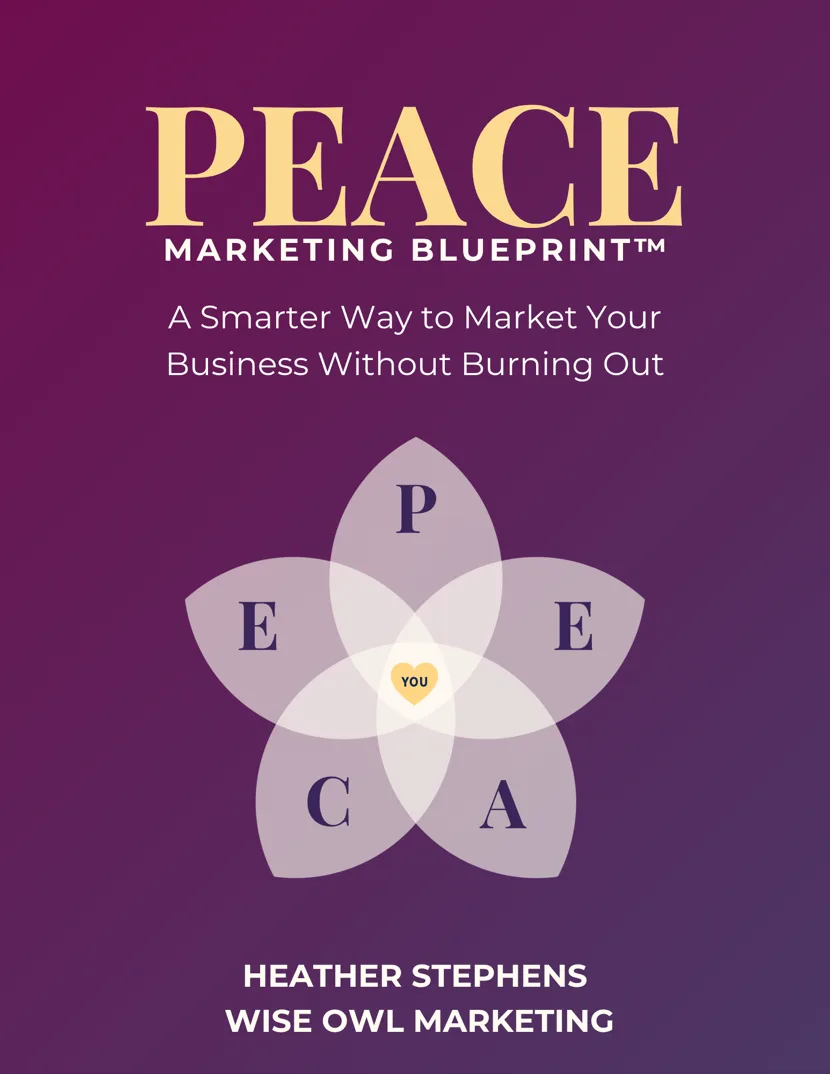

Heather C. Stephens
27+ years in marketing and 11 helping coaches and service providers get found online without burning out. Founder of Wise Owl Marketing and creator of PeacefulBiz and the PEACE Blueprint.
More about Heather →


Get peaceful marketing ideas delivered to your inbox each week.
One practical idea at a time, written like a note from a friend who happens to know marketing. Read it and try it that afternoon.