
Price your coaching from what your life actually costs, not from what other coaches charge. At the time of writing, the average coach earns $67,800 a year, below a comfortable income in most states, and a self-employed coach has to bring in roughly 15 to 25 percent more than an employee to take home the same pay once tax and benefits are covered. Packages beat hourly rates for both sides: you stop selling your time by the hour, and the client commits to a length of engagement that can actually produce a result.
Last Updated: February 2026
Most advice on how to price your coaching services is completely backwards.
They tell you to research competitors. Survey your audience. Calculate your "market rate." Start low and raise prices later.
And then you end up exhausted, burning out, and wondering why you started a business in the first place. (No wonder 87.7% of entrepreneurs struggle with mental health issues.)
Here's the truth: Your pricing shouldn't be based on what you can charge. It should be based on what you need to live the life you actually want.
I call it the peaceful pricing method (lifestyle-first pricing).
I was more than half a decade into my business before I really understood the math behind my pricing. But when I did the math and really saw the numbers in black and white, it completely changed how I thought about my pricing. I finally understood why I could work all the time but never get ahead.
My hope is that this article saves you from that stress and empowers you to charge what you need to live a comfortable life, based on actual numbers. Not some airy-fairy "charge what you're worth," bottom-line baloney, but real numbers you can apply to your business.
Why Most Coaching Pricing "Strategy" Advice Fails
The traditional approach to pricing coaching services goes something like this:
Look at what other coaches charge
Position yourself somewhere in that range
Start a bit lower to "build experience" (aka: beta pricing, founding member pricing, etc.)
Gradually raise prices over time
The problem? This pricing method is designed around the market, not around you.
You end up with a number that might be "competitive" but leaves you:
Working more hours than you wanted just to make ends meet
Taking on clients who drain your energy because you need them more than they need you
Never quite reaching the income you need, always looking for ways to make extra
Feeling trapped by rates you set years ago even though you skills have improved
The market doesn't know what your life costs. It doesn't know you want to take Fridays off to spend with your aging mom, or that you need to cover your kid's college tuition, or that you promised yourself you'd finally take a real vacation this year.
Only you know that.
The Question: What to Charge as a Coach?
Instead of asking "What can I charge?", start with a different question:
What do I actually need to live the life I want?
This isn't about greed or maximizing profit. It's about sustainability. It's about building a business that supports your life instead of consuming it.
To figure this out, the first step in setting lifestyle-first prices is to figure out what your comfortable lifestyle would actually look like.
But first, let's take a peek at where the coaching industry pricing benchmarks are...
What Are Coaches Actually Charging? (Coaching Rates 2026)
Here's what the research actually shows based on cited industry data.
According to the ICF Global Coaching Study 2025 and industry benchmarks, the average hourly rate in North America is $272. While we don't have 2026 numbers yet (it's only February 2026), inflation is projected to remain steady, around 2.7, according to Trading Economics.
Metric | Data | Source |
|---|---|---|
Average hourly rate (North America) | $272 | IACC 2025 |
Average coach revenue/income | $67,800/year | ICF 2025 |
Average active clients | 13.5 | ICF 2025 |
Average client hours/week | 13.3 | ICF 2025 |
Executive coach rate | $200-800+/hour ($425 median) | Industry compilation citing ICF data |
Here's what those numbers actually say:
The average North American coach earns $67,800/year (annual revenue/income from coaching), working about 13 hours per week with clients.
Sounds reasonable, until you do the math.
13.3 client hours × 48 working weeks = 639 client hours/year
$67,800 ÷ 639 hours = $106/hour
That's well below the $272 "average session rate." Why the gap?
Because averages hide reality. Some coaches charge $500/hour but work with 3 clients. Others charge $100/hour and are fully booked. The ICF data includes everyone from brand-new coaches to Tony Robbins.
The only number that matters is the one that works for YOUR life.
And for most people in the US, $67,800/year is far below a "comfortable" income.
What Does a "Comfortable" Income Actually Mean?
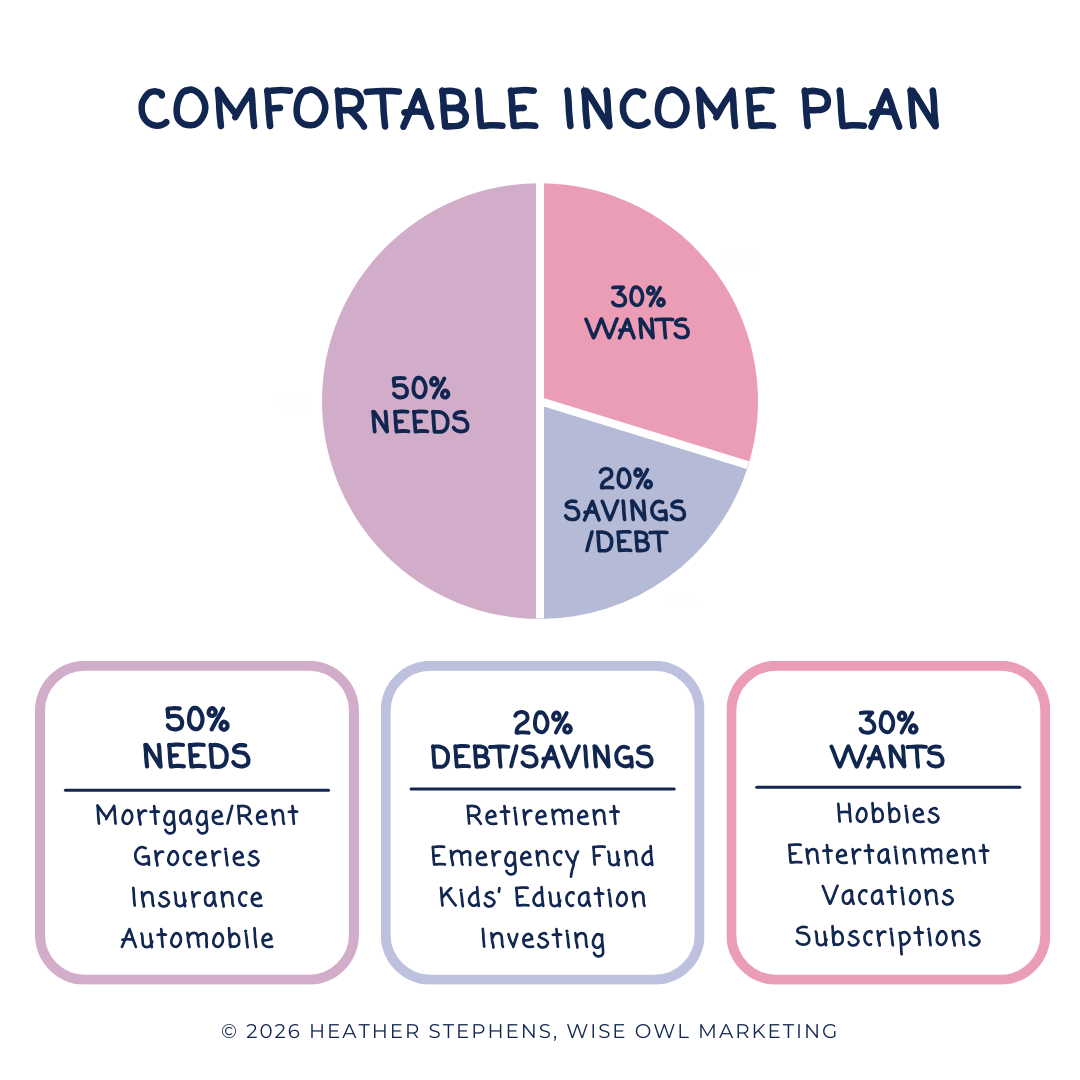
Financial experts recommend the 50/30/20 budget for sustainable living:
50% for necessities (housing, insurance, medical, groceries, transportation)
30% for discretionary spending (dining out, hobbies, entertainment, travel)
20% for long-term goals (emergency savings, retirement, debt payoff)
Here's a helpful calculator from NerdWallet if you want to figure this out based on your own real-life expenses.
Using this rule, the SmartAsset 2025 study calculated what "comfortable" actually costs in every state:
Location | Single Adult | Family of Four |
|---|---|---|
West Virginia | $80,829 (lowest) | $189,364 |
Mississippi | $86,320 | $186,618 (lowest) |
Texas | $90,771 | $204,922 |
Florida | $97,386 | $217,651 |
Colorado | $105,955 | $273,728 |
Washington | $109,658 | $277,888 |
California | $119,475 | $276,724 |
Massachusetts | $120,141 | $313,747 (highest) |
Hawaii | $124,467 (highest) | $294,612 |
Source: SmartAsset 2025, using MIT Living Wage Calculator data
"If you're a single coach with no dependents, your numbers will look different than a coach supporting a family. Neither is right or wrong - but you need to price for YOUR reality, not someone else's."
Notice that's not "thriving" money. That's "comfortable" - meaning you can cover necessities, enjoy some hobbies, AND save for retirement.
The $67,800/year ICF average? It's $13,029 below the lowest (West Virginia) and $56,670 below the highest (Hawaii) comfortable income levels in the United States.
But it gets worse because that $67,800/year is not what they take home; it's their annual revenue/income from coaching they bring in.
As self-employed business owners, our taxes are higher, and our revenue must cover our business expenses, as well. $67,800 is nowhere near enough revenue to support a business and live on.
Why Self-Employed Coaches Need to Earn More than Employees
These "comfortable lifestyle" numbers assume you're an employee... (this is the part most pricing advice ignores)
Here's what changes when you're self-employed:
When you're an employee, the company you work for is paying half your Social Security and Medicare taxes. As a business owner, you pay BOTH halves, an extra 7.65% off the top.
Let's Do Real Math (I Promise it Won't be Difficult!)
To plan for a salary of $87,194 in Wisconsin as a self-employed person, I need a ballpark figure of about 30–37% of profit going to taxes, compared to 22–28% for an employee.
Category | Employee | Self-Employed Coach |
|---|---|---|
Annual Salary | $87,194 | $87,194 |
- Fed income tax (~12–14%) | ~$11,500 | ~$11,500 |
- WI state tax (~4–5%) | ~$3,800 | ~$3,800 |
- Social Security | ~$5,406 (6.2%) | ~$10,812 (12.4%) |
- Medicare | ~$1,264 (1.45%) | ~$2,528 (2.9%) |
- Total Taxes | ~$22,000 (25%) | ~$28,600 (32.8%) |
Net Take Home | ~$65,000–$68,000 | ~$58,000–$60,000 |
A self-employed coach in Wisconsin needs to pay themselves about $97,000–$101,000 to take home the same $65,000–$68,000 as an employee earning $87,194.
Why “Revenue” Is Not the Same as “Income”
When you run your own business, your comfortable income is just your personal take-home pay.
Your pricing has to cover your business expenses, reserves, and taxes first.
Business Expenses for a Typical Coach:
Software (Zoom, scheduling, CRM, email marketing)
Insurance (liability, potentially health)
Professional development
Marketing and advertising
Payment processing fees (2.9% + $0.30 per transaction)
Legal and accounting
Website and tech tools
Business Reserves:
Emergency fund (3-6 months of expenses)
Reinvestment for growth
Savings for slow months
In business terms, this is the difference between:
• Revenue (what clients pay you)
• Operating profit (what’s left after business expenses and reserves)
• Personal income (what you live on)
Large companies use a metric called EBITDA (earnings before interest, taxes, depreciation, and amortization) to measure how healthy the business itself is before owner pay and taxes.
You don’t need to calculate EBITDA as a coach, but you do need to think the same way:
Your business must make money before it can pay you.
Which means your pricing has to cover:
Business expenses
Business reserves
Your personal income and taxes
In that order...
Coaching Pricing Strategy: Base Revenue Requirement Example
If your goal is to take home the same amount as an employee earning $87,194 (about $65,000–$68,000):
As a self-employed coach, you need to bring in about:
$97,000–$101,000 just to match that take-home pay.
Now add business costs.
For a lean solo coach, typical business costs might range:
25–40% of revenue (software, insurance, education, marketing, fees, accounting, website, etc.)
5-10% of reserves (savings, investing back into business, emergency reserves)
Based on this, here is the approximate revenue you'd need to generate annually to take home $65-$68K:
Category | ~20% Expense | ~30% Expense | ~40% Expense |
|---|---|---|---|
Business Expense | $25,000 | $47,600 | $80,000 |
Business Reserves | $6,600 | $11,100 | $20,000 |
Your Income | $100,000 | $100,000 | $100,000 |
Taxes | $33,000 | $33,000 | $33,000 |
Total Revenue Needed | ~$133,000 | ~$159,000 | ~$200,000 |
That’s very different from:
“$87,000 sounds fine.”
Because $87,000 is an employee salary number.
Not a business revenue number.
Define Your Actual Capacity Before You Set Your Coaching Prices
Here's where most pricing advice falls apart: it assumes all your time is available for clients.
It's not.
Before you can calculate your rates, you need to get honest about your actual capacity - not the fantasy version where you're a productivity machine who never gets sick, never has a kid home from school, and never needs to just... think.
Budgeting for Time Off Isn't Optional
The 12 Week Year method (which I use and teach) emphasizes something most productivity advice ignores: rejuvenation isn't a reward for hard work. It's a requirement for sustainable performance.
Authors Brian Moran and Michael Lennington recommend taking a full week off after every 12-week push - not as vacation, but as strategic recovery. They also advocate for "free days" built into every week, where you completely disconnect from work.
Why? Because your brain needs space to process, integrate, and create. The best ideas rarely come while you're staring at a screen. They come in the shower, on a walk, while playing with your kids.
When you price your services, you need to account for:
Annual time off: How many weeks per year do you want completely unplugged? Not "working from the beach" - actually OFF. (I recommend minimum 4-6 weeks, but you might want more.)
Weekly recovery time: Are you building in at least half a day (ideally a whole day) each week with no work? No "just checking email"?
Daily margins: Do you have breathing room between calls, or are you scheduled back-to-back until you're fried?
If you skip this step, you'll price based on 52 weeks and 40+ hours, and then wonder why you're exhausted by May.
The Myth of the 40-Hour Week
Let's talk about what "working hours" actually means for a coach.
If you want to spend 20 hours per week on client-facing work, you don't have a 20-hour work week. You have client work PLUS:
Marketing and visibility (content creation, social media, networking)
Admin (scheduling, invoicing, email, tech troubleshooting)
Business development (sales calls, follow-ups, proposals)
Professional development (training, reading, skill-building)
Strategic thinking (planning, reviewing what's working, course-correcting)
A realistic breakdown might look like:
Activity | Hours/Week |
|---|---|
Client sessions | 15-20 |
Admin & operations | 3-5 |
Marketing & content | 3-5 |
Sales & business development | 2-3 |
Strategic thinking & learning | 2-3 |
Total | 25-36 |
And that's a sustainable week - not a hustle week.
The question isn't "How many hours can I work?"
It's "How many client hours can I realistically deliver while still having a life?"
Build In the Buffer (Because Life Happens)
Here's what your perfectly planned schedule doesn't account for:
The client call that runs 20 minutes over because they're having a breakthrough
The day your kid wakes up with a fever
The week you catch that cold that's going around
The project that takes twice as long as you estimated
The emergency that pulls you away from work entirely
The afternoon when your brain just... won't
If your pricing only works when everything goes perfectly, you haven't built a sustainable business. You've built a house of cards.
I recommend building in at least 20% buffer:
If you want to deliver 15 client hours/week, only schedule 12
If you want to work 48 weeks/year, plan revenue for 40
If you think a project will take 5 hours, quote for 7
This isn't pessimism. It's realism. And it's the difference between a business that sustains you and one that slowly grinds you down.
The Space to Think
One more thing that never shows up in pricing calculators:
You need time away from your computer to think.
Not to consume content. Not to scroll. Not to "research." To actually think - about your clients, your business, your life, your next moves.
Some of my best strategic insights have come while:
Walking my dog
Driving (no podcasts, just silence)
Sitting on my porch with coffee
Taking a shower
This isn't wasted time. It's essential time. And if your schedule is so packed that you never have unstructured space, you're not running your business - it's running you.
When you calculate your capacity, protect this space fiercely. It's not a luxury. It's how you'll avoid burning out and stay creative enough to serve your clients well.
Your Real Capacity Calculation
Before moving to the pricing math, get honest about these numbers:
1. Days you'll actually work per year:
Start by adding up how many days you plan to take off from work.
_____ vacation days
_____ holidays
_____ sick days
+ _____ buffer for life days
------------------------------
_____ total days off
Time Off | Example # Days |
|---|---|
Vacation days | 15 |
Holidays (do include birthdays/anniversaries?) | 15 |
Sick days (be realistic!) | 5 |
Buffer for life (travel delays, snow days, emergencies, mental health days) | 10 |
Total days off | 45 |
Now, if you work Monday to Friday, there are 260 possible working days in a year. (52 weeks x 5 days/week)
Take 260 - _____ total days off = _____ actual working days per year
Working days (52 weeks x 5 days per week) | 260 |
Total days off | 45 |
Actual working days | 215 |
2. Hours you want to work per day:
Not how many you can work. How many you want to work while still having energy for your life.
_____ hours/day × _____ working days = _____ total working hours per year
Example: 6 hours/day × 215 days = 1290 total working hours
3. Percentage of time that's actually billable:
The rest goes to marketing, admin, emails, planning, professional development, and yes - thinking time.
60% billable is a healthy balance for most coaches. That means if you work 6 hours/day, only about 3.5 of those are client-facing. The other 2.5 hours keep your business running.
Some coaches try to push to 70-80% billable. It works for a while - until you realize you've stopped marketing, your systems are falling apart, and you haven't had an original thought in months.
_____ total hours × _____ % billable = _____ actual client hours per year
Example: 1,290 hours × 60% = 744 total client hours per year
4. The reality check:
That's your real capacity.
Not 260 days × 8 hours = 2,080 hours.
744 hours.
5. Your minimum hourly rate:
Let's go back up to baseline revenues we talked about above, using our 744-hour example.
Category | ~20% Expense | ~30% Expense | ~40% Expense |
|---|---|---|---|
Business Expense | $25,000 | $47,600 | $80,000 |
Business Reserves | $6,600 | $11,100 | $20,000 |
Your Income | $100,000 | $100,000 | $100,000 |
Taxes | $33,000 | $33,000 | $33,000 |
Total Revenue Needed | ~$133,000 | ~$159,000 | ~$200,000 |
x Total Billable Hours | x 744 | x 744 | x 744 |
Minimum Hourly Rate | ~$179 | ~$214 | ~269 |
These are break-even numbers with zero buffer for cancellations or slow months.
Suddenly, that "high" rate doesn't seem so high anymore. It's just math.
Common Mistakes: This is Why Many Coaches Burn Out
Most coaches make two critical mistakes with their pricing:
Mistake #1: They price as if Revenue = Income
But in reality: Revenue → business costs → taxes → income
When you skip the middle, you underprice. When you underprice, you overwork. And when you overwork, you burn out.
Mistake #2: They're not honest about their actual capacity
They price as if they have 2,080 hours to sell (52 weeks × 40 hours).
But as we calculated above, the real number is closer to 744 hours, maybe less.
When you overestimate your capacity, you underprice per hour.
When you underprice per hour, you have to book more hours to hit your revenue goals.
When you try to book more hours than you actually have... You burn out.
It's the same destination, two different roads:
The Money Mistake | The Time Mistake |
|---|---|
Forget that revenue ≠ income | Forget that not all hours are billable |
Underprice your services | Overestimate your capacity |
Need more clients to make ends meet | Need more hours to hit your numbers |
Work more than you wanted | Work more than you have |
Burn out | Burn out |
Most coaches are making both mistakes simultaneously. They're undercharging AND overestimating how much time they have to deliver.
No wonder entrepreneurs struggle with mental health issues, burnout, and feelings of overwhelm.
Lifestyle-first pricing fixes both problems by starting at the end:
What do I need to live comfortably? (The money question)
How much time do I actually have to work? (The capacity question)
What does my business need to earn to support #1 within the constraints of #2?
When you work backwards from your life, not forwards from "what the market will bear," the math gets very clear, very fast.
And sometimes that math is uncomfortable. Sometimes it shows you that your current rates can't possibly work.
That discomfort is a gift. It's telling you something needs to change before you burn out, not after.
Hidden Traps: Why Hourly Pricing Hurts Your Coaching Business AND Your Clients
Let's go back to the 744 billable hours we calculated in our example scenario above. Before you start booking sessions for $214 each, we need to go a bit deeper.
Trap 1: Thinking an Hour is an Hour
This 744 is not the number of one-hour sessions you can have. It's your total client time, including the time you spend...
Reviewing notes and prepping before each coaching session
Actual face-to-face coaching time
Sending replay links and notes after the session
Between-call support, like:
Feedback
Answering questions
Providing accountability
Sending encouragement
It's the whole container.
That one-hour coaching session is likely 1.5 or 2 hours of billable time.
You need to know this. Does your pricing account for it?
Trap 2: Time-Limited Thinking
Knowing your hourly rate is a good first step, but actually selling 744 hours of coaching to hit your revenue goals is not easy, especially if you're pricing yourself hourly. Plus, it limits you.
When you price by the hour, you've created a ceiling. Your income can never exceed your available hours multiplied by your rate.
Worse, you've trained clients to think about time instead of transformation.
"How many sessions will this take?" becomes the focus instead of "What result will I get?"
The coaches who earn the most work fewer hours, not more. They've figured out something critical: price the transformation, not the time.
Trap 3: It Hurts Your Clients Too
Here's what nobody talks about: hourly pricing doesn't just limit YOU. It limits your clients' results.
Real transformation rarely happens in a single session.
Think about it... in one hour, you're just scratching the surface. You're learning their story, understanding their context, identifying the real problem underneath the problem they came in with.
The magic happens over time:
Session 1-2: You're getting to know them. Understanding their patterns, their blind spots, their strengths.
Session 3-4: You're testing approaches. What resonates? What resistance comes up? What actually sticks between sessions?
Session 5+: Now you're building on a foundation. You know their triggers. You can call back to previous breakthroughs. You can see the patterns they can't see yet.
When clients buy single sessions, they're buying a transaction, not a transformation.
They show up, get some insight, leave inspired... and then life happens. Old patterns creep back. The insight fades. They don't have you in their corner helping them implement, adjust, and stay accountable.
Packages don't just help your business. They help your clients actually get the results they came for.
A client who commits to 3-6 months with you will get exponentially better results than a client who books one session at a time and "sees how it goes."
That's not a sales tactic. That's just how transformation works.
The Advantage of Coaching Packages Over Hourly
The ICF data backs this up: 40% of business coaches use packages of 7+ months. Sessions are typically sold in 3-6 month blocks, not one at a time.
Here's why packages work better:
For you:
Predictable revenue (you know what's coming)
Committed clients (they've invested in an outcome)
Sustainable workload (you can plan your capacity)
Higher perceived value (a $3,000 package feels different than 10 sessions at $300)
For your clients:
Clear container (they know what they're getting)
Committed mindset (they've decided to see this through)
Better results (transformation takes time; packages give them that time)
How to Price Your Coaching Services: Quick Coaching Package Pricing Formula
Your hourly rate × length of session x # expected sessions = starting package price
The length of a session is not just the time you're on the call with your client. It's the whole container, accountability, between-session support, and the commitment structure.
For example, if your client sessions are 1 hour long, but you also spend 15 minutes prepping, 15 minutes on follow-up, sending the recording and notes, and 30 minutes between sessions providing support, accountability, and feedback, when calculating your pricing, your session length would be 2 hours, not one.
So, to price a 3-month package with 4-calls per month, the formula would be:
$214 (or whatever your hourly rate is) x 2 hours per session x 12 sessions = $5136 bare minimum package price.
But honestly? That formula still thinks too small.
The better question: What is the transformation worth to your ideal client?
If you help someone land a job paying $30,000 more per year than the job they had, what's that worth?
If you help a business owner stop burning out and actually enjoy their work, what's that worth?
If you help a couple reconnect with each other after their kids have left home, and save their 27-year marriage from ending in divorce, what's that worth?
When you price based on value, not time, the hours become irrelevant.
Here's a personal story to illustrate what I mean by value-based pricing:
When we first moved to our current house, our retired neighbor hired our son (who was 12 at the time) to mow her one-acre yard for $75 per week. At the time, we only had a push mower. As soon as our grass started to come in, we decided to upgrade to a riding lawn mower. Instantly, it took him a quarter of the time to mow than it did walking behind the push mower. He asked if he should charge her less. I said no, she wants her yard to look nice, which she values at $75 per week. How you do it or how long it takes you doesn't matter to her. It's the result she wants.
In fact, people will pay a premium for something done quickly...
The Good, Fast, Cheap Triangle (And Why It's a Trap for Coaches)
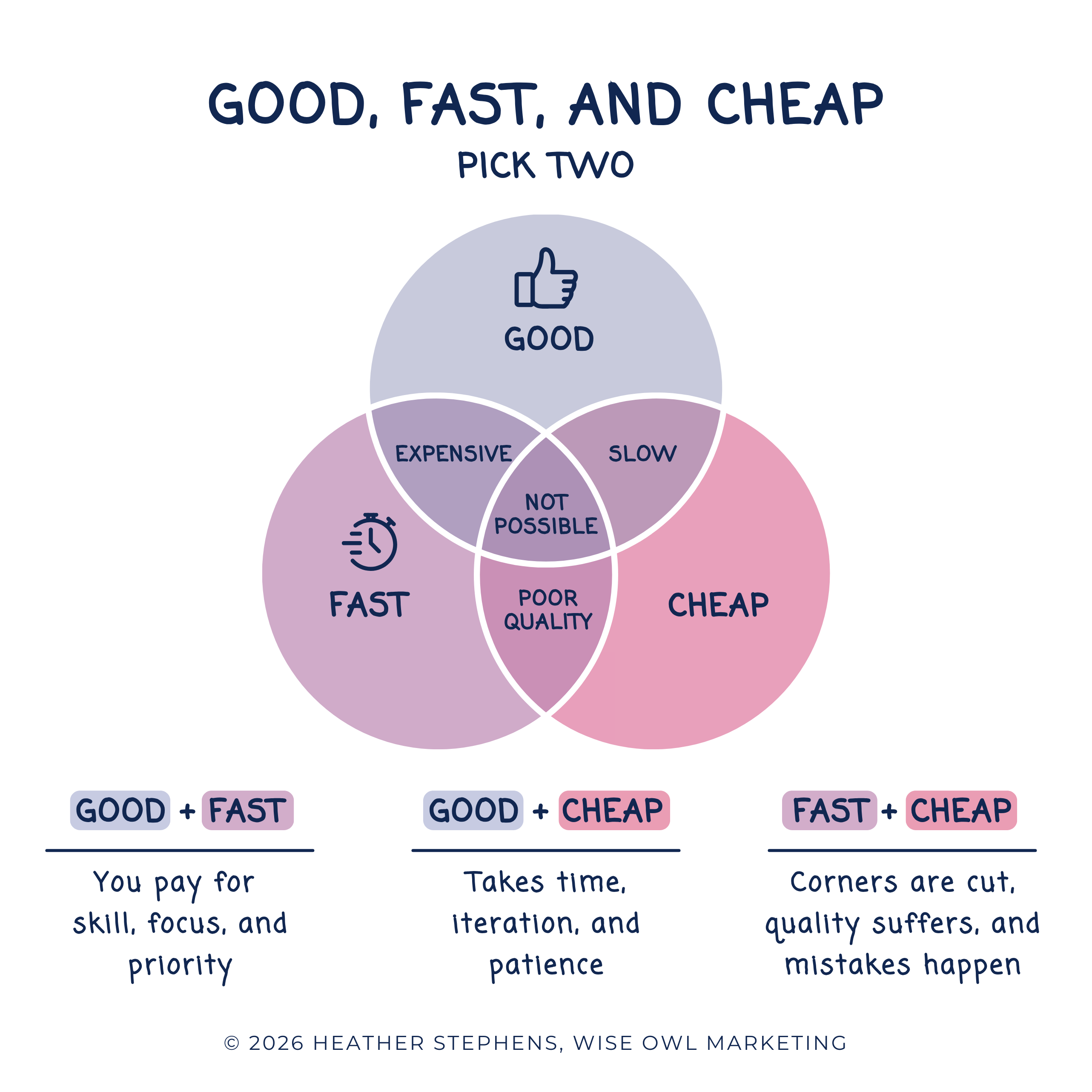
You've probably seen this classic business principle:
Good, Fast, Cheap; Pick Two.
Good + Fast = Expensive
Good + Cheap = Slow
Fast + Cheap = Low Quality
Here's why...
You can’t maximize all three without breaking physics:
You can’t go slow and fast.
You can’t spend a lot and a little.
You can’t deeply care and rush at the same time.
So in most real-world projects, the triangle holds.
Here's the problem: too many coaches try to be all three.
They deliver excellent results (Good). They respond quickly, fit clients in, go above and beyond (Fast). And they charge rates that make them "accessible" (Cheap).
I get the reasoning... (I thought this way too, for a long time.)
Yes, you may get faster with experience. A seasoned coach can do in 1 hour what a beginner takes 10 hours to figure out. So it looks like you got all three, but what really happened is: you paid for accumulated time, not current time.
Yes, you can develop frameworks, systems, and shortcuts. But that's leverage, not magic. It didn't make the work easier; you paid the cost once, so you can reuse it many times to improve the transformation you deliver and your efficiency. That's called expertise, and it's worth paying for.
Yes, simple problems are easier to solve quickly and affordably. However, the size of the problem is the variable, not the good, cheap, fast rule. If the problems your clients have were easy to solve, they'd probably figure it out themselves with the help of ChatGPT.
The deeper truth is:
You can’t optimize for quality, speed, and cost at the same time for complex, custom work.
Once you add:
• nuance
• strategy
• human judgment
• customization/personalization
Something has to give.
Why this Good, Fast, Cheap Rule Matters for Your Coaching Pricing Strategy
Clients who want:
“Fast + Cheap + Life-changing results”
…are asking for a unicorn.
And coaches who try to deliver all three:
• undercharge
• overwork
• burnout
• resent clients
That's not a business model. That's a one-way ticket to burnout.
But here's what most coaches get backwards...
Delivering better results faster doesn't lower your price, it should raise it.
Remember my son and the riding mower? He got faster. The value to the neighbor didn't suffer. If anything, she was happier, with the same beautiful lawn, and he was in and out in half the time. Less noise and distraction for her dog. More peace for her.
People don't just pay for results. They pay a premium for fast, easy results.
Think about it:
Express shipping costs more because it's faster
Flying typically costs more than driving because it's faster
The consultant who solves your problem in one call is worth more than the one who takes six months
When you get better at what you do, you're not supposed to discount your rate because it takes less time. You're supposed to charge more because clients get results faster.
Good + Fast = Premium pricing.
That's the only sustainable combination for coaches who want to avoid burnout.
What to Charge as a Coach: The Lifestyle-First Pricing Method
Step 1: Define Your Lifestyle Requirements
Before you touch a single number, get clear on what you actually want:
Income: What annual take-home pay do you need? Not what sounds impressive, or what you feel like you need to put on your vision board to be a dedicated "dreamer." What do you actually need to pay your taxes, cover your expenses, live your life, reach your goals, and give yourself peace of mind?
Time Off: How many weeks per year do you want completely off? Not "working from the beach," I mean, actually unplugged, laptop off, not posting on social.
Working Hours: How many hours per week do you want to spend on client-facing work? Be honest. If you hate back-to-back calls, don't plan for them. If you want to take off at 3:00 to pick your kids up from school, do it. If you don't want to start working until 10:00 am, that's totally okay.
Client Load: How many clients can you serve well before quality suffers? I'm not talking about how many you can handle. Think about how many clients you can work with and still feel spacious in your life? (Hint: you'll do better work when you're not spread thin, your clients will get better results, and your demand will rise.)
These four factors determine everything else.
Step 2: Do the Math Backwards
Once you know your lifestyle requirements, the math becomes simple:
Available working weeks = 52 minus your time off
Available client hours = Working weeks × weekly client hours
Required revenue per hour = Annual income needed ÷ Available client hours
This gives you your minimum viable rate. This is your floor. If you go below it, your business cannot sustain your life.
Step 3: Build Your Package Mix
Not every client needs (or can afford) your highest-touch offer. A sustainable coaching business usually includes a mix:
VIP/Premium Packages: Your highest-touch, highest-price offering. Fewer clients, maximum impact, premium rates.
Signature Programs: Your bread-and-butter offer. The thing you're known for. Priced to be accessible but still profitable.
Group Programs: Leveraged offerings that serve more people with less of your direct time.
Recurring Revenue: Monthly memberships, maintenance packages, or retainer arrangements that create predictable income.
The right mix depends on your capacity, your strengths, and your lifestyle goals.
TIP: Don't build out all offers at once:
If you're just starting out, focus on your signature program and then add in recurring revenue.
If you have a signature offer that's already selling consistently, consider adding in a VIP package.
If you're maxed out on time, add a group program.
Step 4: Check for Hustle
Here's where most pricing exercises stop. But there's one more critical step:
Does your pricing require hustle to work?
If your numbers only add up when you're fully booked with zero cancellations, you've built in hustle.
If you need to launch constantly or market aggressively to hit your targets, you've built in hustle.
If there's no margin for a slow month, a sick week, or a family emergency, you've built in hustle.
Sustainable pricing includes a buffer. It assumes some spots won't fill. It accounts for the reality that life happens.
The Uncomfortable Truth About Undercharging
If you've made it this far into today's lesson, you may have realized your rates are too low.
You might justify it:
"I'm still building my reputation"
"My clients can't afford more"
"I don't want to be one of THOSE coaches"
"I should be grateful for any clients"
But undercharging isn't humble. It's unsustainable.
When you undercharge:
You resent the work (even when you love the clients)
You can't invest in your business
You attract clients who undervalue transformation
You burn out faster because you're working too much for too little
You eventually quit, and your clients lose access to your gifts entirely
Charging what you need isn't greedy. It's the only way to serve people long-term.
The Burnout-Pricing Connection (What Nobody Talks About)
Here's something most pricing conversations ignore completely:
Underpricing leads directly to burnout and health risks.
And burnout among entrepreneurs isn't just common, it's an epidemic:
87.7% of entrepreneurs struggle with at least one mental health issue (FounderReports 2024)
34.4% have experienced burnout (FounderReports 2024)
42% of small business owners experienced burnout in the past month (Capital One 2022)
63% of business owners work more than 50 hours per week (The Alternative Board)
People working 55+ hours per week face a 35% higher risk of stroke (WHO/ILO 2021)
The connection to pricing is direct: When you undercharge, you have to overwork.
More clients. More sessions. More hours. Just to hit the same revenue number.
And here's the cruel irony: the coaches most likely to underprice are often the ones who got into coaching to escape burnout in the first place.
Your Pricing Is a Burnout Prevention Strategy
When you charge appropriately, you can:
Take fewer clients and serve them better
Have margin for slow months without panic
Take actual time off (not "working from the beach" off - actually off)
Invest in support (VA, systems, tools)
Build a business that sustains you instead of depletes you
Think about it this way:
At $150/session, you need 44 sessions/month to earn $80,000/year (accounting for time off).
At $300/session, you need 22 sessions/month for the same income.
At $500/session, you need 13 sessions/month.
Same income. Dramatically different life.
Peaceful pricing isn't just about money. It's about creating a business that doesn't require you to sacrifice your health, your relationships, or your sanity.
That's why I call it peaceful pricing, because when your numbers actually work for your life, you can breathe.
How to Raise Your Prices (Without Losing Everyone)
If you're currently undercharging, here's how to fix it:
For New Clients
Raise your prices immediately. Today. The next person who inquires gets the new rate.
You don't need to announce it. You don't need to justify it. You just quote the new number.
For Existing Clients
Give notice. 30-60 days is standard. Frame it as an investment in the quality of your work:
"Starting , my rates will be . I'm giving you advance notice so you can plan accordingly. If you'd like to lock in current rates for an extended package, let me know by ."
Some clients will leave. That's okay. The ones who stay value the transformation more than the transaction.
For Your Own Head
The hardest part isn't the conversation with clients. It's the conversation with yourself.
You'll feel like a fraud. You'll worry no one will pay. You'll question everything.
Do it anyway.
The first time someone says yes to your new rate, you'll realize: I should have done this years ago.
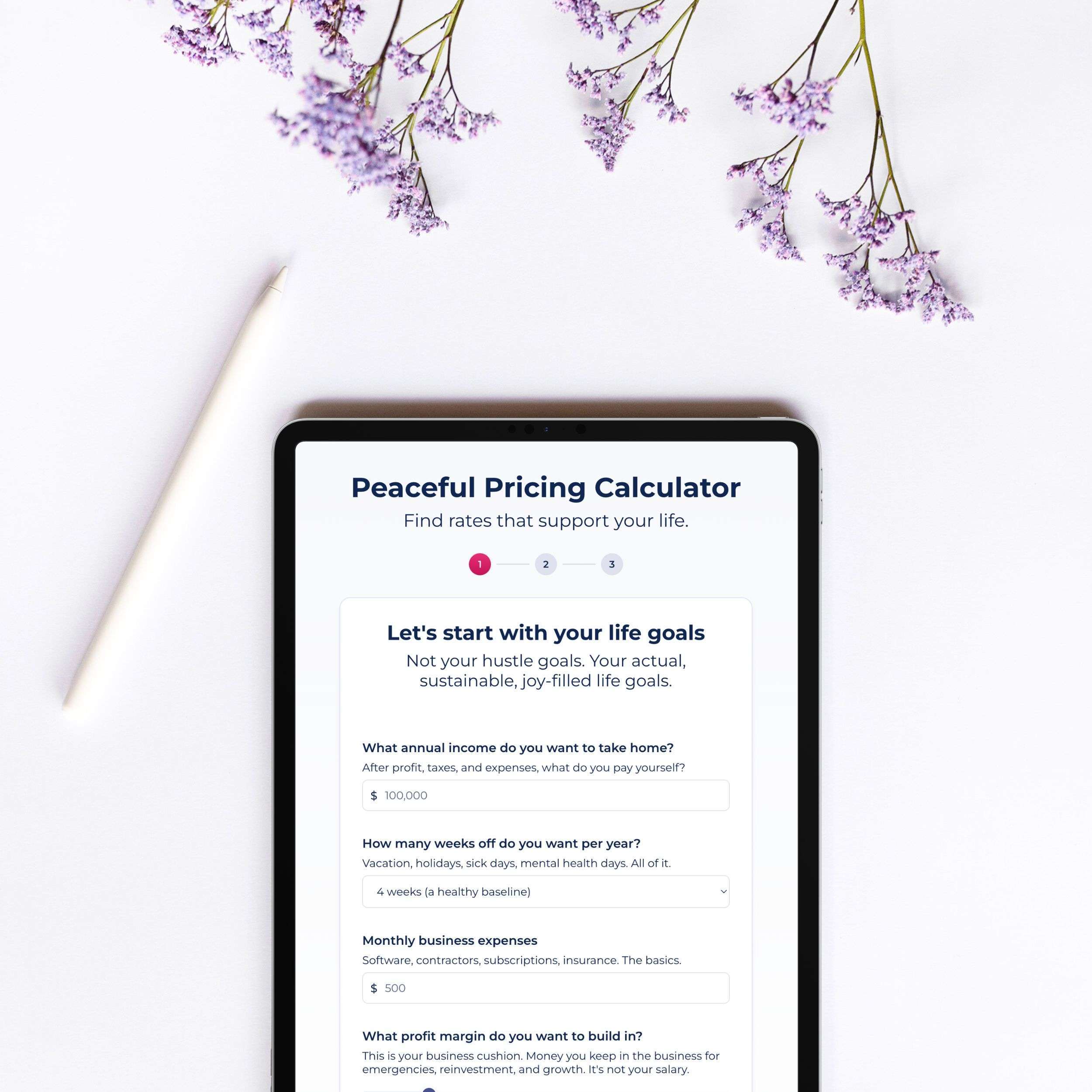
Coaching Pricing Calculator (Free Tool)
I built a free Peaceful Pricing Calculator specifically for coaches who want to price from lifestyle-first principles.
Here's what it does:
Calculates your minimum viable rate based on your actual life needs
Shows you different package mix scenarios
Flags "hustle warnings" when your numbers require unsustainable effort
Helps you see exactly what it takes to hit your income goals
→ Get the Free Pricing Calculator
It takes about 5 minutes. And it might be the most clarifying 5 minutes you spend on your business this month.
Common Pricing Mistakes Coaches Make
Mistake #1: Pricing by the Hour
Hourly pricing caps your income at your available hours. It also trains clients to think about time instead of transformation. And it limits the results they can achieve.
Instead: Price by the outcome, the container, or the transformation, not the clock.
Mistake #2: Offering Too Many Options
When you have 17 different ways to work with you, clients get confused. Confused people don't buy.
Instead: Offer 2-3 clear options. One for people who want maximum support, one for people who want independence, and maybe one in between.
Mistake #3: Starting Too Low "To Get Experience"
You'll never feel experienced enough to raise prices. There's always someone more credentialed, more established, more confident.
Instead: Price for the value you provide now, not the experience you think you lack.
Mistake #4: Copying Competitor Pricing
Their business isn't your business. Their life costs aren't your life costs. Their capacity isn't your capacity.
Instead: Do your own math. What do YOU need?
Mistake #5: Never Revisiting Your Numbers
The prices you set three years ago were based on a different life, different costs, different experience, different skill level, different capacity.
Instead: Revisit your pricing at least annually. Bookmark the Peaceful Pricing Calculator and add a reminder in your calendar for a year from now to check if your numbers still work.
What If No One Will Pay Your Prices?
This fear stops more coaches from charging appropriately than anything else.
Here's what I've learned after 20+ years in marketing:
The right people will pay. The wrong people won't. Both are okay.
If NO ONE is paying your prices, one of two things is happening:
Your marketing isn't reaching people who value what you offer. The solution isn't lower prices, it's better targeting and visibility.
You're not communicating the value clearly. The solution isn't lower prices, it's better messaging.
Psst...Not sure where your marketing needs the most work? Take the free Peaceful Marketing Assessment to find out.
Lowering your prices to attract more buyers usually attracts the wrong buyers. People who chose you because you were cheap will leave when they find someone cheaper.
Price for the people who get it. Then find more of those people.
Pricing Is a Marketing Decision
Here's something most coaches don't realize:
Your price IS part of your marketing.
A $97 program and a $9,700 program attract completely different people, even if the content is identical.
Low prices signal: accessible, entry-level, maybe not that serious.
Premium prices signal: valuable, for committed people, expect results.
Neither is right nor wrong. But you need to choose intentionally.
If you want clients who implement, who show up, who do the work, you usually need to charge enough that they have a vested interest in their results.
If you want to serve people with limited resources, consider a scholarship model rather than across-the-board low prices.
Your pricing tells a story. Make sure it's the story you want to tell.
Next Steps
Get clear on your lifestyle requirements. What income, time off, working hours, and client load do you actually want?
Run your numbers. Use the Peaceful Pricing Calculator to see what rates support the life you want.
Check for hustle. If your numbers only work when everything goes perfectly, build in more margin.
Set your new rates. For new clients, effective immediately. For existing clients, with appropriate notice.
Trust the process. The right people will pay. The wrong people will self-select out. Both are good for your business.
Your pricing is a promise to yourself about the life your business will support.
Make it a promise you can keep.
Frequently Asked Questions
How much should a new coach charge?
The average coaching session rate in North America is $272 (ICF 2025), but that number includes everyone from beginners to executive coaches with decades of experience. More importantly, your pricing should be based on your lifestyle needs, not industry averages. Calculate what you actually need to earn using the lifestyle-first method, then price accordingly. If that feels intimidating, consider an "early adopter" rate with a clear end date rather than pricing yourself into burnout.
How do I know if I'm charging enough?
Run your numbers backwards: take your desired annual income, divide by available working weeks (accounting for time off), then divide by realistic client hours per week. If your current rates don't support that math, you're not charging enough. The Peaceful Pricing Calculator does this math automatically.
Should I charge hourly or use packages?
The data is clear: packages work better. According to ICF research, 40% of business coaches use packages of 7+ months, and sessions are typically sold in 3-6 month blocks. Hourly pricing caps your income, commoditizes your work, and focuses clients on time instead of transformation. Packages allow you to price based on outcomes, create committed clients, and build predictable revenue.
How often should I raise my prices?
Review your pricing annually at minimum. Your life costs change, your expertise grows, and inflation affects everything. Many coaches raise prices 10-20% yearly for new clients. Use your lifestyle-first calculation to determine if an increase is needed.
What if my current clients can't afford higher rates?
You have options: grandfather existing clients at current rates for a set period, offer them a "loyalty" rate that's still an increase but less than new client rates, or accept that some clients will naturally complete their work with you. Not every client is meant to be a forever client.
How do I price group coaching vs. 1:1?
Group coaching is typically priced at 30-50% of your 1:1 rate per person, but serves more people with less of your time. If your 1:1 rate is $500/month, a group program might be $150-250/month per person. The leverage comes from serving 10-20 people in the time it takes to serve one.
What's a good profit margin for coaching?
Coaching is a high-margin business; you should be keeping 60-80% of revenue after expenses to pay yourself, taxes, and build your business reserves. If your margins are lower, examine your tech costs, team costs, or whether you're overdelivering in ways that don't add value. The Peaceful Pricing Calculator helps you factor in expenses.
Pricing doesn't have to be complicated. It has to be honest, about what you need, what you offer, and what kind of business you're building. Start with the life you want. Work backwards from there.
Whenever you're ready, here's how I can help
Start free and go at your own pace. No pressure, ever.
- Free: Keep reading the blog and subscribe on YouTube. I share everything I know.
- DIY: Get the PeacefulBiz app to organize, plan, create, and simplify your marketing.
- Guided: Join the Peaceful Marketing Lab, and let's build together.
- Direct: Book a strategy call for 1:1 help, a custom website, or to decide which program is right for you.
Want the whole framework?
The PEACE Blueprint Guide walks you through all five pillars, with planner pages to build your own peaceful marketing system.
Get the free guide

Heather C. Stephens
27+ years in marketing and 11 helping coaches and service providers get found online without burning out. Founder of Wise Owl Marketing and creator of PeacefulBiz and the PEACE Blueprint.
More about Heather →


Get peaceful marketing ideas delivered to your inbox each week.
One practical idea at a time, written like a note from a friend who happens to know marketing. Read it and try it that afternoon.