
Last updated, January 2026. This post contains affiliate links.
Most advice about AI for lead generation falls into two camps: spammy automation tactics you'd never use, or vague tips that don't tell you what to actually do.
This guide is different.
I'm going to show you the exact prompts, systems, and tools coaches are using to generate leads with AI in 2026, without cold outreach, fake personalization, or selling your soul to the algorithm.
Let's dive in.
Quick Summary:
Today's post answers the question:
How can I use AI to generate leads and grow my coaching business?
Use AI to build a simple lead system that runs in the background.
- Create: Ask AI for 10 “2 AM Google searches” your ideal client would type. Publish 1 helpful blog post per question.
- Capture: Use AI to turn the most common pain point into a specific lead magnet (1–2 pages or a short video) and add it to every post.
- Connect: Use AI to draft a 5-email welcome sequence that delivers the lead magnet, builds trust, and offers a clear next step.
AI drafts faster; you supply the expertise, stories, and final edits so it still sounds like you.
This post includes:
- The 3-stage system for AI-powered lead generation (Create → Capture → Connect)
- Copy-paste prompts you can use today in ChatGPT or Claude
- Which AI tools work best for different marketing tasks
- The common mistakes that make AI marketing feel gross (and how to avoid them)
- Real proof that this approach works, even when you completely disappear from social media
What makes this guide different :
- Designed for limited capacity: systems that still work when you can’t post daily.
- Asset-first, not volume-first: build content that search engines and AI systems can cite for years.
- BYOB (Bring Your Own Brain): your frameworks and stories drive the marketing; AI supports execution.
- Trust + transparency: lead generation without fake personalization, no bots pretending to be you.
Quick Start: AI Lead Generation Prompts
Want to skip ahead? Here are the prompts from this guide:
- AI Alignment Context Prompt
- Blog Topic Identification Prompt
- Lead Magnet Brainstorming Prompt
- Welcome Sequence Prompt
- Content Repurposing Prompt
- Message Refinement Prompt
Or keep reading for the full system.

What Is AI Lead Generation? (And What It's NOT)
AI lead generation is the process of using artificial intelligence tools like ChatGPT, Claude, or specialized marketing software to attract, capture, and nurture potential clients.
But here's where most people get it wrong: they think AI lead generation means automating outreach, scaling cold DMs, or using chatbots that pretend to be human.
That's not what I'm talking about.
Peaceful AI lead generation means using AI as a thinking partner to:
- Create valuable content faster (without losing your voice)
- Design lead magnets that solve real problems
- Write email sequences that build genuine relationships
- Build marketing systems that work while you sleep
The goal isn't more marketing. It's better marketing that doesn't require you to be "on" constantly.
I call this approach "peaceful marketing." It's built on one core principle: marketing should work for you, not exhaust you.
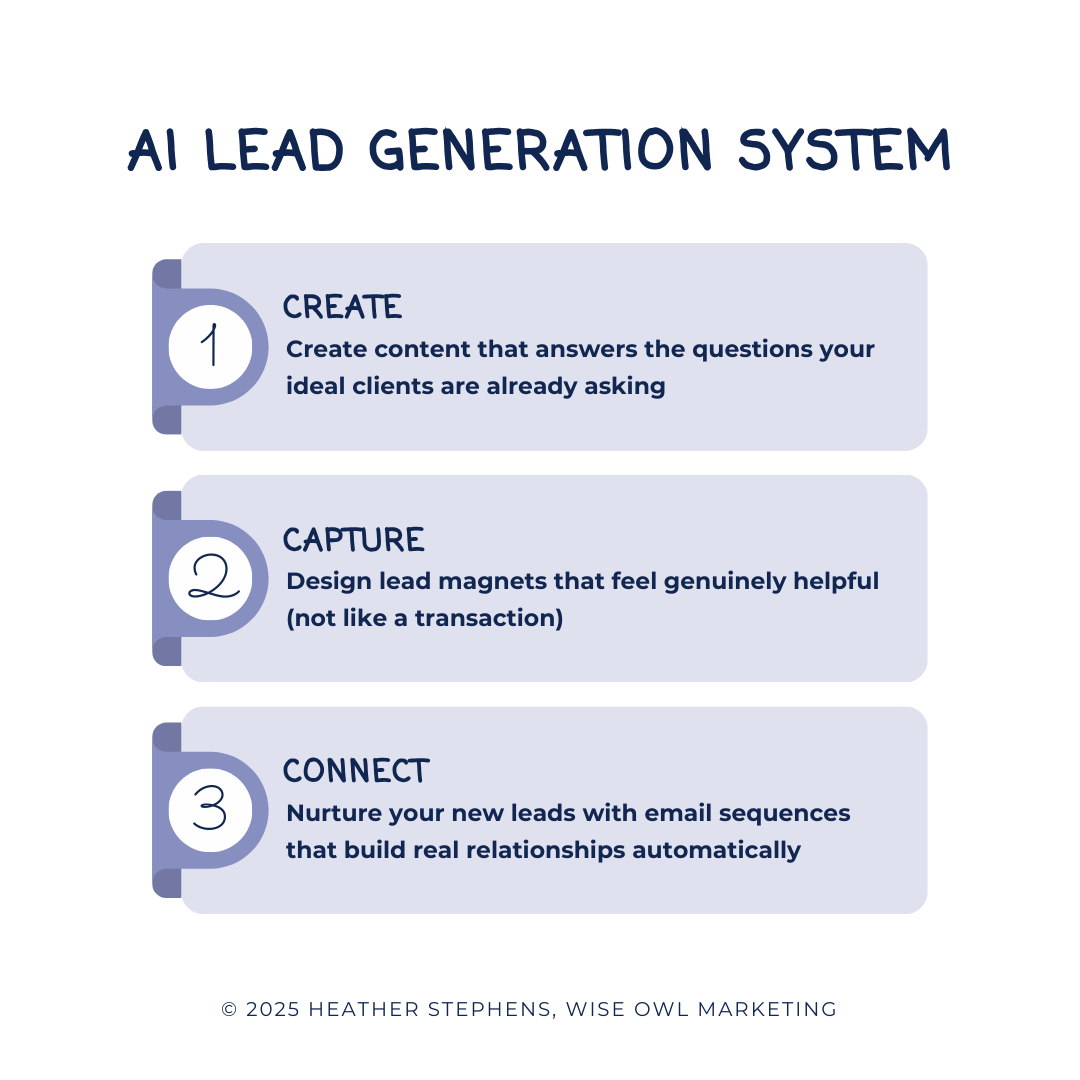
The 3-Stage AI Lead Generation System
The peaceful approach to AI lead generation has three stages:
- Create — Content that answers the questions your ideal clients are already asking
- Capture — Lead magnets that feel genuinely helpful (not like a transaction)
- Connect — Nurture your list with email sequences that build real relationships automatically
None of this is new. Coaches have been doing content marketing forever. What's new is how fast AI lets you build it, if you use AI as a thinking partner instead of a content vending machine.
Let me walk you through each stage with the exact prompts I use.
Before You Prompt: Give AI the Right Inputs (So the Leads Are Actually Qualified)
AI works best when you don’t start with prompts. Start by giving it the context that makes your marketing specific.
What to give AI (copy/paste this once and reuse)
- Your niche + transformation: who you help and the outcome you help them get.
- Your offers: the 1–3 ways people can work with you (and who each offer is for).
- Your “best-fit” client: what they want, what they’ve tried, and what they’re worried about.
- Your boundaries: what you won’t do (no cold DMs, no fake personalization, no scarcity tactics).
One-time Context Prompt (use in ChatGPT/Claude)
Act as my marketing strategist. I’m a [type of coach]. I help [audience] achieve [transformation].

Offers:
1) [Offer + who it’s for + price range]
2) [Offer + who it’s for + price range]

My best-fit clients believe: [beliefs].
They struggle with: [top 5 pain points].
They want: [top 5 desires].

Marketing boundaries: I will not use cold outreach, fake personalization, or pressure tactics.

Voice: [warm/direct/playful].
Words I use: [list].
Words I avoid: [list].
Writing Sample: [paste in some examples of your writing]

Confirm you understand, then ask me 5 clarifying questions before generating any content.
Stage 1: Create AI-Powered Content That Gets Found
Here's something most coaches don't realize: every blog post you write is training AI systems about your expertise.
When ChatGPT, Claude, or Perplexity answers someone's question about coaching, they pull from blog content. If you've written thoughtful, helpful content about your approach, you could be the one AI recommends.
One of my clients, Rachel, got a new client from ChatGPT. The AI cited her blog in a conversation the potential client was having. He followed the link, read her post, booked a call, and hired her.
She didn't game any algorithm. She just consistently answered questions her ideal clients were asking. And when AI went looking for an expert to recommend, it found her.
The Blog Topic Identification Prompt
This is where it all starts. Use this prompt to identify the questions your ideal clients are actually searching for:
I'm a [type of coach] who helps [specific audience] achieve [specific transformation].

What questions are my ideal clients likely typing into Google at 2 AM when they can't sleep? Give me 10 specific, searchable questions, not broad topics, but the exact phrases someone struggling would actually type.

For each question, tell me:
1. The exact search phrase they'd use
2. What pain point is driving this search
3. What they really want to know (the question behind the question)
Then write blog posts that answer those questions. One post per question. Thorough, helpful, genuinely useful, not thin content designed to game an algorithm.
Why This Works
Blog posts have an average lifespan of nearly 2 years. Some of mine from 2016-2019 still bring me clients today. Compare that to social media, where the lifespan of a post is minutes to hours.
When you create long-form searchable content, you're building assets that keep working whether you show up or not.

Stage 2: Capture Leads with AI-Designed Lead Magnets
Your lead magnet shouldn't feel like a transaction. It should feel like a gift.
The best lead magnets solve a real, specific problem. Not "5 Tips for Better Boundaries" (too vague). Something like "The Exact Script I Use When a Client Asks for a Discount" (specific, immediately useful).
The Lead Magnet Brainstorming Prompt
Use this two-part prompt to identify what your audience actually needs:
Part 1: Identify the Problem
Based on what you know about [describe your ideal client], what are the small but painful problems they face regularly?

I'm looking for something I could solve in a 1-2 page PDF or a short video. Give them a quick win that would make them think "wow, if the free stuff is this good..."

Give me 5 specific problems, not broad categories.
Part 2: Create the Lead Magnet
Help me outline a lead magnet called [TITLE] that solves [SPECIFIC PROBLEM].

Requirements:
- Takes less than 10 minutes to consume
- Gives them an immediate, tangible win
- Showcases my approach without giving away everything
- My voice is [warm/direct/playful/professional]. I want this to sound like me, not like a template. Here are samples of my writing [PASTE A PARAGRAPH OF YOUR WRITING]

Give me: the outline, key points to cover, and a compelling subtitle.
Why This Works
Approximately 96% of first-time website visitors aren’t ready to buy coaching immediately. They’re still researching options and deciding what they need.
A lead magnet opt-in gift solves that problem. It turns an anonymous visitor into an email subscriber, so you can build trust over time with a welcome sequence and regular emails, instead of losing that visitor when they leave your site.

Stage 3: Connect Automatically with AI-Written Email Sequences
Email marketing still has the highest ROI of any marketing channel, somewhere between $36-42 for every $1 spent, depending on which study you read. Nothing else comes close.
But most coaches either don't email their list, or only email when they have something to sell. Both approaches leave money (and relationships) on the table.
A welcome sequence changes everything. When someone downloads your lead magnet, they automatically receive a series of emails that:
- Deliver what they signed up for
- Introduce you as a real human
- Provide unexpected additional value
- Address common fears or objections
- Invite them to take a next step
This happens automatically. While you sleep. While you serve clients. While you take a Tuesday off because you can.
The Welcome Sequence Prompt for AI
Help me draft a 5-email welcome sequence for new subscribers who downloaded my lead magnet [NAME].

Here's the structure I want:
- Email 1: Deliver the lead magnet + warm introduction to who I am
- Email 2: Share my story and why I do this work
- Email 3: Provide an unexpected quick win related to [TOPIC]
- Email 4: Address the fear/objection that [COMMON CONCERN]
- Email 5: Invite them to [NEXT STEP - discovery call, low-ticket offer, etc.]

My voice is conversational and warm. I want these to sound like emails from a friend who happens to be an expert, not like marketing.

Here's an example of how I typically write: [PASTE A PARAGRAPH OF YOUR WRITING]
Why This Works
Your welcome sequence nurtures each subscriber automatically. Your ongoing emails keep you top of mind. When they're ready, and most weren't ready when they first found you, you're the obvious choice.
This isn't explosive growth. It's sustainable growth that compounds over time without requiring you to constantly feed the content machine.
Bonus Prompts for AI-Powered Lead Generation
Here are a few more prompts I use with my own clients. These work best when you've already fed the AI information about your voice and framework.
Content Ideas Prompt
I want to create a month of content around the theme of [THEME].

Based on what you know about my framework and ideal clients, suggest 4 blog post topics that would be:
- Searchable (people are actually Googling this)
- Helpful (provides real value, not fluff)
- Aligned with my offers (naturally leads toward my paid work)

For each one, give me:
- A potential title
- The main question it answers
- Why my ideal client would search for this
Content Repurposing Prompt
Here's a blog post I wrote: [PASTE POST]

Help me turn this into:
1. A nurture email that shares the key insight (under 300 words)
2. Three social media posts that pull out quotable moments
3. A short video script I could record in under 2 minutes

Maintain my voice throughout, warm, direct, no hype.
Message Refinement Prompt
Based on everything I've shared about my work, what do you think is the most compelling thing about what I offer that I might be underselling?

What makes my approach different that I should be talking about more?
That last one isn't a lead generation prompt exactly, but it's the kind of thinking work that makes all your lead generation more effective.
Best AI Tools for Lead Generation (Comparison)
Not all AI tools are created equal. Here's what I use and recommend:
| Tool | Best For | Strengths | Limitations |
|---|---|---|---|
| Claude | Strategic thinking, frameworks, long-form content | Nuanced understanding, maintains context well, excellent for planning and writing | Can't generate images |
| ChatGPT | Quick drafts, brainstorming, research | Web browsing, versatile, widely accessible | Can feel more generic without careful prompting |
| Perplexity | Research, fact-checking, finding sources | Cites sources, great for current info | Not ideal for creative content |
| Jasper AI | Marketing copy at scale | Templates, brand voice features | Can feel formulaic |
| Whisk (by Google Labs) | Creating images and graphics | Customizing subject, scene, and style to create consistency | Results are not always perfect |
| Notebook LM | Repurposing your content or organizing your information | Creating podcasts, videos, infographics, mind-maps, etc. based on your content | Images, videos, etc. are not editable |
| Descript (affiliate link) | Video/podcast editing and repurposing | Transcription, editing by text, AI-powered video and podcast editor. | There's still a learning curve |
My setup: I use Claude for strategic work, planning content calendars, developing my frameworks, and creating the systems that power my marketing. I also use it for drafting and editing my content. I also use ChatGPT and Gemini to help me find relevant stats and statistics to include in my posts. But honestly? The tool matters less than the approach.
An ethical marketer using any AI tool will build something sustainable. A spammy marketer using the "best" tool will still spam people.
What NOT to Do: AI Lead Generation Mistakes
Let's talk about what makes AI lead generation feel gross, so you can avoid it.
❌ AI-Powered Cold Outreach
You know those LinkedIn messages that feel weirdly personal but also... off? "I noticed you're passionate about helping women entrepreneurs thrive!" Yeah, AI wrote that after scraping your profile.
Don't do this. It feels icky because it IS icky. It's using AI to fake a personal connection that doesn't exist.
❌ Chatbots Pretending to Be Human
If someone thinks they're talking to you but they're actually talking to a bot, you've broken trust before the relationship even starts.
AI can absolutely help you respond faster or draft replies, but the person should know they're talking to a human who used AI assistance, not an AI pretending to be human.
❌ Volume Over Value
Some "AI marketing" advice is basically "now you can post 10x more!" But more isn't better if it's not helpful.
I'd rather you publish one genuinely useful blog post per week than flood the internet with AI-generated mediocrity.
❌ Letting AI Replace Your Voice
Core idea: AI works best as a thinking partner, not a substitute for your expertise.
What goes wrong: When you use AI as a content vending machine, give it a topic, publish whatever comes out, and you end up sounding like everyone else.
What works instead: The coaches winning with AI are the ones who bring their own frameworks, stories, and perspectives to the table. AI helps them articulate and scale what's already in their heads.
My method: “Aligned AI Architect” = BYOB (bring your own brain). By giving AI your wisdom and insights, and letting AI help you organize, draft, and refine.
Does Actually Work? My Unplanned Experiment Using AI for Lead Generation
I didn't plan to test this. Life got hard in 2024, and I completely stopped posting on social media. Not as a strategy, but because my family needed me. For over a year: no posts, no stories, no engagement. I basically disappeared from the platforms everyone says you have to be on.
And I still got new leads. New traffic. New clients.
What saved me wasn't the marketing I did that year. It was the searchable content I'd built over the previous decade, blog posts, email sequences, systems that kept running whether I showed up or not.
When I looked at my analytics after that brutal year, the truth was clear:
- Blog posts I'd written as early as 2016 were still bringing me clients in 2024.
- The handful of videos I published to my teeny-tiny, neglected YouTube channel were still generating leads.
- And AI was citing my content and recommending me to potential clients.
This is what peaceful lead generation actually looks like. Marketing systems that work even when you can't.
You might not have a decade of content yet. That's okay. The best time to plant a tree was ten years ago. The second best time is now.
AI won't build this for you overnight. But it will help you build it faster than I ever could have, without sacrificing your voice, your values, or your sanity.
The 90-Day AI Lead Generation Plan
Here's what this looks like when you put it all together:
Month 1: Build Your Content Foundation
- Use the blog topic prompt to identify 4 searchable topics your ideal clients are asking about
- Write and publish one blog post per week (AI helps you draft faster, you edit for voice)
- Each post includes a call to action for your upcoming lead magnet
Month 2: Create Your Capture System
- Use the lead magnet prompts to create something genuinely helpful
- Build a simple landing page with an opt-in form
- Write your 5-email welcome sequence (AI drafts, you refine)
- Add the lead magnet offer to your website and existing blog posts
Month 3: Nurture and Expand
- Keep publishing weekly searchable content
- Your welcome sequence runs automatically for every new subscriber
- Start sending a weekly or biweekly email to your full list
- Repurpose your blog content for email and social using the repurposing prompt
The ROI Math: Hustle vs Peaceful Marketing
When you look at your calendar, consider the "half-life" of your effort.
- The Hustle Cycle: If you spend 3–5 hours per week creating trending reels and social posts, you are essentially starting from zero every Monday. By the time you finish your coffee, last week's content is already buried in the newsfeed. It requires a constant "on" presence to keep the leads coming.
- The Asset Strategy: If you spend those same 3–5 hours on long-lasting searchable content, like a blog post, a YouTube video, or a podcast, you are building a business asset. These posts don't disappear; they get indexed by search engines and cited by AI.
The result? Instead of a hamster wheel, you get a compounding effect. One post from this week joins a post from last month, and three years from now, they are all still working together to drive traffic while you sleep.
Let's say that after a few months of consistently publishing long-lasting content assets, your blog posts begin to conservatively bring in 10 new email subscribers per month. That's 120 people per year who've raised their hand and said, "I want to hear more from you."
Your welcome sequence nurtures each one automatically. Your ongoing emails keep you top of mind. When they're ready, and most weren't ready when they first found you, you're the obvious choice.
This isn't explosive growth. It's sustainable growth that compounds over time and doesn't require you to be "on" constantly.
Frequently Asked Questions About AI Lead Generation
What is AI lead generation?
Is using AI for lead generation spammy?
What's the best AI tool for lead generation?
How long does it take to see results from AI-powered lead generation?
Can AI write my emails without sounding robotic?
Do I need a big email list for this to work?
What if I'm not technical, can I still use AI for my marketing?
Will AI replace coaches and service providers?
How is this different from what other people teach about AI marketing?
How do I make sure AI-generated content sounds like me?
1. Bring your own ideas, frameworks, and wisdom to AI and ask it be your thinking partner.
2. Give AI information about your business, offers, audience, and your goals for the content so it understands the context.
3. Provide AI examples of your actual writing, so it can learn your writing style. Paste in emails you've sent, blog posts you've written, or even voice memos you've transcribed.
4. Tell AI specifically what makes your voice unique: "I use metaphors from gardening," "I'm direct but warm," "I never use corporate jargon."
5. Finally, treat every AI output as a first draft, edit it until it sounds like something you'd actually say.
Want to go deeper?
Whenever you're ready, here's how I can help
Start free and go at your own pace. No pressure, ever.
- Free: Keep reading the blog and subscribe on YouTube. I share everything I know.
- DIY: Get the PeacefulBiz app to organize, plan, create, and simplify your marketing.
- Guided: Join the Peaceful Marketing Lab, and let's build together.
- Direct: Book a strategy call for 1:1 help, a custom website, or to decide which program is right for you.
Want the whole framework?
The PEACE Blueprint Guide walks you through all five pillars, with planner pages to build your own peaceful marketing system.
Get the free guide

Heather C. Stephens
27+ years in marketing and 11 helping coaches and service providers get found online without burning out. Founder of Wise Owl Marketing and creator of PeacefulBiz and the PEACE Blueprint.
More about Heather →


Get peaceful marketing ideas delivered to your inbox each week.
One practical idea at a time, written like a note from a friend who happens to know marketing. Read it and try it that afternoon.