
Persuasion in marketing is helping someone understand what you offer in terms that matter to them, so a person who genuinely needs your help can recognize it and act on it. Manipulation gets them to act against their own interest by triggering an emotion. The difference is whether what you are saying is true. A real deadline is persuasion. A timer that resets when the page reloads is manipulation, and your reader can usually feel it even when they cannot name it.
Only 2 left.
On a digital download.
Nothing is running out. There's no last copy. Somebody installed a counter to trigger your fear of missing out.
We've all watched this act: timers that reset when you reload the page, doors that close forever and reopen in April, subject lines written to make you panic just enough to click.
If that's what marketing is, no wonder we'd rather clean the garage than promote ourselves.
This post is for the coaches and service providers who dread marketing because it feels gross and self-serving. Persuasion in marketing does not have to work that way, and the version that doesn't is something you already do every day.
Not All Persuasion Is About Being Pushy
When your client is stuck, you don't lecture them. You ask questions. You help them see what's possible. You paint a picture of where they could be in six months, and you do it because you genuinely believe they can get there.
That's persuasion. And you do it without thinking, because it comes naturally, from a place of truly caring about your clients.
Then you sit down to write a social post about your own business, and something tightens up. Suddenly you're worried about coming across as pushy. Salesy. Like one of those marketers.
For most of us, the problem isn't the act of persuasion. We hate the way we've been taught to do it in most online marketing courses: the countdown timers, the manufactured scarcity, the subject lines designed to make someone panic just enough to click. That stuff feels wrong because it is wrong. It's not persuasion. It's pressure, and it's a big part of why so many of us end up tired of marketing altogether.
Positive persuasion is something else entirely. It's helping someone understand what you offer in terms that matter to them, so that a person who genuinely needs your help can recognize it and act on it. Nothing in that definition requires urgency, tricks, or a single psychological tactic. It just requires clarity and care.
And if you're the kind of coach who already shows up that way for your clients? You already know how to do this. You just haven't applied it to your own marketing yet.
Persuasion vs. Manipulation: How to Tell the Difference
The marketing my clients and I hate is the kind that feels manipulative, not everything that's "persuasive". Think: countdown timers that reset when you reload the page, "only 3 spots left" on an offer with unlimited spots, subject lines engineered to make someone panic just enough to click.
Persuasion looks like providing clarity so someone can make an informed decision. Manipulation is like sleight of hand. You hope the other person doesn't notice what's happening behind the curtain. It is the opposite of the softer way of marketing I have been building my business on.
The real difference between persuasion and manipulation boils down to one question: what are your intentions? Are they to coerce or provide clarity? Would you still keep your integrity if your reader could see exactly what you were doing and why?
The tricky part is that the same tactic can be persuasion or manipulation depending entirely on whether what you're saying is true.
When considering a tactic that might be seen as manipulative, I like to ask myself, what if someone said or did this to my Grandma? Would I think it makes sense, or would I feel protective of her?
The tactic | Persuasion (true) | Manipulation (false) |
|---|---|---|
Urgency | The workshop is on the 14th. After that, the room closes because the workshop has happened. | A countdown timer that exists only to trigger urgency on an offer that stays open. |
Scarcity | I take four one-to-one clients at a time, because that's what I can do well. | "Only 3 spots left" on an offer with unlimited spots. |
Social proof | A client describes, in their own words, what changed for them. | Testimonials edited until they all make the same promise. |
Authority | Here's what I learned running this business since 2015. | Borrowed credibility, rented props, implied results you haven't produced. |
Naming a problem | "Marketing is taking more out of you than it's bringing in." | "You are the reason your business is stuck." |
Look down the right-hand column and notice what those versions have in common. Every single one requires the reader to believe something that isn't true. They are manipulation.
Of all the tactics that get misused this way, fear is the one that deserves the most careful look.
Where Fear Fits In (And Where It Doesn't)
I was in middle school when an anti-drug commercial played on TV. A man held up an egg and said, "This is your brain." Then he cracked it open into a sizzling frying pan and said, "This is your brain on drugs. Any questions?" The phrase was simple, direct, and triggered enough fear in my 12-year-old mind that I never did drugs.
Fear is one of the most powerful tools in marketing. And honestly? It works. That commercial is proof; I'm 52 years old, and I can repeat it verbatim. That's exactly why it deserves more care than the other principles, not less.
Using it makes sense when you need to protect someone from immediate danger. For most of us, though, it's misplaced. We're not selling acute life-and-death services.
We don't have to make someone feel afraid to sell them something. If I ever use fear in my marketing, it's so that my ideal clients feel understood.
When you name a problem your ideal client is living with, something shifts for them. They stop feeling alone in it. They think, "She gets it. She knows exactly what this is like." That moment of recognition is what opens the door, not the fear itself. It is the same reason clarity in your marketing does more work than pressure ever will.
There's a narrow, legitimate use for fear. If someone is genuinely heading somewhere painful and doesn't know it, telling them so is a service. The same way a mechanic telling you your brake pads are gone is a service. You name the risk, and then, in the very next sentence, you tell them what they can do about it. That's why I write plainly about things like the business burnout cycle: the thing it describes is real, and the cost of not seeing it early is high.
The Heaven and Hell framework you've been taught in marketing courses works on this exact principle, and I do think it's effective, even as a peaceful marketing technique, when you use it with integrity.
You paint the picture of where someone is (the struggle, the stuck place, the thing that keeps them up at night), and then you paint where they could be instead. I'm not using it as manipulation; I'm giving them a map that shows them how to reach the goal they're looking for.
It crosses the line when the danger is manufactured or when the fear is invented by the same person selling the solution. We had this happen a few weeks ago when an exterminator came by with pictures of scary bug infestations they'd handled, saying they were in some of my neighbors' homes. Everyone was complaining about it in our neighborhood Facebook group and no one had had an issue.
When fear is triggered, and the only relief or protection is on a credit card form, listen to your Spidey senses. Most people can feel it, even when they can't name it.
Bottom line: ethically using fear in your marketing boils down to your integrity. Whether you're naming something real that your reader needs to hear, or whether you're pumping up the pressure to move them faster through your funnel than they'd move on their own.
You already know which one you're doing. So do they.
How to Persuade Without Pressure
None of this means we should all be afraid to use persuasion in our marketing. There are circumstances where it makes sense. Especially when it's truly in your audience's best interest. The risk of not using it is that you may come across as vague in your messaging. That's unhelpful and makes it harder for the people who need you to recognize it.
Here are some ways to persuade without pressure.
Describe the outcome, not the deliverable. "Six sessions and a recipe guide" tells someone what they receive. "In two months you'll have energy that lasts past 3 pm, a way of eating that doesn't feel like punishment, and the tools to get back on track when life gets chaotic" tells them what changes. The second one is more persuasive, and it isn't remotely pushy.
Say the true specific thing. Specifics persuade because they're checkable. A real number, a real timeframe, a real limit on your capacity. If you're not sure what your real numbers are, start with the metrics that actually matter. Vague superlatives persuade nobody.
Let the work do it. A thorough article, a genuinely useful free resource, a straightforward answer on a discovery call. These help the right person come to their own conclusion without the need for pressure tactics. This is why I'm so passionate about teaching my clients to build content that keeps working long after they close their laptop.
Follow up anyway. When you show up consistently for people who asked to hear from you, you're providing a service, not being pushy. Fake urgency and guilt-tripping are manipulative. You know the difference.
Keep the exit obvious. Make it easy for people to unsubscribe. Provide clear pricing. A reader who knows they can leave is a reader who can actually say yes.
Don't rush the sale. This is the whole idea behind pricing your services with confidence: when the number is right and you can explain it, you don't need to hurry anyone. Let people sleep on it and think it through to make sure they're making the right decision. Avoid the ever-so-popular fast-action-taker discount that goes away the minute they get off the discovery call. Someone who feels cornered will say yes and then resent you, and you don't want that client anyway.
If Everyone Marketed Like a Human Who Cared, the World Would Be Better
If this way of thinking sounds like the way you'd rather work, it's the foundation the rest of my approach sits on. The PEACE Blueprint starts with Protect Your Peace for this exact reason: marketing you're ashamed of is marketing you'll stop doing.
If the tiredness underneath all of this sounds familiar, start with why being full is not the same as failing. And if you'd rather build the kind of marketing that does the persuading for you, the whole of content that compounds is about exactly that.
Frequently Asked Questions About Persuasion in Marketing
What is persuasion in marketing?
Persuasion in marketing is helping someone understand the value of what you offer in terms that matter to them, so that a person who genuinely needs your help can recognize it and decide. It's showing that you understand their situation, that a different situation is possible, and how to get there. Nothing in that definition requires urgency, tricks, or a single psychological tactic.
What's the difference between persuasion and manipulation in marketing?
Persuasion helps someone act in their own interest. Manipulation gets them to act against their own interest by triggering an emotion. The practical test is whether what you're saying is true, and whether you'd be comfortable if your reader could see exactly what you were doing and why. Persuasion survives that test. Manipulation depends on the other person not noticing.
Is using urgency in marketing manipulative?
No. A real deadline is information a reader needs to make a decision. A workshop on the 14th genuinely closes after the 14th. What makes urgency manipulative is inventing it: countdown timers that reset, "last chance" emails for offers that never actually close, doors that reopen in April.
How do I use fear ethically in my marketing?
Name a risk that is real, that your reader can actually do something about, and release the pressure in the very next sentence by telling them what to do. The test: if the danger was invented by the same person selling the solution, it was never information. When fear is triggered and the only relief is a credit card form, most people can feel it, even when they can't name it.
How do I persuade people without feeling pushy?
Describe the outcome rather than the deliverable. Use specifics that can be checked. Let thorough, useful work carry the argument. Show up consistently for people who asked to hear from you. Keep the exit obvious. Persuasion that relies on the reader feeling cornered is the only kind that needs to feel pushy. The rest is just clarity and care.
Whenever you're ready, here's how I can help
Start free and go at your own pace. No pressure, ever.
- Free: Keep reading the blog and subscribe on YouTube. I share everything I know.
- DIY: Get the PeacefulBiz app to organize, plan, create, and simplify your marketing.
- Guided: Join the Peaceful Marketing Lab, and let's build together.
- Direct: Book a strategy call for 1:1 help, a custom website, or to decide which program is right for you.
Want the whole framework?
The PEACE Blueprint Guide walks you through all five pillars, with planner pages to build your own peaceful marketing system.
Get the free guide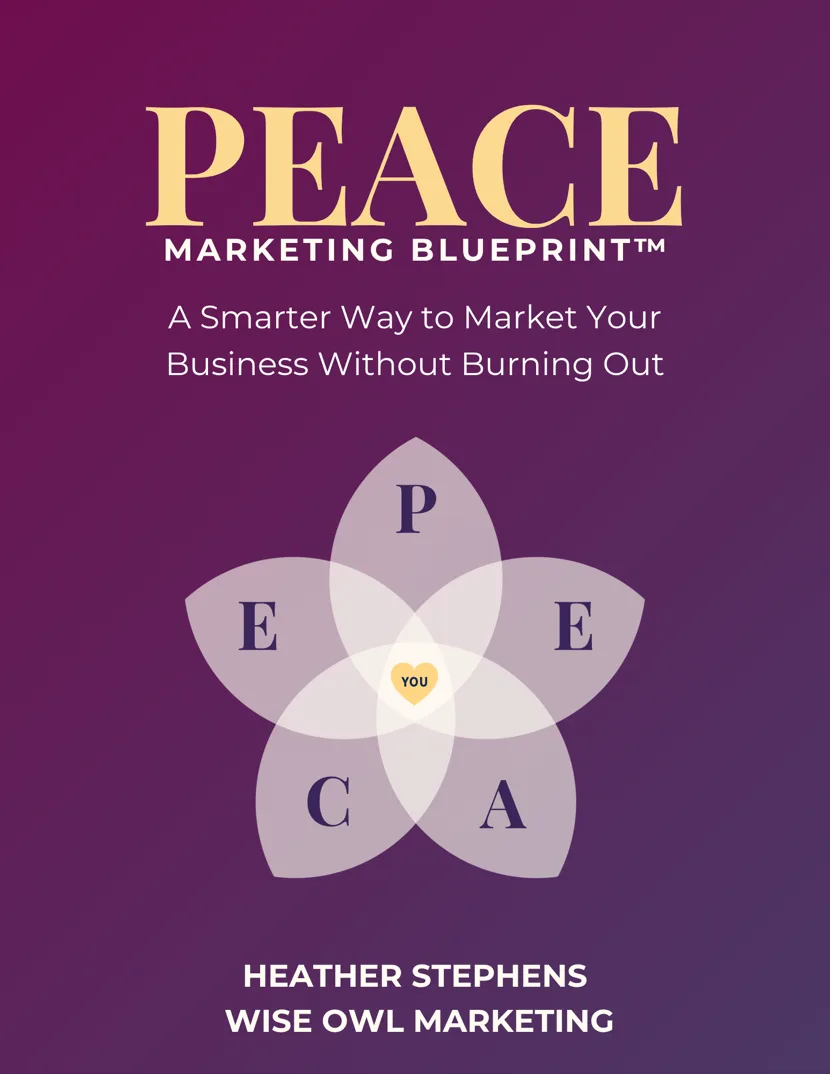

Heather C. Stephens
25+ years in marketing and 11 helping coaches and service providers get found online without burning out. Founder of Wise Owl Marketing and creator of PeacefulBiz and the PEACE Blueprint.
More about Heather →


Get peaceful marketing ideas delivered to your inbox each week.
One practical idea at a time, written like a note from a friend who happens to know marketing. Read it and try it that afternoon.