
If you've drifted from your original goals and vision, you're not the only one. It happens. You're human. And this post is the exact right place you need to be.
In this post (and the video below), I will guide you through my six-step mid-year clarity reset.
Ideal client clarity
Offer audit
Map the client journey
Write your one promise
Update your bio
Fix your homepage
It's designed specifically for coaches and service providers who need to refocus and get back on track with their goals. I also created a free workbook you can follow along with.
This is part of my Peace & Profit Workshop series, where I publish a video and workbook for you each month to help you grow your business. You can opt in to all the videos and grab this month's workbook below.
Subscribe to our YouTube Channel
You Started the Year With a Plan. Let's Get You Back on Track.
Here's a one-hour mid-year marketing reset for coaches with busy lives.
Getting off track from your goals is one of those things that nobody really likes to talk about. You sat down in January and mapped it all out carefully. You described the clients you wanted to work with, the offers you wanted to focus on, how often you were going to show up, and dreamed about the life you hoped your business would help you create. You had a plan.
And then life happened.
Maybe you got busy with clients and couldn't sustain the consistency you were hoping to keep. Maybe you went down a rabbit hole on a fun new project and drifted away from that main thing you said you wanted to build. (I've done that this year, building the PeacefulBiz app when my initial goal was to finish my book.) Maybe the year just got really busy, and your plan got buried below other priorities.
That's okay. That's what this reset is for.
This is the companion post for my Peace & Profit: Clarity video. I made a free workbook to go with it: six exercises that take about an hour total and help you refocus and align your activities with the vision you had for your business and life. You can download the workbook below, open it up, and follow along with the video or work through it on your own time.
Exercise 1: Define Your Ideal Client
You probably did this back in January. Or you have one that you've done in the past. Both are great. Let's do it again anyway.
I know you're probably groaning; this isn't always a fun marketing exercise. But our ideal client research isn't a one-and-done thing. Our ideal clients evolve as our businesses do, and so does our understanding of who we actually love to work with. I recommend revisiting this quarterly, and this is as good a time to do it as any other.
So who are you looking for? The workbook walks you through four things:
They have an urgent problem you can solve. Not a "someday I should deal with that" problem. Something they feel the need to fix now. There's a big difference between someone interested in puppy nutrition and someone Googling "how do I get my puppy to stop biting." One is a "that would be nice" situation. The other is a problem they need solved now so their kids can stop being terrorized. This is a personal example from my own life. My son once spent a whole summer in snow boots when our puppy was going through his biting phase. Your best clients are the ones with an urgent problem.
They can and will get results. Some people are perpetually getting ready to get ready. They buy the courses, sign up for the challenges, and don't do the work. (I know that's not you, right? You're not gonna just read this post and do nothing. Right? Pinky promise?) Your ideal client is someone who takes action. When they show up on your calendar, you want to feel energized and excited because they're making progress. There's nothing worse than feeling like you're dragging a client through the mud and hearing, "I didn't do my homework" on every call. I've been there, and I won't do it again.
They need something you love to deliver. You might be capable of a lot of things. That doesn't mean you should offer all of them. Your ideal client wants the thing that lights you up, not just the thing you can technically do. It's the opposite of the scenario I mentioned above. When you enjoy your work, it's more fun for your clients too, and they feel better about hiring. Trust me, they can tell if your heart is not in it.
They can afford to pay you well. This one matters more than people like to admit. You need clients who can pay you what you actually need to live a comfortable life, not what feels safe to charge. Think about what you need to cover your business expenses, pay yourself, and live without freaking out about bills each month. That number is your starting point for pricing your coaching services.
Check out the pricing calculator if you need help figuring out what this number is.
Pay attention to this, especially if your answers to any of these have shifted since January. Update the workbook and make it the foundation of everything that comes after.
Exercise 2: Audit Your Offers
Here's a question you may not have considered: are the offers you're selling still the ones you actually want to deliver?
It's easy to drift. You added something because a client asked. You kept something because it felt wrong to drop it. And now you've got a lineup that doesn't quite match the business you enjoy.
The offer audit is about getting honest with yourself. Look at everything you're currently selling and ask three things: Does this still light me up? Are my clients getting great results? Does the offer work with my current life? Am I getting paid enough to make it worth the time and energy it takes to deliver it?
If the answer to any of those is no, you're aware of it now. It doesn't mean you have to cut it today. I don't recommend you make any harsh decisions. But the offer might be something to journal on and evaluate when the time is right. The last thing you need is to impulsively cut an offer that's bringing in most of your revenue without another reliable revenue stream to take its place.
The workbook walks you through all of this with a simple grid. List your offers, rate them, and you'll see pretty quickly which ones drain your energy and which ones deserve to stay.
One more thing worth checking: are your offers actually connected to each other? Is there a natural path someone can take from their first yes with you to a deeper yes? If they're floating separately with no thread between them, you're going to want to fix that. A connected offer suite makes your marketing simpler and your client journey smoother. The ideal product suite is one solution for one ideal client with offers providing varying degrees of support. Think DIY, done with you, and done for you.
Exercise 3: Map Your Client Journey
Once you know who you're serving and what you're selling, the next question is: how does someone actually find you and become a client?
This is what I call mapping the client journey. If you've never done this, and your marketing feels random and disconnected, this is most likely why.
The client journey has a few natural stages. First, someone becomes aware you exist. Maybe they find a blog post, a YouTube video, or a friend mentions your name. Then they start to check you out. They may poke around your website, read some emails, maybe watch a few videos. Then they decide to take it a step further. They may book a call, buy an offer, or send you a DM asking for more information.
Your job is to make sure you have something helpful for clients at each stage. A piece of Genius Content that grows your audience and introduces you to cold strangers. A masterclass or challenge or membership or something that builds trust with people who are warming up. Then a clear next step for someone who's ready to move forward, like a discovery call, sales page, etc.
In the workbook, you'll map out what you currently have at each stage so you can spot the gaps. Most people find they have plenty of awareness content but nothing that helps someone move from "I like her" to "I want to work with her." That's where the client journey often crumbles.
So take a look at what you've got. Where are people finding you? What happens after that? And is there a clear path from first hello to yes?
Exercise 4: Write Your One Promise
This is something I see clients often overlooking. I think it's because we're so close to our own work that we can't see it clearly anymore.
Your one promise is the single transformation you deliver. It's not a list of deliverables or things you do. It's not your proven process or proprietary method. It's the outcome your client walks away with, the problem that's solved, or the goal they've achieved with your help.
Here's a simple fill-in to get you started from the workbook:
I help [who] do/get/feel [what] so they can [result].
Keep it simple. One sentence. Don't try to be clever. Clear always wins. If you're writing three sentences, you're describing your offer, not your promise. Keep cutting until there's nothing left to cut.
Write it in the workbook. Then say it out loud. If it sounds like you, keep it. If it sounds like a LinkedIn bio, keep refining it.
Exercise 5: Update Your Bio
Your bio is not a resume. No one really cares about your credentials and certifications. They're fine for your About page and LinkedIn history to show you're legit, but they do not belong in your bio. Your bio should be the bridge between who you are and who your ideal client is looking for.
Most bios are written for the wrong audience. They're written to impress peers, not to connect with clients. So, if yours sounds like, "Jane Smith is a certified life coach with 15 years of experience specializing in mindset, emotional intelligence, and transformational leadership development..." stop. That's not an opener that will make your ideal clients feel seen.
Here's what works better: start with who you serve and what changes for them when they work with you. Then bring in your story, just the part that's relevant to why you do this work. Keep it short enough to read in under a minute.
Here's an example: "Jane helps burned-out professionals stop white-knuckling their way through the week and actually enjoy the work they do. If you've been successful by every outside measure but still feel like something's missing, you're exactly who she works with."
Should you use first person or third person?
Use third person for your official bio, like the one on your speaker profile, media kit, or podcast guest intro. Someone else is introducing you, so it reads naturally when it's "Jane helps burned-out professionals..." rather than "I help..."
Use first person for your about page, social media bios, your email signature, and anywhere you're speaking directly to your audience. "I help coaches attract dream clients without the daily posting grind" lands warmer when it's coming straight from you.
Pull up your current bio right now. Read it out loud. Ask yourself: if my ideal client read this, would they feel like I was talking to them? You're not telling your story here; you're telling theirs. If the answer is no, it's time for an update. The workbook gives you a simple fill-in-the-blank structure to get you there fast.
Exercise 6: Fix Your Homepage
Your homepage has one job: make your ideal clients feel like they're in exactly the right place.
That's it. It's not to show everything you offer or to tell your whole story. We don't need to impress visitors. We just want them to stop scrolling, pause for a moment, and think, "this is exactly what I've been looking for."
Ask yourself: if someone landed on your homepage right now, cold, never heard of you before, would they know within about ten seconds who you help and what you do for them?
If you're not sure, I'm sure your homepage could be better. You either know you've nailed it because it's giving you results or it needs work.
If you've honestly spent too many hours tweaking your site that you can't tell anymore, try asking a friend who doesn't know much about your business, or an AI tool for an impartial opinion.
Start at the top. Your headline is doing the most work on that page. I find that headlines are either too vague ("Welcome to my website") or too clever (a tagline that makes sense to you but nobody else). What you want is clear over clever, every time.
I used to have a headline that said, "Take your business from who's that to who's who." Clever for Wise Owl Marketing, but not clear to anyone landing on my site cold. It now says, "Getting coaching clients shouldn't cost you your peace."
Once you have your headline dialed in, then look at your first button or call to action. Where does it send people? Is that where you actually want them to go right now? A homepage that was set up two years ago might be pointing people toward an offer you don't even sell anymore.
Work through the homepage section in the workbook. It walks you through each piece from top to bottom so you don't miss anything.
Frequently Asked Questions
Do I need to start over completely if I've drifted from my original plan?
No. That's actually the whole point of this exercise. You're not throwing out what you built; you're getting back into the groove of what you've already planned. Most of the time, a mid-year reset takes an hour or two. We're not doing a full rebrand here. Start with the workbook and see what still fits before you change anything.
How often should I go through this kind of clarity exercise?
I recommend revisiting your ideal client, your offers, and your one promise at least quarterly. Things shift. Life happens. Client needs shift. A quick check-in every few months keeps your marketing pointing in the right direction without turning it into a big project.
What if I'm not sure who my ideal client is anymore?
That's more common than you think, and it's actually a good sign because it means you've grown. Go back to basics in the workbook: who do you love working with, what problem can you solve that feels urgent to them, and what do you love delivering? Start there. The clarity usually comes faster than you expect. And if you don't know, guess. Then pay attention to your discovery calls, emails, and client engagements. Listen to the words they use, the problems they talk about, challenges they experience, etc. Your ideal clients will tell you who they are.
What's the difference between my one promise and my tagline?
Your tagline is for the outside world. It's often short, catchy, and memorable. Your one promise is for you. It's the internal compass that makes sure everything you say and sell points in the same direction. Get the promise clear first. It will make writing your tagline so much easier.
I've redone my bio a dozen times, and it still doesn't feel right. What am I missing?
Usually you're writing it for the wrong person. If your bio sounds impressive but doesn't make your ideal client feel seen, it's not doing its job. Try reading it from their point of view. Does it answer "is this person for me?" If not, start with what your clients need, and work from there.
Ready to Get Refocused?
Download the free Peace & Profit Clarity Workbook and work through all six exercises at your own pace. It's a Google Doc, so you can type right in or print it and write by hand, whatever feels most peaceful to you.
And if you want a clearer picture of where your marketing stands right now, take the Free Peaceful Marketing Quiz: Why Your Marketing Feels So Hard (And What to Do About It). It's built around the PEACE framework and gives you a personalized next step based on where you actually are.
Whenever you're ready, here's how I can help
Start free and go at your own pace. No pressure, ever.
- Free: Keep reading the blog and subscribe on YouTube. I share everything I know.
- DIY: Get the PeacefulBiz app to organize, plan, create, and simplify your marketing.
- Guided: Join the Peaceful Marketing Lab, and let's build together.
- Direct: Book a strategy call for 1:1 help, a custom website, or to decide which program is right for you.
Want the whole framework?
The PEACE Blueprint Guide walks you through all five pillars, with planner pages to build your own peaceful marketing system.
Get the free guide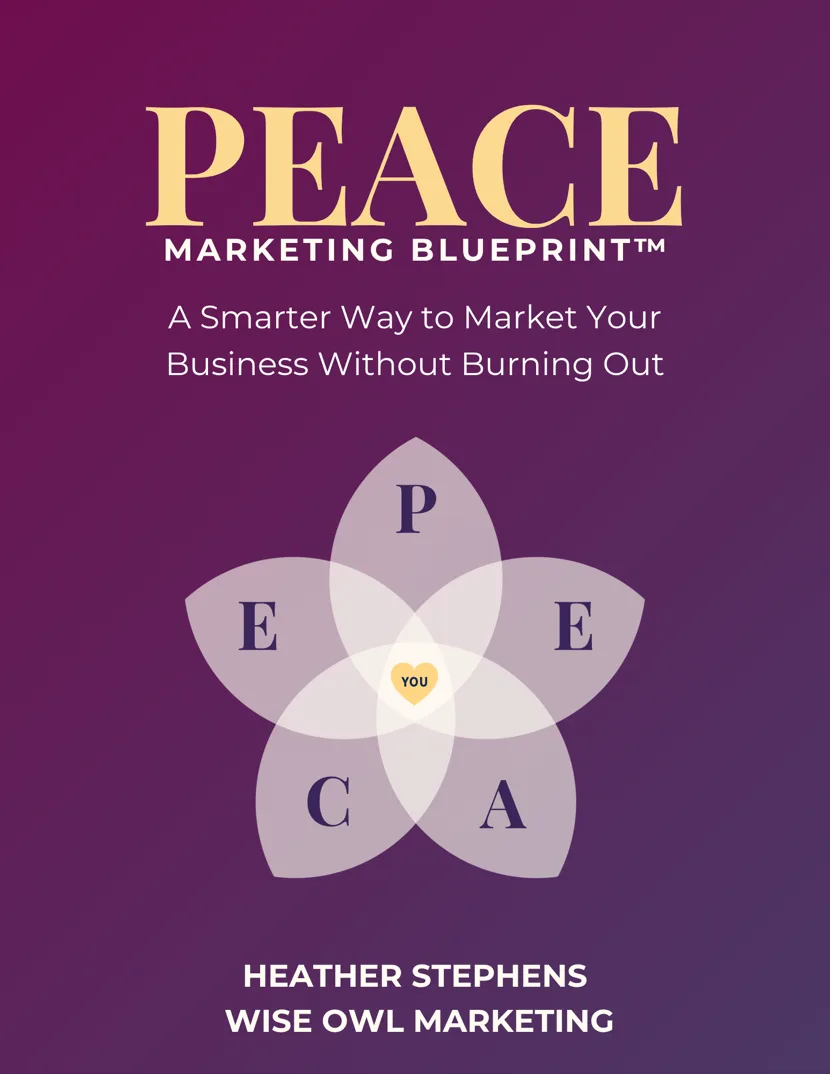

Heather C. Stephens
25+ years in marketing and 11 helping coaches and service providers get found online without burning out. Founder of Wise Owl Marketing and creator of PeacefulBiz and the PEACE Blueprint.
More about Heather →

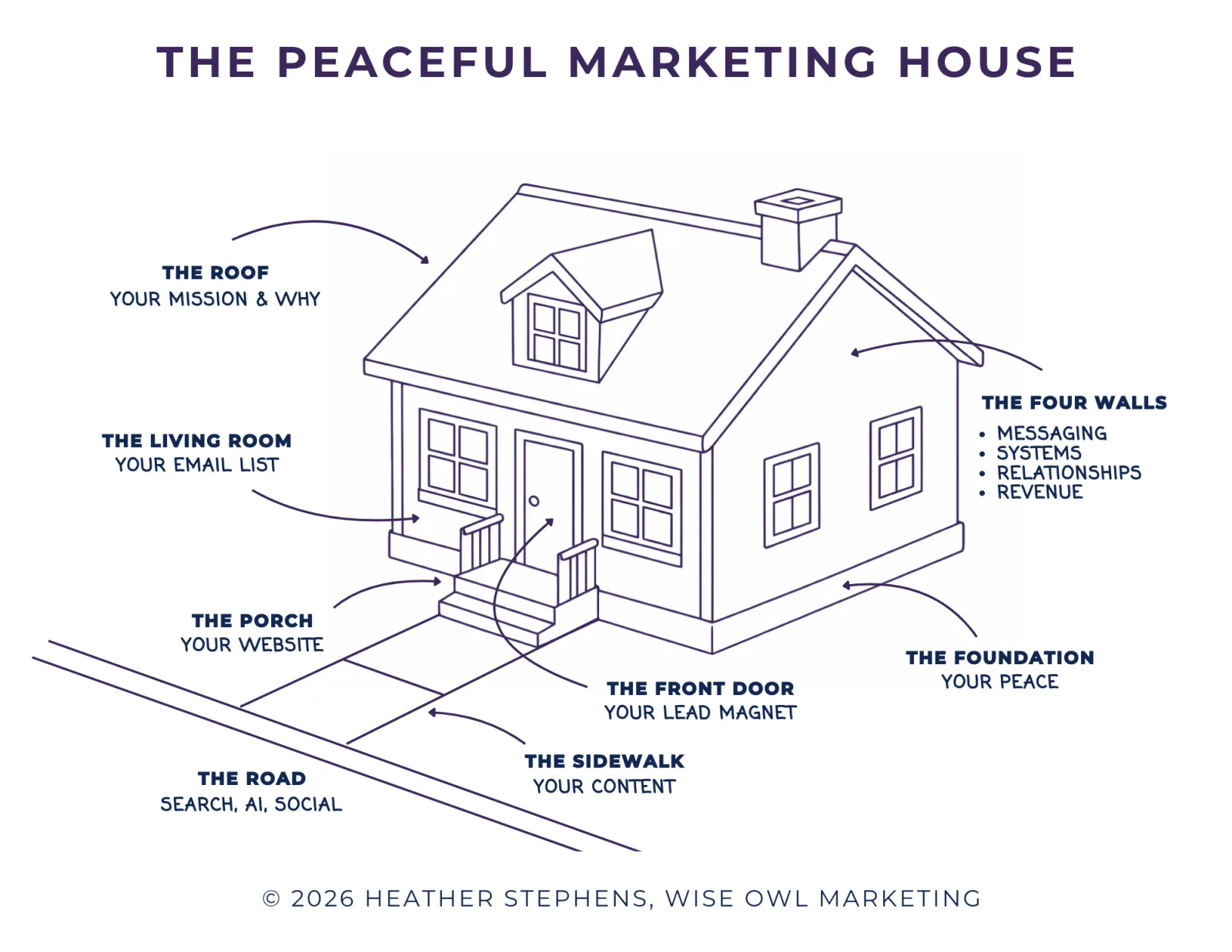
Get peaceful marketing ideas delivered to your inbox each week.
One practical idea at a time, written like a note from a friend who happens to know marketing. Read it and try it that afternoon.