How to Get Clients Without Social Media: 12 Proven Strategies for Coaches that Work in 2026
By, Heather Stephens

Updated January 2026
In 2024, I made a decision to step away from social media. My initial intention was to take a month off. It turned into an entire year.
I was in one of those seasons where stepping back was necessary to take care of myself and my family. I had too much on my plate. Something had to give. I chose to let go of social media.
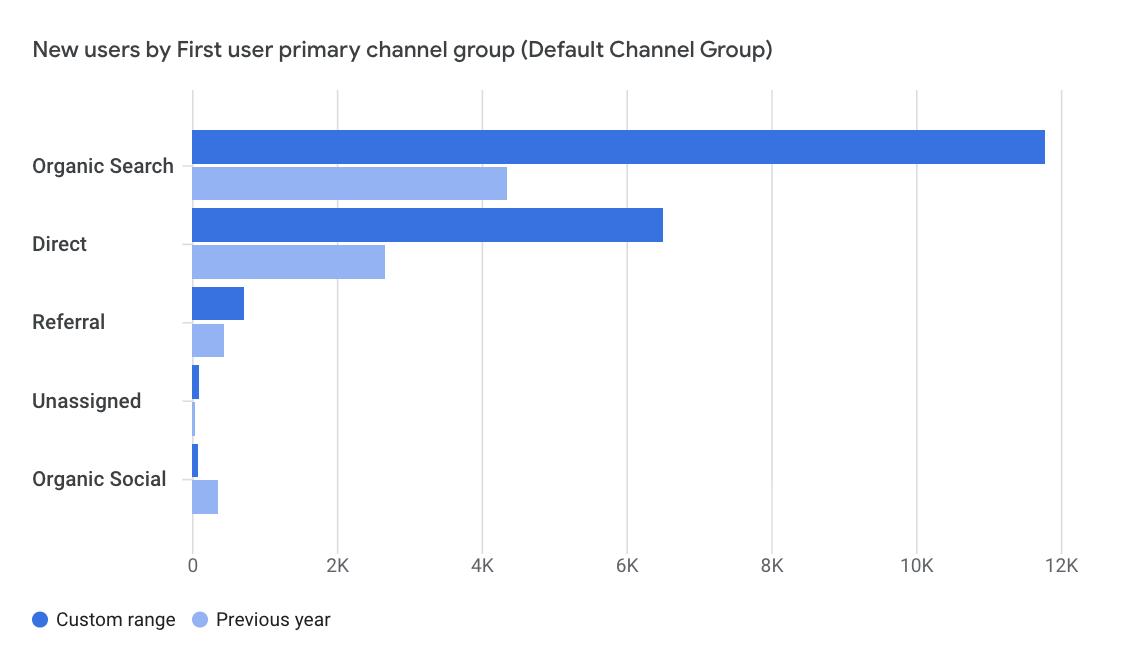
Here’s what happened to my business: my organic search traffic grew 170% year over year during the time I stopped posting on social media.
I wasn’t publishing new blog posts every week. I wasn’t showing up on social media. What I was doing, when I had the energy, was updating old posts. Making them more current. More comprehensive. More useful.
Google rewards that. So do AI search tools.
The landscape is still changing faster than ever. AI tools like ChatGPT and Perplexity now answer many questions directly, which means we’re all receiving fewer clicks even when we rank well.
But here’s what hasn’t changed: the same comprehensive, helpful content that grew my traffic 170% is now what AI tools cite as sources.
The coaches who invested in depth over volume are the ones getting referenced. The strategy evolved from “rank and get clicks” to “create content so good that AI tools trust and cite you.”
The Shift in Search:
- OLD positioning: Create comprehensive content so Google recommends you to its users
- NEW positioning: Create comprehensive content so AI & Google recommend you to their users
The core principles remain:
- Evergreen beats ephemeral.
- Systems beat hustle.
- Quality beats quantity.
- Trust is everything.
The SEO-rich blogs I’d published in the past kept working while I couldn’t.
Not despite my absence from social media. Because I’d spent years building something else entirely.
My content of choice has always been blogging. I enjoy writing because it doesn’t require being camera-ready, a quiet house, or hours of video editing. For years, I felt guilty about that, like I should be doing more (Reels, TikToks, live streams). I did post on social media, but I never loved it.
Takeaway: If a platform drains you, your consistency will eventually break. Choose a format you can sustain for 6–12 months.
What I didn’t realize all those years was that putting my focus on blog content instead of social media would pay off in spades down the road.
Even though I was radio-silent on social and not actively publishing new articles, my old blog content kept working, bringing ideal clients to my. My email sequences kept nurturing leads automatically. The referral relationships I’d built over two decades kept sending people my way.
I didn’t realize I’d been building what I now call a Marketing Emergency Fund. I was just doing what I’d always enjoyed and intuitively knew: that creating evergreen content and smart systems makes more sense than running on the content hamster wheel every day.
If you’ve ever felt overwhelmed by everything marketing seems to require, or like you’re supposed to love showing up online but you just… don’t, I get it. You’re not alone. Marketing advice often assumes you have unlimited time, unlimited energy, and unlimited enthusiasm for being visible. Most of us don’t.
I’m going to show you exactly how coaches and service providers can get clients without social media. Not theory. The actual strategies that kept my business running while I couldn’t show up.
This isn’t a quick hack or a shortcut. Building a social-media-free client attraction system takes time, typically 6-12 months before you see significant results. But unlike social media, where you have to show up continuously to stay top of mind, these strategies compound. The work you do today keeps working for years.
Let’s dive in.
Listen to the podcast of this blog post
This audio podcast summary was generated with AI
View Transcript ⌄
How to Get Coaching Clients Without Social Media Deep Dive
[00:00:00] Welcome back to the Deep Dive. Yeah. Today we are, uh, we’re unpacking a topic that I think is gonna hit very close to home for a lot of you mm-hmm. I mean, if you are. Routing a business or building a personal brand or even just trying to exist online in, you know, 2025. You probably know the feeling I’m talking about.
Oh, absolutely. It’s that gnawing pit of the stomach anxiety that just says, if I stop posting, I stop existing. The fear of invisibility, it’s a very specific kind of, um. Modern dread. Exactly. It’s the hamster wheel. Mm-hmm. You’re exhausted, you’re completely burnt out. You’re staring at your phone at nine o’clock at night trying to think of a witty caption for a photo of your laptop, but you’re terrified to stop that verified because you’ve been told that the algorithm is this hungry beast that you have to feed every single day.
Where else? Right. And it’s really visceral fear. Yeah. The first thing we need to acknowledge, and this based on the research we’re looking at today, is that this isn’t just a feeling. It’s not you being dramatic. It has real consequences. [00:01:00] It has real physiological consequences. We are pulling data from founder reports.
That paints a pretty stark picture actually. Yeah. 87.7% of entrepreneurs are struggling with mental health issues. That is wow. That is a staggering number. Nearly 90% that is, and over a third are actively experiencing burnout like right now. Wow. And when you dig into the root causes in that report, a massive driver is this whole hustle culture narrative.
The idea that you have to show up daily. Be everywhere beyond 24 7. It’s the pressure to perform for an algorithm that frankly doesn’t care about your wellbeing at all. Not at all. It’s just a machine. But here’s the pivot, and honestly, it’s the reason we are doing this specific deep dive today. What if that fear that if you stop posting, your business just dies?
What if it’s a lie? What if the model itself is the problem? Right? What if the Feed the Beast model isn’t just exhausting, but it’s actually inefficient? We’re looking at a case study today from Heather Stevens at Wise All Marketing [00:02:00] that just completely upends that entire narrative. This is the hook. I mean, it’s fascinating.
In 2024, Heather didn’t just. You know, cut back a little. Yeah, she stopped. She stopped using social media for her business for a full year. A whole year. Cold Turkey. Cold Turkey. No Instagram stories, no LinkedIn thought leadership posts. No tweets, nothing. She stepped away due to personal necessity, you know, family issues, life just happening.
And she let the feeds go completely silent. Okay, so conventional wisdom says her leads should have just dried up. Her revenue should have tanked. I mean, if you weren’t visible, you aren’t viable. Right? You, you would think so. That’s what we’ve all been told, but the data shows the exact opposite. Okay.
Instead of collapsing her organic search traffic, so people finding her through Google it. It grew by 170% year over year. Wait, 170% growth, 170% while doing zero social media. That, okay? That is the number we need to anchor on today, because if that is possible, it [00:03:00] means the hamster wheel isn’t the only way to power the generator.
It’s not, and to be clear, the mission of this deep dive isn’t just to tell you to quit social media and you know, hope for the best. That’s not a strategy. No, that’s not a strategy. That’s just quitting. Yeah. We’re gonna unpack exactly how she did it. We’re gonna walk through what she calls. Peaceful marketing, which involves 12 specific ways to get clients that have absolutely nothing to do with the social media algorithm.
I love that term, peaceful marketing. It sounds like a spa treatment for your business strategy or something. It really does. And she buckets these 12 strategies into two core pillar. She argues that, you know, when you strip away all the noise, there are really only two sustainable ways to get clients without social media.
Okay? What are they? Pillar one is content that brings clients to you. So think searchable, discoverable assets. And pillar two is relationships that bring clients, which is all about borrowed audiences and referrals. Before we get into all 12 [00:04:00] strategies, though, I wanna spend a minute on the math because I think a lot of us feel the exhaustion of social media, but we don’t realize there’s a mathematical reason for it.
It’s not just that we’re tired, it’s that the system is kind of rigged against longevity. This is the concept of content halflife. It’s so crucial to understand if you wanna reclaim your time and your sanity. We’re drawing on research by Scott Graffio from 2025, and what does halflife mean in this context?
He measured the time it takes for a piece of content to receive 50% of its total lifetime engagement. So basically, how long does the post actually live before it just starts dying? Okay, so if I post a video on TikTok, how long do I have to make an impact? Minutes? I mean, the, the K on TikTok is effectively instant unless you go viral immediately.
The content is dead in the water almost as soon as it hits the feed. It’s a flash in the pan. Right. Okay. What about something like Facebook that feels a bit more permanent? You’d think so, but not by much. Facebook is about 81 minutes. 81 minutes. So let’s just play that out for a [00:05:00] second. You spend an hour, maybe more designing a graphic in Canva, writing the copy, checking hashtags, getting everything perfect, you post it.
Mm-hmm. And an hour and a half later, it’s basically old news. Mm-hmm. It’s buried under a mountain of. Cat videos and you know, political arguments. Precisely, yeah, it’s already gone. It gets slightly better on Instagram where the half-life is around 19 hours. But even there you are on a 24 hour cycle, you are constantly resetting the clock to zero every single morning.
Every morning. It’s the literal definition of a treadmill. Now, compare that to these peaceful marketing channels we’re about to talk about. This is where the whole paradigm shifts a blog post. The Half-Life is roughly 1.97 years. Whoa. Years versus minutes. Yeah, that is a massive difference In asset class.
We’re not even talking about the same thing. That’s not even comparable. Pinterest pins last about 3.88 months. And things like YouTube videos or podcast episode, they don’t just last. They often compound. They get more valuable over time, right? You’ll see videos from [00:06:00] three years ago suddenly spike in traffic all the time because they answered a question someone just happened to search for today.
This brings up the whole opportunity cost concept, doesn’t it? Right? Every hour you spend creating a disposable Instagram story is an hour you didn’t spend creating a permanent asset. You’re renting attention for a really high price instead of owning an asset that pays you dividends for years. I love the financial analogy the source material uses here, the marketing emergency fund.
Can you break that down, because I think this framing just changes everything. It’s brilliant. Most of us are familiar with Dave Ramsey’s concept, right? Yeah. A financial emergency fund, you have three to six months of expenses saved in cash. So if a crisis hits, you lose your job. The car breaks down, you aren’t destitute, you have a cushion, you have time.
Heather applies this exact logic to marketing. She draws a distinction between a social media stockpile and a real marketing emergency fund. Yes, and this distinction is absolutely vital. A social media [00:07:00] stockpile is what we all usually do. You say, okay, I’m going on vacation for a week, so I need to batch, create and schedule seven posts.
So the algorithm doesn’t forget me, right? You’re filling the content calendar. You are, but it functions like a checking account. You spend the posts and when the week is up, the account is empty. You come back from vacation to zero momentum, and frankly, a lot of pressure. Whereas the Marketing emergency fund is, it’s an investment portfolio.
It’s a collection of assets, your SEO blogs, your evergreen videos, your nurtured email sequences that continue to generate leads in sales even when you aren’t working. It’s interest earning interest. The story of Kathy in the notes really brought this home for me. It’s a heavy story, but it illustrates why this matters so much beyond just business growth.
It’s about life. It is, yes. Kathy was a tutor and she experienced a really profound tragedy, the loss of a loved one. And as anyone who’s been through that, your business is the absolute last thing on your mind. She was dealing with grief, [00:08:00] hospice care. Estate planning, all the heavy human stuff that takes a hundred percent of your energy.
She had to step away from her business entirely. In a hustle culture model where you have to show up on stories every day to get paid, her income would’ve just vanished. It would hit zero. Yeah, instantly. But because she had built this marketing emergency fund, because she had blog posts that were ranking on Google and automated email sequences, her business kept onboarding new students while she was grieving.
The systems were just. Running on autopilot. That is the dream, isn’t it? I mean, to build something that supports your humanity rather than you having to sacrifice your humanity to support the business, that’s the entire goal. It’s freedom. It’s not about being lazy, it’s about being secure. Okay, so let’s get practical.
I’m sold on the concept. How do we actually build this thing? Let’s dive into pillar one, searchable content strategies. The mantra here is be findable, not famous, findable, not famous. I love that framing. It just removes all the ego from it. Yeah. You know, you don’t need a million [00:09:00] followers to have a million dollar business.
You just need to be the answer to the specific question. Your ideal client is typing into Google at two in the morning. So strategy number one is SEO optimized blogging. Now I can hear some listeners rolling their eyes. Blogging is dead. No one reads anymore. It’s 2026. But the data says something very different.
Blogging is absolutely not dead, but I would say diary blogging is dead. Okay, that’s a good distinction. Nobody cares what you had for breakfast or your random musings on the weather. What is alive and kicking is problem solving, blogging. The key here, according to the source, is specificity. Heather gives a great example of this with her own rankings, right?
She does. So she has content around the topic of lid magnets. Now, if she tries to rank for that generic term lead magnet, she’s competing against HubSpot, Wikipedia, these huge marketing firms with million dollar budgets. She ranks a position 68, so she’s on page seven of Google. She’s invisible. She’s effectively [00:10:00] invisible.
Nobody goes to page seven unless they are absolutely desperate or, you know, doing a deep research paper. But when she targets the phrase lead magnets for coaches. She ranks position one. That is the power of the niche. It’s the long tail keyword strategy. And think about the intent behind the search.
Someone searching lead magnet could be a student, a software developer, anyone, someone searching lead magnets for coaches is her exact ideal client, probably with a wallet in hand looking for a solution right now. There’s also a new layer to this that didn’t really exist five years ago, and that’s the AI factor.
This feels huge. This is fascinating. We are moving from search engines to answer engines. We’re talking about chat, GPT, clawed, perplexity, Gemini, all of them. Okay. When you ask chat GPTA question, where does it get the answer? It doesn’t know things. Mm-hmm. It scrapes the web. It reads blog posts. It synthesizes information so you aren’t just writing for humans anymore.
You are literally writing to be the [00:11:00] source of truth for the ai. Exactly. Heather mentions a client of hers, Rachel, who actually landed a new client because chat, GPT recommended her blog post in a conversation. How did that work? The user asked chat GPT for advice on a specific topic, and the AI said, according to this article by Rachel.
Then it linked directly to her blog. If you don’t have searchable text content, you are completely invisible to the ai. You’re cutting yourself out of the entire future of search. That is a huge insight. So blogging isn’t just about Google anymore. It’s about feeding the AI so it can recommend you. Okay.
Strategy number two is YouTube. The source calls this triple discoverability. Yeah, YouTube is an. Absolute powerhouse because it works in three ways at once. First, it is the second largest search engine in the world right after Google itself. People treat it like Google. They do. They search how to bake sourdough, how to fix my sink, how to deal with anxiety, right?
Second, Google actually ranks YouTube videos in its standard search results. Yes. [00:12:00] So often you’ll see that video carousel right at the top of the Google page. You’re getting double exposure. Okay? And third, you have the recommendation engine. YouTube is incentivized to keep people watching. So it will dig up your video from two years ago and show it to a new viewer if it thinks it’s relevant.
You definitely don’t get that on Instagram. They are not digging up your reels from 2022 and showing them to new people. Never. The feed is ephemeral. It’s gone. YouTube is a library. Now for the introverts listening, or maybe the camera shy listeners, is this a deal breaker? Do you have to be some high energy YouTuber?
No, and the source is very, very clear on this. Faceless videos are a massive opportunity, especially for coaches and consultants. How so? Well think about it. If you’re teaching someone how to use a piece of software or walking them through a financial framework, a screen share, or a slide deck. Is often more valuable than just seeing your face talking.
That’s true. I’d rather see the spreadsheet than the person talking about the spreadsheet. Exactly. [00:13:00] You don’t need to be a charismatic TV personality. You just need to be helpful. Hmm. And there’s a hub strategy here too. You don’t just let the video live alone on YouTube. You embed it into a blog post on your own site.
Asset stacking. I like that. Right now you have the video for engagement and all the text for SEO, you’re doubling the surface area for luck to strike. Okay. Strategy number three is podcasting. Obviously we’re a little biased here. We think audio is king, but from a client acquisition perspective, what’s the unique value proposition of a podcast?
It’s the binge factor and the intimacy. When someone discovers a podcast they like, they don’t just listen to the newest episode. No, they scroll back, they listen to the last 10, they listen to the best of. This extends the shelf life of your content to 18 to 24 months easily, and the trust factor is just wild.
The stats are incredible. 63% of listeners trust podcast hosts more than social media influencers, and it makes sense, right? You’re in their ears while they’re walking the dog doing the dishes, [00:14:00] commuting. It’s a very intimate connection. It is. It’s very different from a 15 second TikTok dance where you’re just trying to grab their attention for a second.
But the discoverability can be tricky with audio, right? I mean, you can’t just upload an MP three and expect Google to find it. That’s the catch. You’re right. Google can’t listen to audio files yet, or at least not perfectly enough to index them for search rankings. You must have show notes. So you need a page on your website, a dedicated page on your website with the transcript, the key takeaways, and the links.
That is how you turn a podcast episode from just an audio file into a searchable long-term asset. Got it. Make the audio readable for the bots. Okay. Strategy number four is Pinterest, and this is one that I think people constantly miscategorize. I know I used to, it is the misunderstood giant. Everyone thinks Pinterest is social media.
It’s not. It is a visual search engine. What’s the distinction in user behavior there? Intent? Yeah. It’s all about intent. Yes. People go to Facebook to connect with friends or you know, argue about politics or just kill time. People go to [00:15:00] Pinterest to plan, to plan. They’re planning a wedding, a home renovation, a business launch, a self-improvement journey.
They are in a future focused problem solving mindset. And it’s not just for recipes and hairstyles anymore. Oh, not at all. For coaches, especially in niches like wellness, life coaching organization, career finance. It is an absolute gold mine, and the lifespan of a pin is months, often, years. It just circulates for a very, very long time.
But the strategy here isn’t just post a pretty picture, right? You have to understand the mechanism. No, no. The pin is just a signpost. The destination is your website. Every single pin should link back to a blog post or a lead magnet. You are siphoning that high intent traffic off of Pinterest and onto your own property.
Okay, so we have the four engines of searchable content, blogging, YouTube, podcasting, and Pinterest. These are the things that work while you sleep. They build your emergency fund right? Before we get to the relationship pillar, we have to talk about the bridge [00:16:00] because all that traffic is just vanity. If it doesn’t convert, we need to talk about the email list, the asset you actually own.
We cannot overstate this. If your entire business is built on Instagram or TikTok, you’re building on rented land. Rented land. That’s the perfect way to put it. We have seen it happen a thousand times. Accounts get hacked, algorithms change. Entire platforms get banned. If Mark Zuckerberg decides to change the rules tomorrow.
You could lose everything overnight unless you have the email list. That’s your database, that’s yours. The email list is the only thing you truly control. And the ROI. The return on investment, it’s just math. It’s not even close. Email marketing returns about 36 to $42 for every single dollar spent.
Compare that to social organic reach. Facebook’s organic reach is currently sitting at a dismal 1.37%. Ouch. So if I have a thousand followers, maybe 13 people see my post, if you’re lucky. Yeah, yeah. Whereas if you have a thousand email subscribers, 100% of them receive the email in their [00:17:00] inbox. Now open rates are usually 20, 30%, but it’s not even a competition.
The ecosystem Heather describes is really clear here, the content, the blog or video attracts the traffic. Mm-hmm. The lead magnet captures the email. The welcome sequence nurtures the trust, and then the sales sequence converts. But there is a trap here called low hanging fruit rot. Yes. This is such a common mistake.
Yeah. People said at the lead magnet, they collect the emails. And then they never email the list, right? They don’t wanna bother people. They don’t wanna be annoying. They think I’ll email them when I have something perfect to say, or I’ll email them when I launch something in six months. And in the meantime, the list goes cold.
An email list that you never talk to is worthless. You have to nurture the asset. You have to treat those people like humans who actually ask to hear from you. You need a regular rhythm. Okay, let’s pivot. Let’s go to pillar two. Relationship strategies. We’ve built our content engines. Those are the robots working for us 24 7.
Now we need to talk about people. [00:18:00] The core concept here is borrowed trust, borrowed audiences. It’s a great concept. It’s the idea that instead of trying to build an audience from scratch, one person at a time, you go where your ideal clients are already gathered and you leverage the trust they have in someone else.
Exactly. Host a partner. And you transfer that trust from them to yourself. Strategy, hashtag five is the sister post strategy. I wanna deep dive on this because it seems to solve a huge problem with guest blogging. Usually you write a guest post for someone, their audience reads that they think, ah, that was nice.
And then they just stay on that site. Exactly. It’s a dead end. You get a little exposure, but exposure doesn’t pay the bills. The sister post strategy creates a bridge. Walk us through the mechanics. How does this actually work? Okay, so let’s say you’re a productivity coach. You write a guest post. For a popular business blog, and the title is Why you are Always Tired.
That’s part one. It lives on their site. It has to be high value, not fluff. It diagnoses the problem beautifully. Okay. So they read it and they [00:19:00] feel seen. They feel understood. Right. But you structure it so that the natural next step, the specific how to framework or the implementation guide is in part two and part two lives on your website.
Ah, okay. So at the end of the guest post, you say, you say something like, to get the exact five step checklist to fix this. You can read part two right here. You link to your site, now you have moved that reader from the borrowed audience onto your own turf. And on that part two page on your site, what do you have?
Your lead magnet? Yeah, your email capture form. Exactly. You turn a passive reader into an active lead. It’s a seamless user journey that really respects the reader, but also serves your business that is so smart. It’s not just hoping they click the link in your bio, it makes the click part of the actual solution you’re offering.
Precisely. Okay. Strategy hashtag SA is podcast guest. We talked about having your own show, but guesting is often faster because you don’t have to do all the production work. It is, but you have to have the right mindset. The source calls it the [00:20:00] gift, not the grab. The grab. What does the grab look like? I feel like I get these emails all the time.
You probably do. The grab is the pitch email that says Hi. I’m awesome. I’ve made millions of dollars. You should put me on your show so I can talk about myself. Here’s my bio. Yeah. Hosts hate that. It’s self-serving. It’s boring. It’s boring. The gift on the other hand, is pitching a topic. It’s, hi. I listened to your episode about burnout.
I have a specific framework that helps entrepreneurs recover from burnout in 30 days. I’d love to share that actionable strategy with your audience. You’re offering to solve a problem for their listeners. You’re making the host look good. You’re making them look good by providing value, again, quality over quantity, always.
One interview on a really niche podcast with 500 super engaged listeners who are your exact target market is worth more than 50 interviews on some random general business show with huge numbers, but the completely wrong audience. Strategies. Hashtag [00:21:00] seven and hashtag eight are bundles and collaborations.
These are huge in the coaching world right now. They are, A bundle is basically a digital goodie bag. A group of creators get together, they all contribute a course or a template or something, and they offer it as a package usually for free or a very low price in exchange for email addresses. It’s a great way to grow a list really fast.
I mean, I’ve seen people add thousands of subscribers in a single week with these. There’s a catch, isn’t there? There is. It’s the freebie seeker problem. If you participate in a bundle that’s too broad or not aligned, you’ll fill your list with people who just want free stuff and will never, ever buy from you.
You’ll actually damage your email deliverability. So you have to be very selective. Very. The partners in the bundle need to align with your values and your price point. Otherwise, it’s just noise. Okay. Strategy hashtag nine is one that makes everyone squirm. Referral systems, the peaceful ask. We all hate asking for referrals, don’t we?
We feel like desperate salespeople. Please [00:22:00] tell your friends about me. It just feels needy. It feels gross. So how do we fix it? The key is all in the timing and the framing. You don’t ask when you send the final invoice. You ask after a win. When they’re at their happiest. Exactly. They just got a result.
They’re feeling grateful and excited, and the script is so simple. You don’t say, do you know anyone who wants to buy my coaching? And say, I really enjoyed working with you on this. If you know anyone else who is dealing with this specific problem, I’d love to help them too. I’d love to help. That shifts the energy completely.
It’s an offer of service, not a request for business. Exactly, and you have to close the loop. This is just basic human psychology. If someone refers you, thank them. Immediately send a handwritten note, send a Starbucks card, send a small, thoughtful gift. If you reward the behavior, the behavior gets repeated, and if you ignore it, they will never refer you again.
Why would they? Right. Okay. Strategies 10, 11, and 12. Cover partnerships, speaking and networking. Heather specifies peaceful [00:23:00] networking, which is just music to the ears of introverts everywhere. This isn’t about working a room at a big conference and handing out 500 business cards and making frantic small talk, and that is my actual nightmare.
It’s most people’s nightmare. Peaceful networking is all about depth. It’s one-on-one coffee chats. It’s curated small groups. It’s building real, genuine relationships with peers who serve the same audience, but in a different way. Like a copywriter partnering with a web designer. Exactly. You prefer clients back and forth.
It’s symbiotic, not competitive. It’s a win-win. It’s interesting as we look back at this list, blogging, YouTube, podcasting, Pinterest, sister posts, guesting bundles, collabs, referrals, partnerships speaking, networking. Not a single one of them requires a daily feed post, not one. And that is the liberation of this whole concept.
You can build a massive, thriving business without ever having to dance on TikTok. You could just opt outta the hamster wheel. Now we do have to look at the future a little bit because the landscape is always shifting. The [00:24:00] expert in our source material brings up a concept called social search. This is a really crucial nuance.
We aren’t seeing social media is completely useless forever. We’re saying the way people use it is changing How, so? Younger generations, gen Z, specifically, they’re using TikTok and Instagram as search engines. Something like 24% of users are searching for answers on these platforms instead of going to Google.
So if you do decide to keep a toe in the social media waters, you shouldn’t be treating it like a diary anymore. No, you should treat it like a library. You optimize your captions in your onscreen text with keywords. You apply SEO principles rather than just, you know, chasing trending audio. So you wanna be found when they search how to budget, not just seen when they’re doom scrolling.
It’s about being discoverable. Not just viral. It all comes back to intent. Search is high intent, scroll is low intent. Now, I wanna ground all of this in reality, because if someone is listening to this and thinks, great, I’ll start a blog today and I’ll be rich next week. [00:25:00] They’re gonna be so disappointed.
We need to talk about the timeline. This isn’t a quick fix. No. And Heather is very, very honest about this. Mm. This is a six to 12 month build. You’re planting an orchard. You’re not just buying groceries for tonight. It takes time for the trees to bear fruit. Let’s break down the phases so people know what to expect.
Okay, so months one to three are the foundation. You pick one content format, just one a blog, or YouTube or a podcast. Do not try to do all three at once. And you set up your email list. That’s it. Focus on quality and consistency. You’re just getting the muscle memory working. And months four to six, this is the habit phase or what I like to call the valley of despair.
Huh? You’re showing up consistently. The seeds are germinating underground, but you probably don’t see the traffic yet. You might feel like you’re talking to yourself. This is where most people quit. You have to just trust the process. And then months six to 12, that’s expansion. This is where you add the relationship strategies.
You’ve got [00:26:00] your content rhythm down. So now you start guesting on podcasts or doing sister posts to accelerate the traffic. You’re pouring gasoline and the fire you’ve already built. And year two and beyond compound growth. This is when the magic really happens. The blog posts from year one start ranking on page one of Google.
The referrals start flowing from the partnerships you built. The flywheels start spinning on its own. Your assets are finally working harder than you are. It’s a long game. But the prize is a business that doesn’t own you. The prize is a business that survives your life. So as we wrap up this deep dive, I just wanna remind everyone of the core message here It is about choice.
You do not have to do all 12 of these things. In fact, please don’t. That would just be a different recipe for burnout. Exactly. Pick the one that aligns with your strengths. If you’re a great writer, blog, if you’re a talker, podcast, if you love to teach, do YouTube videos, but build an asset. And remember the proof.
Heather stepped away for a year. She didn’t just survive. She grew [00:27:00] 170%. The fear of invisibility is real, but the data says you can be visible in a different, more permanent, and frankly, more peaceful way. Before we go, I wanna leave you all with a provocative thought from the expert. It’s a question. It’s a question I want every listener to answer honestly, for themselves right now.
If you couldn’t create any new content for six months starting tomorrow. Maybe you get sick, maybe you just need a break. Would your business survive? Oof that that hits hard? If the answer is no, then it is time to stop stockpiling content for tomorrow and start investing in assets for next year. It’s time to build your marketing emergency fund, and if you’re trying to figure out which of these paths is the right one for you, the source material offers a peaceful marketing assessment to help you identify what to fix, what to keep, or what to let go of.
We’ll make sure to link that in the show notes. Action is the antidote to anxiety. Start planting the seeds today. Thanks for diving in with us. Here’s to building a business that lets you live your life. We’ll see you [00:28:00] in the next deep dive.
Discover What’s Holding You Back in Your Marketing
Before we dive into today’s strategies, it helps to know where YOU naturally thrive in marketing, and where you might be overcomplicating things.
Take the Peaceful Marketing Assessment
This free 5-minute assessment reveals your unique marketing profile and shows you exactly where to focus your marketing efforts based on your strengths, your business stage, and your capacity.
You’ll discover:
- Your natural marketing strengths (so you can lean into them)
- Where you’re likely overcomplicating things
- The ONE area to focus on next for the biggest impact
- A personalized action plan based on your results
TL;DR: The “Marketing Emergency Fund” Strategy
If you’re tired of the social media content hamster wheel, you aren’t alone. This post explores how to build a business that thrives on searchable, evergreen assets rather than daily posts.
- The Problem: Most social media content has a half-life of less than 24 hours, meaning your hard work disappears almost instantly.
- The Solution: Build a “Marketing Emergency Fund” using platforms like Blogging, YouTube, Podcasting, and Pinterest, where content can drive traffic for months or even years.
- Key Growth Driver: By shifting focus to SEO and searchable content, you can see massive growth in organic traffic (up to 170% YOY) even during seasons when you aren’t actively posting.
- Additional Strategies: Leverage Borrowed Audiences (podcast interviews and guest posts) to build trust quickly and funnel those leads into an Email List, the only asset you truly own.
Table of Contents
Why Social Media Isn’t Required (But You’ve Been Told It Is)
Here’s a reality check that often gets ignored in most marketing advice:
According to a study of 227 entrepreneurs by FounderReports, 87.7% of entrepreneurs struggle with at least one mental health issue, like high stress, financial worries, and impostor syndrome. More than a third experience burnout. Half deal with anxiety.
The World Health Organization found that people working 55 or more hours per week face a 35% higher risk of stroke and a 17% higher risk of dying from heart disease compared to people who worked standard hours.
And yet the marketing advice keeps saying the same thing: Post more. Show up everywhere. Hustle harder.
Here’s what nobody tells you: the constant-posting, always-visible approach isn’t the only way to get clients. It’s just the loudest advice. There are quieter strategies that work just as well, often better, for people who’d rather spend their energy serving clients and enjoying life than feeding algorithms.
The Hidden Costs of Social Media Marketing
Social media has convinced us that it’s the best and only way to market. Business owners are drawn to it because it’s not complicated and it’s not expensive. What we ignore is the fact that maintaining visibility requires constant presence. If you’re not posting daily, you’re falling behind. The algorithm is the gatekeeper to your success.
There are hidden costs with marketing on social media.
The time cost: Creating daily content for multiple platforms eats into time you could spend serving clients, building relationships, or creating assets that actually compound.
The energy cost: The constant context-switching between creating, posting, engaging, and checking notifications drains cognitive resources. You end up exhausted with nothing to show for it but a handful of likes.
The mental health cost: The comparison trap, the dopamine roller coaster of engagement metrics, the anxiety of algorithm changes. Social media was literally designed to be addictive.
The opportunity cost: Every hour spent creating content that disappears in 24 hours is an hour not spent creating content that could work for you for years.
The Math That Changes Everything
Let me show you the numbers that made me a believer in evergreen content.
The lifespan of social media content is brutally short.
Content Lifespan Comparison
Let’s compare how long your content actually works for you:
| Platform | Content Lifespan (Average half-life) | Effort Required | Compounds Over Time |
|---|---|---|---|
| TikTok | 0 minutes (instant decay) | Daily Creation | No |
| Twitter/X | 49 minutes | Daily Creation | No |
| 81 minutes | Daily Creation | No | |
| 19.04 hours | Daily Creation | No | |
| 23.77 hours | Daily Creation | No | |
| Podcast | 6.68 days* | Create Once | Yes |
| YouTube | 9.67 days* | Create Once | Yes |
| 3.88 months | Create Once | Yes | |
| Blog post | 1.97 years* | Create Once, Update Occasionally | Yes |
| Email sequences | Years | Create Once | Yes |
*Half-life measures the time to 50% of the initial engagement. Source: Scott Graffius’s 2025 research on 5 million social posts.
What those YouTube and podcast numbers don’t capture.
Scott’s research measured the average half-life across all content: trending videos, news commentary, and evergreen tutorials lumped together. A reaction video to last week’s celebrity drama behaves very differently from a tutorial on how to add tracking codes to your WordPress site.
What about the lifespan of old blog posts?
According to Databox research, 61-80% of organic traffic to websites comes from “old” blog posts. I’ve personally verified this in my own analytics, posts from 2016-2019 are still bringing me discovery calls today.

Meanwhile, that Instagram post you stressed over yesterday? It had about 19 hours before it reached half its potential engagement. That Facebook post? 81 minutes. When it’s buried in the news feed, you’re right back at zero.
The YouTube lifespan for evergreen topics:
In a video titled “How to Get 200 Views Per Day for 5 Years,” Capture Video and Marketing explains that evergreen topics, like how-tos and tutorials, continue to drive traffic for years. The image below shows their YouTube analytics and the steady growth that happens 4-12 months after publishing an evergreen video.
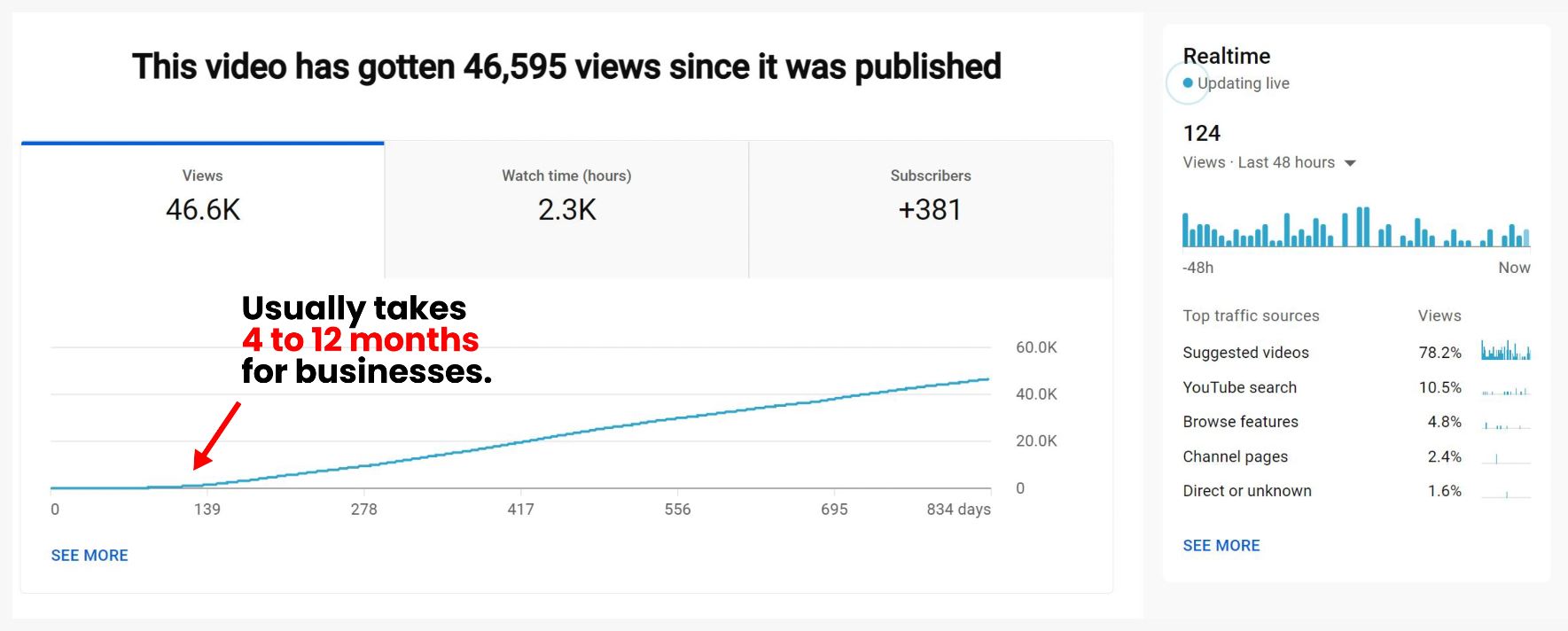
A typical graph shows a spike after 4-12 months.
My video on how to add tracking codes to your WordPress site? Still getting views one year after. That post on forcing a copy of a Google Doc? Same story.
You can see in the screenshot below, the initial traffic spike that lasted about two weeks from the day I published it (Oct 28, 2024, to Nov 11, 2024), but since then, almost every day, it’s had a few, even though I have a teeny tiny, neglected YouTube channel that hasn’t seen a new video since November 14, 2024. I recorded this to show one of my clients how to modify her links, and on a whim, decided to turn it into a YouTube video. Honestly, the people watching it are probably not my ideal clients, but it’s a good example of how this type of content can perform long-term.
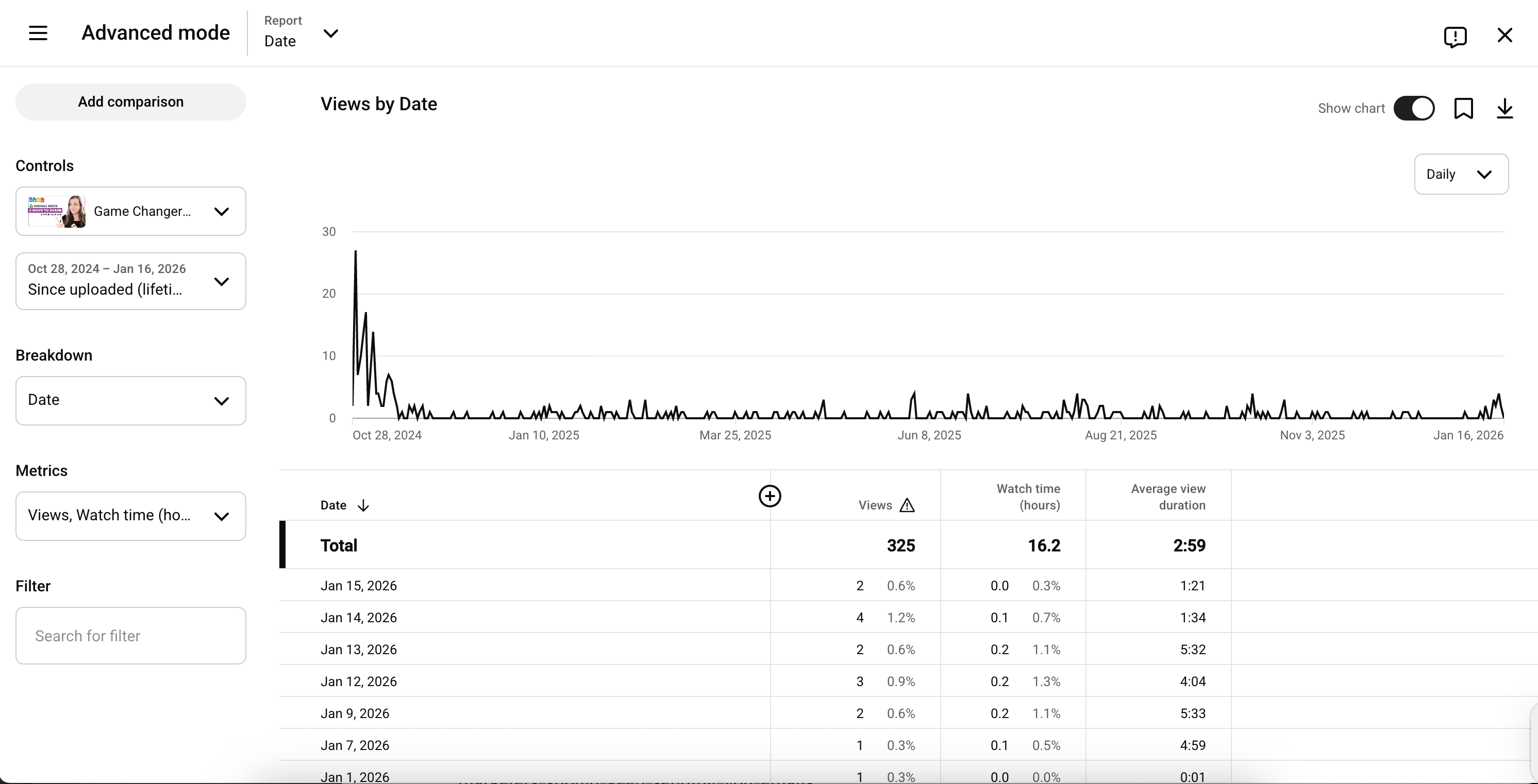
Evergreen tutorials can generate traffic for five to seven years because the problem they solve doesn’t go away.
Podcast lifespan for evergreen topics
Podcasts work similarly. New episodes get the most downloads in the first 30-45 days; that’s where Scott’s 6.68-day half-life comes from. But new listeners don’t just subscribe and wait. Podcast content compounds. Each new listener often consumes older episodes, extending shelf life to 18–24 months. Contrast that with ads (two weeks) or whitepapers (three-to-six months). JAR Audio
They binge your back catalog. One podcast strategist described it perfectly: “A bunch of people found your show and they’re working their way through your entire back catalog and your business card keeps growing and growing.”
The half-life stat tells you about the initial spike. It doesn’t tell you about the long tail, and for searchable, evergreen content, the long tail is where the magic happens.
Email Math: Is even more compelling
For every $1 spent on email marketing, the average return is $36 to $42, according to Litmus and Statista. That’s not a typo. Some industries see even higher returns, with retail and ecommerce averaging $45 per dollar spent.
Compare that to social media: According to Social Status and Hootsuite, Facebook’s organic reach averaged just 1.37% in 2024. Instagram isn’t much better at around 3.5%. That means if you have 1,000 followers, fewer than 35 of them will see your post.
Your email? It lands in about 90% of inboxes, and roughly 20-25% of those people will actually open it. Omnisend reports that 42% of marketers say email is their most effective channel, far ahead of social media and paid search at just 16% each.
That social media following you’ve been working so hard to grow? You don’t actually own those followers. The platform does. And they’ve decided you only get to talk to a tiny fraction of them for free.
How to Choose Your Marketing Approach
Here’s what I’ve learned after twenty-five years of marketing: Alignment beats algorithms every single time. Focus on the type of marketing that you enjoy.
Of course, there is some credence for considering the type of content your audience likes to consume. I.e., if you serve people who commute to work in their car, a podcast might be easier for them to consume than a blog post or video, but if that’s a barrier for you to actually create the content, they’re not going to be consuming your content anyway.
Your #1 priority is to get searchable evergreen content out there so Google and AI can start sending you clients.
I know this sounds woo-woo, but I wholeheartedly believe that if you’re doing something you love, it shows in your work. If you hate every minute of it, that will show, too. Maybe not in the technical sense, but there’s a tension to the work when someone is forcing it, instead of coming from a place of love.
A blog post you enjoy writing will outperform an Instagram reel you hate creating. A weekly email you send consistently will beat a daily TikTok you abandon after two weeks. A podcast that energizes you will outlast a YouTube channel that drains you.
The content format doesn’t matter as much as the consistency. And you can’t be consistent with something that makes you miserable.
One of my clients, Rachel, enjoyed LinkedIn. She was able to consistently show up; it was her marketing medium of choice. Unfortunately, posts on LinkedIn live an average of 24 hours before they’re buried and forgotten. The time she spent creating that content wouldn’t benefit her long-term. Yes, maybe it would help her gain a few likes or followers, but it was unlikely to bring her clients a week later.
So, I suggested she take her best LinkedIn posts and turn them into blog posts. That took the friction out of blogging for her, and she started to blog consistently. A few months later, she got a new client because ChatGPT cited her blog post in a conversation. The AI recommended her. He followed the link to her site, read her post, booked a call, and became a client. Her content was working for her while she wasn’t even online.
That’s the power of searchable, evergreen content.
The Two Types of Client Attraction
Before we dive into specific strategies, I want to give you a framework for thinking about all of this.
There are really only two ways to get clients without social media:
1. Content That Brings Clients (Searchable/Discoverable)
This is content that works while you sleep. People search for answers to their problems, and your content appears. They find you when they’re actively looking, not when they’re passively scrolling.
2. Relationships That Bring Clients (Borrowed Audiences + Referrals)
This is going where your ideal clients already gather. Instead of building from scratch, you borrow trust from people who’ve already grown the audience you’re trying to reach.
Both are needed for a complete strategy. Content brings strangers. Relationships bring warm leads.
Let me show you exactly how to implement each.
Part 1: Searchable Content Strategies (Create Once, Attract Forever)

Strategy 1: SEO-Optimized Blogging
Your ideal clients are searching for answers to their problems right now, at this very moment. They’re typing questions into Google. They’re asking AI for recommendations. They’re hoping someone out there understands what they’re going through.
If you don’t have content out there, you’re invisible. Not just to Google anymore, but to the AI tools people are increasingly using to find solutions.
Why blogging works for coaches:
A single blog post that ranks for the right search term can bring you clients for years. My post about lead magnet ideas for coaches consistently brings me traffic from people actively looking for marketing help. They’re not scrolling Instagram hoping to stumble on solutions. They’re searching because they have a problem they want to solve.
Be Findable Before You’re Famous
There’s a myth that marketing only works once you’ve “made it,” once you have thousands of followers, a big email list, and a recognizable name. So people wait. They tinker with their website endlessly. They perfect their offer in private. They tell themselves they’ll start marketing “when they’re ready.”
Meanwhile, someone right now is searching for exactly what they offer. And finding nothing. Because the person who could help them is still waiting to be famous first.
The data proves this works at any size. Right now, 1,329 people are searching “lead generation for life coaches” every month. Another 1,056 search “CRM for business coaches.” And 2,637 search “lead magnet ideas for coaches.”
These aren’t huge numbers. But they’re the right numbers: real people actively looking for solutions. You don’t need millions. You need the right hundreds.
A single blog post that ranks for the right search term can bring you clients for years. One YouTube video that deeply resonates with fifty people can matter more than one that reaches five thousand strangers.
Small audiences still search for solutions. And they often become your best clients because they found you when they were actively looking, not when they were passively scrolling.
Stop waiting to be famous. Start being findable.
When Creating Searchable Content, Specificity Matters
On my website, I have content about lead magnets. When I write generically about “lead magnets,” I rank at position 68. That’s basically invisible, buried on page 7 of Google.
But when I write specifically about “lead magnets for coaches”? I rank at position 1. Literally the first result, both on Google and in Google’s AI Summary.
Same topic. Same expertise. The only difference is specificity.
This isn’t a fluke. It’s how search works. It’s how AI recommendations work. It’s how human brains work. When someone searches for help, they’re not typing “I need a business consultant.” They’re typing “confidence coach for women in corporate leadership” or “marketing help for wellness practitioners.” The more specific your content, the more likely you are to be the answer to their specific question.
Generic content competes with everyone. Specific content dominates its corner.
How to implement:
- Choose topics your ideal clients are searching for (not topics you wish they cared about)
- Create comprehensive, helpful content that actually answers their questions
- Optimize for search by choosing the right keywords and structuring your posts clearly
- Update old content to keep it ranking
- Add lead magnets to capture emails from readers
The AI factor:
Here’s something fascinating from my own analytics: 4,517 people searched “lead generation for coaches” and were shown my content this year. And AI tools like ChatGPT, Perplexity, and Claude are pulling answers from blog content. One of my clients, Rachel, got a new client because ChatGPT cited her blog post in a conversation. The AI recommended her. He followed the link, read her post, booked a call, and became a client.
If you don’t have content out there, you’re invisible to AI too.

Strategy 2: YouTube (The Searchable Video Powerhouse)
YouTube isn’t social media in the same way Instagram is. People don’t mindlessly scroll YouTube hoping something interesting appears. They search for specific answers to specific problems. And here’s the kicker: YouTube is owned by Google.
Why YouTube is worth the effort:
YouTube offers something no other video platform does: triple discoverability.
First, it’s a search engine. YouTube is the second largest search engine in the world, behind only Google itself. People actively search for solutions to their problems.
Second, YouTube videos rank in Google. When someone searches Google for “how to create a lead magnet,” YouTube videos often appear in those results. You’re not just visible on YouTube; you’re visible across all of Google’s properties.
Third, YouTube suggests your content. The platform’s recommendation algorithm surfaces your videos to people watching similar content. Someone who just watched a video about email marketing might see your video about lead magnets in their sidebar, even though they’ve never heard of you.
This triple discoverability is why YouTube content compounds in a way that other video platforms simply don’t.
Camera Shy? You don’t have to show your face…
If the idea of being on camera makes you want to hide under your desk, here’s good news: faceless YouTube channels work beautifully for coaches and service providers.
You can share your screen while demonstrating software, teaching from slides, walking through a process, or showing examples. Tutorial and how-to content often works better this way because viewers can focus on what you’re teaching rather than watching you talk.
That said, if you’re comfortable on camera, showing your face does help build trust faster. Viewers feel like they know you. But it’s not required.
Important! Remember your website is the hub:
Here’s what most people miss: your YouTube content should point back to your website, and your website should embed your YouTube videos.
In every video description, link to the relevant blog post on your site. Create a blog post for each video with the embedded video, a summary, and additional resources. This gives you SEO benefits on both platforms and gives viewers multiple ways to find and engage with your content.
Your website is your content hub. YouTube is a powerful distribution channel. Don’t let the content live only on YouTube.
How to implement a search-driven YouTube strategy for your coaching business
- Focus on searchable, evergreen topics: how-to content, tutorials, answers to common questions
- Optimize titles, descriptions, and tags for search (include your target keywords)
- Include a clear call-to-action in every video, pointing to your website or lead magnet
- Embed videos on your blog with transcripts or summaries for extra SEO benefit
- Repurpose your videos into blog posts, email content, and short clips
The video repurposing advantage:
One YouTube video can become a blog post (with embedded video), an email to your list, a podcast episode (audio extracted), multiple short clips for other platforms, and a resource you can reference in guest appearances. The effort-to-output ratio is excellent when you build repurposing into your process.
Challenges to know about before diving into YouTube:
YouTube does require more technical skills than blogging. You’ll need to learn basic video editing, understand lighting and audio (even for screen recordings, audio quality matters), and develop some comfort with the platform. But the searchability and longevity make it worth the learning curve for many coaches.

Strategy 3: Podcasting (Your Own Show)
Audio content creates a unique kind of connection. Listeners hear your voice week after week, often during intimate moments like commuting, exercising, or doing housework. They feel like they know you. By the time they reach out, they’ve already built significant trust.
Why podcasting works for coaches:
Podcasts build relationship at scale. A listener might spend hours with you over the course of a few weeks, binging your back catalog. That’s more time than most clients spend with you before they buy. By the time they’re ready to reach out, they’re already sold.
Episodes also have long shelf lives. Unlike social media posts that disappear in hours, podcast episodes can drive traffic and build trust for years. New listeners often start from the beginning, discovering content you recorded months or years ago.
The podcast show notes SEO connection:
Here’s something many podcasters miss: your podcast episodes should live on your website.
Create a blog post for each episode with the embedded audio player, show notes, key takeaways, and a full transcript. This gives search engines text to index (they can’t “read” audio) and gives listeners multiple ways to consume your content.
Episode titles should be searchable. “Episode 47: Chatting with My Friend Sarah” tells search engines nothing. “How to Create a Lead Magnet That Actually Converts” tells both search engines and potential listeners exactly what they’ll get.
Your website is the hub. Your podcast app presence is distribution.
How to implement a podcast strategy for your coaching business:
- Choose a searchable show name and episode titles that include keywords
- Focus on topics your ideal clients need help with
- Include clear calls-to-action in every episode
- Submit to all major podcast directories (Apple Podcasts, Spotify, etc.)
- Create blog posts with embedded audio and full transcripts for SEO benefit
- Point listeners back to your website for show notes and resources
Podcast vs. YouTube:
Both are excellent for building trust through searchable content. YouTube has the advantage of triple discoverability (YouTube search, Google search, and recommendations). Podcasting has the advantage of being easier to produce (no video editing, no lighting concerns) and fitting into moments when people can’t watch a video.
Many coaches eventually do both, often repurposing the same content across formats. But if you’re starting from scratch, pick the one that fits your strengths and your audience’s preferences.
Strategy 4: Pinterest (The Visual Search Engine Most Coaches Overlook)
Here’s what most coaches get wrong about Pinterest: they treat it like social media.
It’s not. Pinterest is a visual search engine, the fourth-largest search engine in the world after Google, YouTube, and Bing. People don’t scroll Pinterest hoping to be entertained. They search with intent: planning, researching, and looking for solutions to specific problems. It is a dominant search engine for early-stage intent, such as home decor, DIY, and visual inspiration
That distinction changes everything.
Why Pinterest works for coaches:
Pinterest reached 553 million monthly active users in 2025, with Gen Z as the fastest-growing demographic. But the number that matters most? Pins have a long shelf life. They do not disappear like Reels or Stories. Users come to search, plan, and buy. (Tamira Hamilton)
A single pin can drive traffic to your website for months or even years after you create it. Compare that to an Instagram post that’s essentially invisible after 24 hours.
80% of Pinners have discovered a new brand or product on Pinterest. (Hootsuite): These aren’t passive scrollers, they’re actively looking for solutions. When a coach searching for “lead generation strategies” finds your pin, they’re already in problem-solving mode.
Why Pinterest is Good for SEO
- Dual Search Visibility: Google crawls and indexes Pinterest content, meaning your Pins and boards can often appear in Google’s Search and image results, as well as in searches directly on the Pinterest platform.
- High Intent Traffic: Most Pinterest searches (96-97%) are unbranded. Users search for ideas and solutions, making them more likely to click through to your site compared to passive scrollers on other social networks.
- Backlink Benefits: Each Pin that links back to your website acts as a backlink, which is considered valuable for SEO because it can drive high-quality referral traffic and signal brand authority to Google. This can help increase your site’s direct traffic and overall domain authority (how much Google trusts your site).
- Long Content Lifespan: While an Instagram post might only last 24 hours, a well-optimized Pin typically reaches its half-life of engagement around 13 months.
The niches where Pinterest shines for coaches:
Pinterest works especially well if you serve:
- Health and wellness coaches
- Life coaches (especially organization, productivity, goal-setting)
- Career coaches
- Relationship coaches
- Parenting coaches
- Business coaches targeting female entrepreneurs
- Art therapists
- Graphic designers
- Interior designers
- Home organizers
- Any coach in lifestyle, self-improvement, or creative niches
If your ideal clients are women between 25 and 54 who research before they buy, Pinterest is likely where they’re already looking.
Pinterest SEO: How coaches get found:
Pinterest’s algorithm is powered by AI-enhanced search that understands what users mean, not just what they type. It rewards long-tail, intent-based keywords like “non-toxic skincare for sensitive skin” or “email marketing tips for coaches.” (Jenna Kutcher)
That means your pin titles, descriptions, and board names need to include the exact phrases your ideal clients are searching for.
For coaches, strong keyword phrases include:
- “[Your niche] coach tips”
- “How to [achieve specific result]”
- “[Problem] solutions for [audience]”
- “[Topic] checklist” or “[Topic] guide”
How to implement Pinterest for your coaching business:
- Start with your blog content. Every blog post you write can become 3-10 pins with different graphics and headlines. Pinterest rewards fresh pins, even when they link to older content.
- Create keyword-rich boards. Keep ten to fifteen well-optimized boards instead of fifty you rarely use. Always prioritize quality over clutter. Jen Vazquez Media Name boards what people search for: “Lead Magnet Ideas for Coaches” not “Marketing Stuff I Like.”
- Design pins that stop the scroll. Vertical images (2:3 ratio) perform best. Use readable text overlays with clear headlines. Your pin title should work like a search headline, not a clever caption.
- Pin consistently, not constantly. One to two new Pins per day outperforms sporadic bursts. (Jenna Kutcher) Use a scheduling tool like Tailwind or Hootsuite to batch your pinning once a week.
- Use Pinterest Trends. Pinterest Trends forecasts interest up to 90 days in advance. (Daniella van der Hujssen) Check trends.pinterest.com to see what’s rising in your niche before it peaks.
- Always link to your website. Every pin should drive traffic back to a blog post, lead magnet landing page, or resource on your site. Pinterest is the traffic driver; your website is where conversion happens.
The peaceful approach to Pinterest:
Here’s what I love about Pinterest for coaches who are tired of the social media hamster wheel: After setting up a system with templates and workflows, a VA can handle your Pinterest presence in about an hour a week. (Jenna Kutcher)
You don’t need to be “on” Pinterest, constantly engaging. You don’t need to respond to comments in real-time. You don’t need to show your face or share personal updates.
You create pins. You schedule them. They work for you for months.
It’s the definition of building assets that compound, which is exactly what we’re going for.
A realistic note:
Pinterest isn’t instant. It typically takes 3-6 months to see significant traffic from a new Pinterest strategy. But unlike social media, where you’re always starting over, Pinterest rewards patience. The pins you create this month will still be working for you next year.
If you’re already creating blog content, adding Pinterest to your strategy is relatively low effort for potentially high reward. If you’re not blogging yet, focus on that foundation first.
Part 2: Your Email List (The Bridge Between All Strategies)
Before we talk about relationship-based strategies, I need to emphasize this: Your email list is the most valuable asset you own.
Social platforms change their rules constantly. They can throttle your reach, ban your account, or become irrelevant overnight. Remember when everyone was on Facebook? When Instagram was the only place that mattered? The platforms you’re building on today might not exist in ten years.
Your email list is yours. No algorithm sits between you and your subscribers. No platform can take it away. Every other marketing channel is rented. Email is owned.
Your email list is yours. No algorithm sits between you and your subscribers. No platform can take it away. Every other marketing channel is rented. Email is owned.
The Email Ecosystem for Coaches
Here’s how the pieces fit together:
1. Lead magnet: This captures subscribers from all channels. The right lead magnet attracts people who are already thinking about the problem you solve. The wrong one attracts freebie collectors who never buy. I learned this the hard way when I created a beautiful printable planner. My list grew, but sales stayed flat because I’d attracted the wrong people. More on lead magnets that attract buyers.
2. Welcome sequence: This automatically nurtures new subscribers. 3-5 emails that introduce who you are, what you believe, and how you help. This runs without you, delivering value while you sleep.
3. Regular emails: This keeps you top of mind. Weekly, biweekly, or monthly, whatever pace you can sustain. Consistency matters more than frequency.
4. Sales sequences: This converts subscribers to clients when they’re ready. Not pushy. Not manipulative. Just clear invitations for people who want your help.
The Low-Hanging Fruit Most Coaches Ignore
During a recent clarity call with a potential client, I saw that she was doing a great job growing her email list. She was working hard to get those subscribers. Then I discovered she hadn’t emailed them in months.
She had amazing offers, great social media engagement, but a whole bunch of opportunities just sitting there, waiting to be tapped. That’s what we call in marketing “low-hanging fruit.” Revenue waiting to happen.
You can’t make sales with your email list if you don’t actually email them.
I see this more often than you’d think. Business owners who invested time and money building their list, then let it go cold because they didn’t know what to say, felt awkward about selling, or simply got too busy. Meanwhile, those subscribers are slowly forgetting who they are and why they signed up in the first place.
Your email list is not a trophy to collect. It’s a relationship to nurture.
Why Email Matters for Your Social-Media-Free System
Your email list is the connective tissue that makes everything else work. Blog posts bring traffic, lead magnets capture emails, welcome sequences build trust, and regular emails stay top of mind until people are ready to buy.
Without email, you’re just creating content and hoping people remember you. With email, you’re building an asset that compounds over time.
Whatever season your business is in, whether you’re launching, resting, serving clients, or taking a break, keep building your email list and keep nurturing it. It’s the one marketing activity that compounds over time and creates options when you need them.
When you have plenty of leads, you no longer feel desperate on sales calls. You don’t have to take every client because you’re worried about making rent. You can be choosy, which paradoxically makes you more attractive to the right people.
A healthy, engaged email list is freedom.
Part 3: Borrowed Audience Strategies (Relationships That Bring Clients)
Here’s a truth most content creators don’t share publicly: You can create content forever and still feel invisible. You can publish blog posts, send emails, and wonder why your audience isn’t growing faster.
The problem is this: when you only create content on your own platforms, you’re waiting for people to find you. You’re standing in your living room, talking to whoever happens to wander in.
But there are people out there who’ve already gathered the audience you’re trying to reach.
The core philosophy: Instead of building from scratch, borrow trust from people who’ve already gathered your ideal clients.
When you guest on a podcast, write for someone else’s blog, or teach in someone else’s community, you get something your own platform can’t give you: borrowed trust.
The host has already done the work of building credibility with their audience. When they invite you in, some of that trust transfers to you.
Common Borrowed Audience Strategies
Borrowing an audience is all about strategic collaboration. By showing up in spaces where your ideal clients already hang out, you can shortcut the months (or years) it takes to build a cold audience from scratch.
- Podcast Guesting: Pitch yourself to hosts who serve your niche. A single 30-minute interview can act as a permanent referral engine, driving traffic to your site for years as new listeners find the show’s back catalog.
- Guest Blogging: Write for established industry blogs. This not only positions you as an expert but also provides valuable SEO backlinks that help your own website rank higher on Google.
- Expert Training in Memberships: Many coaches have paid memberships and are constantly looking for guest experts to teach a specific skill. This places you directly in front of a “warm” audience that has already invested money to solve their problems.
- Joint Webinars or Workshops: Partner with a complementary service provider (e.g., a mindset coach partnering with a business strategist) to co-host a free training. You both promote the event to your respective lists, effectively doubling your reach.
- Newsletter Takeovers: Collaborate with another creator to “swap” a feature in your weekly emails. You provide a high-value tip for their readers, and they do the same for yours.
- Virtual Summits: Participate as a speaker in online events. Summits are high-intensity lead generators that can add hundreds of targeted subscribers to your email list in just a few days.
Pro-Tip: When borrowing an audience, your goal is to be helpful, not pitchy. If you provide genuine value, the audience will naturally want to follow the “bridge” back to your own platform. I
Focus On the Gift, Not the Grab
Mindset shift: Instead of focusing on how this guest appearance will benefit you, think about how it will benefit your host. “How can I serve this person’s audience?” not “How can I get exposure?”Here’s the approach that works: Show up to give value, not to take attention.
When you guest on a podcast, your goal isn’t to pitch your services. It’s to help the host’s audience with something specific. When you write a guest post, you’re contributing to the host’s body of work, not hijacking their platform for your agenda.
This isn’t just ethical. It’s effective. Audiences can tell when you’re genuinely interested in helping them versus when you’re trying to get something from them. They can feel the difference between generosity and extraction.
The entrepreneurs who build lasting businesses are the ones who prioritize relationship over transaction. Who give more than they ask. Who show up even when there’s nothing to promote.
That’s not hustle. That’s hospitality.
Strategy 5: The Sister Guest Post Strategy (Guest Blogging That Actually Works)
Most guest posts are dead ends. You write something great for someone else’s site, their audience reads it, and then… nothing. They stay on that site. You got exposure but not growth.
Here’s what I developed to fix that:
The Sister Guest Post Strategy creates two connected pieces of content: Part 1 for the host’s site, Part 2 for yours.
How it works:
- Write Part 1 for the host’s site. Make it genuinely valuable. It should stand on its own. Don’t make it a teaser that frustrates readers.
- End with a natural bridge. Something like: “In Part 2, I go deeper on [specific next step]. You can find it here.”
- Part 2 lives on your site with a content upgrade (lead magnet) that’s directly relevant to the topic.
- The reader path: Guest post → Your site → Lead magnet → Email list → Nurture → Client
Why it works: You’re not just borrowing an audience. You’re building a bridge from their platform to yours. The host’s readers get value. The host gets quality content. And you get subscribers, not just pageviews.
How to find guest posting opportunities:
Look for blogs your ideal clients read. Check if they accept guest posts (many have submission guidelines). Pitch a specific topic that fills a gap in their existing content. And deliver exceptional value. This is your first impression for a lot of potential clients.
Strategy 6: Podcast Guesting (Quality Over Quantity)
Here’s how most people approach podcast guesting: Pitch 50 shows a week with copy-paste templates. Spray and pray. Hope something sticks.
That’s exhausting. And it doesn’t work very well.
The peaceful approach: One great interview on the right show is worth more than ten mediocre ones.
63% of podcast listeners trust their favorite hosts more than social media influencers. When a host invites you on, that trust transfers to you. A show with 500 engaged listeners who match your ideal client is better than 50,000 random listeners who don’t.
How to approach podcast guesting:
- Find aligned shows. Where do your ideal clients already listen? What shows would they trust?
- Listen before you pitch. Understand the host’s style, what they’ve covered, what gaps you could fill.
- Pitch a specific topic, not yourself. Hosts want to deliver value to their audience. “I’d love to talk about the three biggest mistakes coaches make with lead magnets” is better than “I’d love to come on your show to talk about marketing.”
- Prepare to give your best. Don’t hold back or tease paid content. Give real, actionable value.
- Have a clear next step. What’s the ONE thing you want listeners to do? Make it specific and relevant to what you discussed.
Longevity: One podcast interview can drive traffic for years as new listeners discover the show’s backlog.
How to Find and Pitch Your Way onto the Right Stages
How to Find Guest Posting and Podcast Opportunities
Before you can send a pitch, you need to find the right stages to perform on. Here are the most effective ways to find people actively looking for guests in 2026:
- Use Advanced Google Search Strings: Search for your niche combined with specific footprints. For example:
"Your Niche" + "guest post by""Your Niche" + "write for us""Your Niche" + "podcast guest"
- Leverage Podcast Directories: Use platforms like Listen Notes to find podcasts in your niche. Look for shows that have interviewed guests with similar expertise to yours.
- Monitor Social Media “Call for Guests”: On platforms like X (Twitter) or LinkedIn, search for hashtags like
#PodcastGuest,#GuestBlogger, or#ResourceRequest. - Check “Speaking” or “Contact” Pages: Many established bloggers and podcasters have a dedicated page for guest submissions or speaker inquiries.
The “Value-First” Pitch Template
When reaching out, your email should be short, personalized, and focused entirely on the value you bring to their audience.
Remember, you are the guest, and in the end, you want to leave them feeling glad to have invited you and excited to have you back again in the future. This starts with the pitch.
Before making a pitch to be a guest on someones blog or podcast…
- Look at their top-performing content and ask yourself, “What can I add to the conversation they haven’t already shared?”
- Read their comments and testimonials to see what their audience is asking.
- Listen to their podcast, watch their videos, and read their blogs to get a sense of their style.
- Find ways you can both edify them and provide a fresh perspective that their audience will value.
Here’s a pitch email template you can customize and make your own.
Subject: Idea for [Name of Podcast/Blog]: [Catchy Topic Title]

Hi [Host Name],

I’ve been a long-time [listener/reader] of [Podcast/Blog Name], and I particularly loved your recent episode on [Specific Topic]. Your insight on [Specific Point] really resonated with me.

I’m reaching out because I’d love to contribute a [guest post / guest interview] that helps your audience [solve a specific problem or achieve a goal].

Based on your content and comments, I think your community would get a lot of value from one of these topics:

Topic 1: [Benefit-driven title and 1-sentence description]

Topic 2: [Benefit-driven title and 1-sentence description]

I am a [Your Title] who specializes in [Your Niche]. You can see an example of my [writing/speaking] here: [Link to your best work].

Would either of these topics be a good fit for your upcoming content calendar?

Best,

[Your Name]
Pro-Tip: Never send a “blind” pitch. Mentioning a specific detail from their recent work proves you aren’t just copy-pasting your way through a list.
Strategy 7: Bundles and Collaborations
What are bundles? Collections of courses, templates, or resources from multiple creators, sold together or given away for email addresses.
Done well: Grow your list quickly with genuinely interested people. Done poorly: Fill your list with freebie-seekers who never buy.
How to approach bundles peacefully:
- Be selective. Not every bundle is worth joining. Look at who else is participating. Do they serve a similar audience with similar values?
- Contribute something valuable. Don’t throw in your weakest freebie. This is people’s first impression of you.
- Have a nurture plan. Write a welcome sequence specifically for bundle subscribers. They don’t know you yet, so introduce yourself.
- Focus on fit over size. 5,000 aligned subscribers beats 50,000 who’ll never open your emails.
Other collaboration types:
Joint workshops or webinars, co-created content, shared trainings, newsletter swaps. The format matters less than finding partners who serve the same audience with complementary (not competing) offers.
Strategy 8: Guest Training and Expert Appearances
Opportunities include:
Guest expert in someone’s course, monthly trainer in a membership community, summit speaker, newsletter interviews, expert quotes for articles.
How these opportunities come:
They come from relationships, not cold pitches. From being known for something specific. From showing up generously in other people’s spaces. From saying yes when opportunities align (even small ones). And from delivering so much value hosts want you back.
Each appearance plants seeds. Some grow into clients, some into referrals, some into friendships that lead to opportunities years later.
Strategy 9: Referral Systems
People refer for two reasons: they want to help their friend, and they want to look good for making a great recommendation. Your job is to make sure referring you accomplishes both.
Why referrals work:
They come with built-in trust. They’re pre-qualified (the friend knows their situation). They have a higher conversion rate than cold leads. And they feel good for everyone involved.
The downside to relying on referrals alone:
While referrals are high-quality, they shouldn’t be your only source of clients. Relying solely on word-of-mouth creates a few significant vulnerabilities for a coaching business:
- Inconsistent Lead Flow: Referrals are notoriously unpredictable. You are essentially waiting for someone else to have a conversation about you, which means you can’t “turn up the dial” when you need more revenue.
- The “Feast or Famine” Cycle: Without a searchable content system, you are likely to experience months of being overbooked followed by months of silence.
- Lack of Scalability: You can only get as many referrals as your current network allows. If you want to reach a new audience or grow beyond your current circles, you need a way for strangers to find you.
- No Control Over the Message: When someone refers you, they describe you in their own words. This might not always align with your current high-level offers or the specific types of clients you are looking to attract now.
Key Takeaway: Referrals are a wonderful “bonus,” but they shouldn’t be the foundation of your business. By building a Marketing Emergency Fund of searchable content, you ensure that new leads are coming in even when your referral sources are quiet.
How to Ask for Referrals Without Feeling Awkward
Most business owners never ask for referrals. Not because they don’t want them, but because asking feels uncomfortable. Pushy. Transactional. Like you’re putting the relationship at risk.
It doesn’t have to feel that way.
The key is timing and framing. Ask at the right moment, in the right way, and it feels natural instead of needy.
The right moment: Ask after a win. When your client is feeling good about the work you’ve done together. When they’ve just gotten a result. When gratitude is fresh.
The wrong moment: At the beginning of a project (you haven’t delivered yet), when they’re frustrated with something (even if unrelated to you), or out of the blue after months of silence.
Notice what’s not in these scripts: pressure, guilt, obligation, or anything that sounds like a sales pitch. You’re simply opening a door.
Make Referring You Feel Good
When someone sends you a client, they’ve done something meaningful. They’ve put their reputation on the line for you. That deserves real acknowledgment.
A quick “thanks!” text is fine. But it’s also forgettable.
Consider going further: A handwritten note stands out in a world of digital everything. A small, thoughtful gift shows you noticed. A public shout-out (if appropriate) celebrates them in front of their own audience.
The thank-you doesn’t have to be expensive. It just has to be sincere and specific.
How to build a referral system:
- Deliver exceptional work. Happy clients naturally refer. This is table stakes.
- Ask at the right time. After a win or transformation, when gratitude is fresh.
- Make it easy. Give them language to use: “In case anyone asks, here’s how you might describe what we did together…”
- Thank referrers properly. A handwritten note, a small gift, a public shout-out if appropriate.
- Close the loop. “Just wanted you to know, Sarah’s project went really well. Thanks again for connecting us.”
Here’s a simple system:
When a referral comes in: Thank the referrer immediately. After you’ve started working together: Update the referrer briefly. When the project is complete: Close the loop.
This isn’t complicated. It’s just thoughtful. And thoughtfulness gets remembered.
The bar is shockingly low. Most people don’t feel remembered. Be the exception, and watch how the referrals flow.
Strategy 10: Strategic Partnerships
What a Strategic Partnership looks like:
Complementary service providers referring to each other. Affiliate relationships with aligned businesses. Joint ventures on specific projects.
Example partnerships for coaches:
Life coach + therapist (different services, same client type). Business coach + web designer. Health coach + personal trainer. Career coach + resume writer.
How to build partnerships:
- Identify who serves your clients before or after you do
- Build genuine relationships first
- Look for ways to help them before asking for anything
- Create formal referral agreements when appropriate
Strategy 11: Speaking and Teaching (Live Events)
Opportunities:
Local business groups, industry conferences, virtual summits, corporate workshops, community organizations.
Why it works:
Positions you as an expert. Builds relationship through live interaction. Creates content you can repurpose. Opens doors to future opportunities.
For introverts: Start small. One local group. One virtual event. Build confidence over time.
Strategy 12: Networking (The Introvert-Friendly Version)
Traditional networking (crowded rooms, small talk, business card exchanges) is exhausting for many coaches.
Peaceful networking looks different:
Small, curated groups. Online communities in your niche. One-on-one coffee chats (virtual or in-person). Giving value in communities before asking for anything. Building genuine friendships that happen to lead to business.
Key shift: Think relationships, not transactions. Some of the best referral sources are people you’d call friends first, business contacts second.
The Marketing Emergency Fund: Your Safety Net
Let me connect all of this to a concept I think is critical for sustainable business.
Dave Ramsey talks about the importance of having a financial emergency fund, three to six months of expenses set aside so you’re not one crisis away from disaster. When the car breaks down or the roof leaks, you’re covered. You don’t have to scramble.
Your marketing needs the same thing.
A Marketing Emergency Fund is a collection of content assets that keep working when you can’t, such as:
- Blog posts that rank in search.
- Email sequences that nurture automatically.
- Lead magnets that capture subscribers 24/7.
- Podcast episodes or YouTube videos with evergreen value.
- Referral relationships that send clients your way.
When I stepped away in 2024/2025, my Marketing Emergency Fund kept my business running. Not record-breaking growth, but steady. Leads kept coming. Clients kept booking.
The question to ask yourself: If you couldn’t create any new content for six months, what would keep working for you?
Social Media Stockpile vs. Marketing Emergency Fund
One of my clients, Maggie, shared on a coaching call that she was building a stockpile of social posts she could schedule when she got too busy to create. It was smart thinking, batching content for busy seasons.
But here’s what I realized after my unplanned social media sabbatical: batching social content just kicks the can down the road. Those posts still disappear in 24-48 hours. She was stockpiling pennies when she could have been investing in assets that compound.
The difference between a social media stockpile and a true Marketing Emergency Fund is lifespan.
A social media stockpile includes: Instagram posts scheduled for next month, tweets ready to go, content that buys you time but still evaporates.
A Marketing Emergency Fund includes: Blog posts that rank for years, YouTube videos that keep getting discovered, email welcome sequences that nurture every new subscriber, podcast backlogs people binge when they find you, and books that sell while you sleep.
The first is a checking account. The second is an investment portfolio.
When Systems and a Marketing Emergency Fund Save You
Kathy, one of my members, lost a loved one earlier this year. Dealing with hospice, caregiving, grief, and settling an estate, she had a lot on her plate. But her tutoring business didn’t stop.
Her team onboarded new students while she grieved. Her blog posts kept attracting new families. Her email sequences kept nurturing leads. She’d put systems in place: contractors who knew their roles, intake processes that worked without her, and content that ran on autopilot.
Her business kept breathing even when she couldn’t show up.
That’s what we’re building toward: a business that survives your worst seasons.
You do the hard thinking once, when you have capacity. Then you follow the system when you don’t.
How to Build Your Marketing Emergency Fund
First, audit what you already have. You might have more than you think. Old blog posts that could be updated. Podcast episodes that are still relevant. Content scattered across platforms that could be consolidated somewhere searchable.
Second, identify your evergreen topics. What questions do your clients ask repeatedly? What problems never go out of style? Those are your best investments. Write the post once, benefit for years.
Third, create at least one substantial piece per month. Not throwaway content. Something with staying power. A comprehensive blog post. A video tutorial. A resource people will bookmark and share. If you can do two a month, or one a week during your high-capacity season, do it. If it’s going to stress you out, just focus on one per month.
Fourth, update and maintain your assets. Old content needs occasional attention. Refresh outdated information. Add new examples. Keep your best-performing pieces current.
Fifth, build the connective tissue. Your assets need a way to work together. A blog post leads to a lead magnet. The lead magnet triggers a welcome sequence. The sequence invites people to take the next step. This ecosystem is your emergency fund working as a system.
Start Before You Need It
Here’s the uncomfortable truth: you can’t build your Marketing Emergency Fund during an emergency.
You can’t create systems when you’re drowning. You can’t batch content when you can barely function. You can’t build the runway while the plane is already in the air.
The time to build is now. While you have capacity. While things are relatively stable.
The entrepreneurs who weather hard seasons aren’t the ones who worked harder during the crisis. They’re the ones who built systems before the crisis hit.
What About AI and New Platforms?
Let me address the elephant in the room.
AI is changing search. ChatGPT, Perplexity, Claude, and Google AI Overviews now cite blog content directly. Well-structured, comprehensive content is more valuable than ever. That’s another reason to invest in searchable content over social media.
Quick Tips for AI Search Optimization
AI tools like ChatGPT and Perplexity prioritize content that is clear, authoritative, and well-structured.
- Answer Questions Directly: Use a clear “Question and Answer” format for key sections to help AI models identify your content as a direct solution.
- Use Semantic Keywords: Instead of just repeating one keyword, include related terms and natural language phrases that provide broader context to your topic.
- Maintain High Formatting Standards: Use clear headings (H2s and H3s) and bulleted lists, which make it easier for AI to crawl and summarize your main points.
- Prioritize “Information Gain”: AI rewards unique insights or personal case studies that aren’t found in a thousand other generic articles.
The Rise of “Social Search” in 2026
While we’ve looked at the traditional lifespan of a post and the content that performs best for both traditional search and AI search, it’s important to note a massive shift currently happening: Social media is turning into a search engine.
For years, we treated platforms like Instagram or TikTok as “discovery” feeds, places where content was pushed to users based on an algorithm. But today, more than 24% of users are bypassing Google entirely and searching directly on social channels to find answers, tutorials, and even coaching recommendations.
What Social Search means for your coaching business:
- Your posts are now searchable assets: In the past, a caption was just a caption. Now, Instagram and TikTok use AI to index your spoken words, on-screen text, and captions as metadata. If you use natural keywords, a video you posted months ago can still surface when someone searches for a specific problem.
- Google is indexing social content: Major search engines are now deeply indexing Reels, TikToks, and LinkedIn posts. This means your social content is finally gaining a “long tail” that can appear in traditional Google search results.
- Intent over Trends: Because users are searching for help (e.g., “how to manage executive burnout”), the platforms are rewarding structured, educational content over viral dances or fleeting trends.
The Bottom Line: Social media may eventually work more like a “Marketing Emergency Fund”, but personally, I’m not planning to dive back in anytime soon.
Guidelines for Social Search Optimization
If you choose to post on social media with a focus on searchable content, I did the research for you to help you ensure your content is discoverable. Treating every post as a searchable resource, using clear titles, keyword-rich captions, and helpful “how-to” structures, may help you extend the life of your content beyond the initial 24-hour decay.
- Keyword-Rich Captions: Treat your caption like a mini-blog post. Use natural language keywords in the first two sentences so the platform’s search engine can categorize them.
- On-Screen Text is Metadata: The AI in Instagram and TikTok “reads” the text you overlay on Reels and videos. Ensure your main topic is clearly written on the screen.
- Optimize Your Bio: Your profile name and bio should contain your primary keywords (e.g., “Burnout Coach for Tech Execs”) to help you appear in user search results.
- Ditch Generic Hashtags: Swap broad hashtags (like #marketing) for specific, searchable phrases that users actually type into the search bar.
AI Search and Social Search are the most recent strategies people are talking about in the marketing space, but I guarantee they won’t be the last.
New platforms will always emerge. Take the peaceful approach: observe, don’t chase. Your foundation (content + email + relationships) will work regardless of what platform is trending.
- People will always search for answers.
- People will always want to be nurtured via email.
- Relationships will always lead to referrals.
These things won’t ever change.
Frequently Asked Questions
Can you really build a coaching business without social media?
Yes. I grew my organic SEO traffic by 170% in a year while posting almost nothing on social media. The key is building searchable content (blogging, YouTube, podcasting), email marketing, and relationship-based strategies (referrals, podcast guesting, collaborations) that work without requiring daily posting.
What’s the best way to get coaching clients without Instagram?
The most effective strategies are: SEO-optimized blogging that ranks in search, email marketing to nurture leads over time, podcast guesting to reach established audiences, referrals from happy clients, and strategic partnerships with complementary service providers. These methods bring clients consistently without requiring daily social media content.
How long does it take to get clients without social media?
Building a social-media-free client system typically takes 6-12 months to see significant results. The first 3 months focus on foundation (content, lead magnet, email). Months 4-6 expand into relationships (guesting, partnerships). By month 12+, your content library and relationships compound, bringing consistent leads with less daily effort.
Is email marketing better than social media for coaches?
For most coaches, yes. Email marketing averages $36-42 ROI for every $1 spent. You own your email list (no algorithm changes), have direct access to subscribers, and see higher conversion rates than social media. Email also works automatically through sequences, unlike social media which requires constant posting.
What is the Wise Owl Marketing Sister Guest Post Strategy?
The Sister Guest Post Strategy is a guest posting method developed by Heather Stephens of Wise Owl Marketing. Instead of writing a standalone guest post, you write Part 1 for the host’s site and Part 2 for your own site (with a lead magnet). This creates a bridge that brings the host’s audience to your email list, rather than just giving you exposure without growth.
How do I get clients as an introvert who hates networking?
Focus on strategies that don’t require crowded rooms or constant visibility: blogging and SEO bring clients to you, email marketing nurtures relationships at scale, podcast guesting is one-on-one conversation, and online communities let you build relationships at your own pace. Peaceful networking focuses on genuine relationships over transactions.
What exactly is a “Marketing Emergency Fund” and why do I need one?
A Marketing Emergency Fund is a concept developed by Heather Stephens of Wise Owl Marketing, inspired by Dave Ramsey’s financial emergency fund. It’s a collection of evergreen marketing assets (blog posts, email sequences, lead magnets, YouTube videos) that keep working when you can’t actively create content. It’s what keeps your business running during illness, vacation, or challenging life seasons.
What’s the difference between borrowed audiences and building your own audience?
Building your own audience means creating content on your platforms (blog, YouTube, podcast, email list) and waiting for people to find you. Borrowed audiences means going where your ideal clients already gather: guest posting on established blogs, appearing on podcasts, teaching in other people’s communities. Borrowed audiences provide faster growth; owned audiences provide long-term stability. Most coaches need both.
Do I need to quit social media completely?
No. This isn’t about social media being evil. It’s about building a foundation that doesn’t depend on it. Some coaches enjoy social media and use it well. The goal is to have options. When social media is your only marketing strategy, you’re one algorithm change away from losing everything. When it’s one tool among many, you can use it when it serves you and step away when it doesn’t.
What if I don’t have time to create all this content?
Start smaller than you think. One blog post per month. One lead magnet. One email sequence. The compound effect starts the moment you begin, not the moment it pays off. A single blog post published today is infinitely more valuable than a perfect content calendar you never execute. Build the habit first. Expand later.
Layer content marketing with other strategies like borrowed audiences and referrals.
How do I know which strategy to focus on first?
Start with what aligns with your strengths. If you’re a strong writer, start with blogging. If you love conversation, consider podcasting or podcast guesting. If you have existing relationships, activate your referral network. The best strategy is the one you’ll actually do consistently.
Can AI replace content marketing?
AI is changing how people find information, but it’s making quality content more important, not less. AI tools like ChatGPT and Perplexity cite blog content. They recommend experts based on the content they’ve published. Having comprehensive, helpful content that AI can reference actually gives you an advantage. The coaches who will struggle are the ones with no content at all.
Key Points Summary
The Proof: My organic search traffic grew 170% year over year while I was barely posting on social media. The blog posts I’d written years ago kept working while I couldn’t.
The Problem: Social media content has a brutal half-life; Instagram posts reach 50% of their engagement in 19 hours, Facebook in 81 minutes. You’re starting over every single day.
The Solution: Build a Marketing Emergency Fund, a collection of evergreen assets (blog posts, email sequences, lead magnets, videos) that keep working when you can’t.
The 12 Strategies to Get Clients Without Social Media:
Searchable Content: Create once, attract clients for years.
- SEO Blogging
- YouTube
- Podcasting
Borrowed Audiences: Borrow trust from people who’ve already built the audience you want.
- Sister Post Strategy
- Podcast Guesting
- Bundles
- Guest Training
High-Trust Relationships: Warm leads who already know you convert faster.
- Referrals
- Partnerships
- Speaking
- Networking
The Connector: Your email list is the bridge between all strategies. It’s the only marketing asset you truly own.
The Timeline: Building a social-media-free system takes 6-12 months. The first months feel invisible. By year two, your content library becomes an asset that compounds while you sleep.
The Bottom Line: You don’t have to quit social media entirely. You just need to stop depending on it. Build the foundation first, then use social media if and when it serves you, not because you’re afraid to disappear without it.
Your Next Step
If you’ve read this far, you’re clearly serious about building a business that doesn’t require constant social media presence. Here are the ways I can help:
Here are 3 easy ways to get started…
- Get your personalized action plan
Take the Free 3-Minute Peaceful Marketing Assessment
- Get coaching, tools, implementation, and community
Join the Peaceful Marketing Lab
- Put my experience to work in your business
Book a Free Clarity Call to explore ways we can work together to reach your goals
Remember, this isn’t about hustling harder. It’s about building smarter. Your content should work while you sleep. Your systems should run while you rest. Your business should support your life instead of consuming it.
That’s peaceful marketing. And it works.
Related Posts You’ll Find Helpful:
- Lead Magnet Ideas for Coaches
- Email Marketing vs Social Media: Which Matters More?
- How to Choose the Right Keyword
- Blog Post Ideas for Coaches
- How to Grow Your Email List
- Building a Sales Funnel That Works
- How to Automate Your Coaching Business
- Top Systems to Consistently Market Your Business
- Content Repurposing: Get More From What You Create
- SEO Marketing Strategy for Coaches
- How to Use AI for Content Creation
- The 12 Week Year Method for Marketing




Looking for Something Specific?

Where Should I Send Your Free 2026 Marketing Planning Bundle?
*Your free planner will be delivered to your inbox. Check your spam folder if you don't see it within 15 minutes. Submit a support ticket if you need help. By entering your email address, you agree to receive emails, including marketing tips, offers, and announcements, in accordance with my privacy policy.
